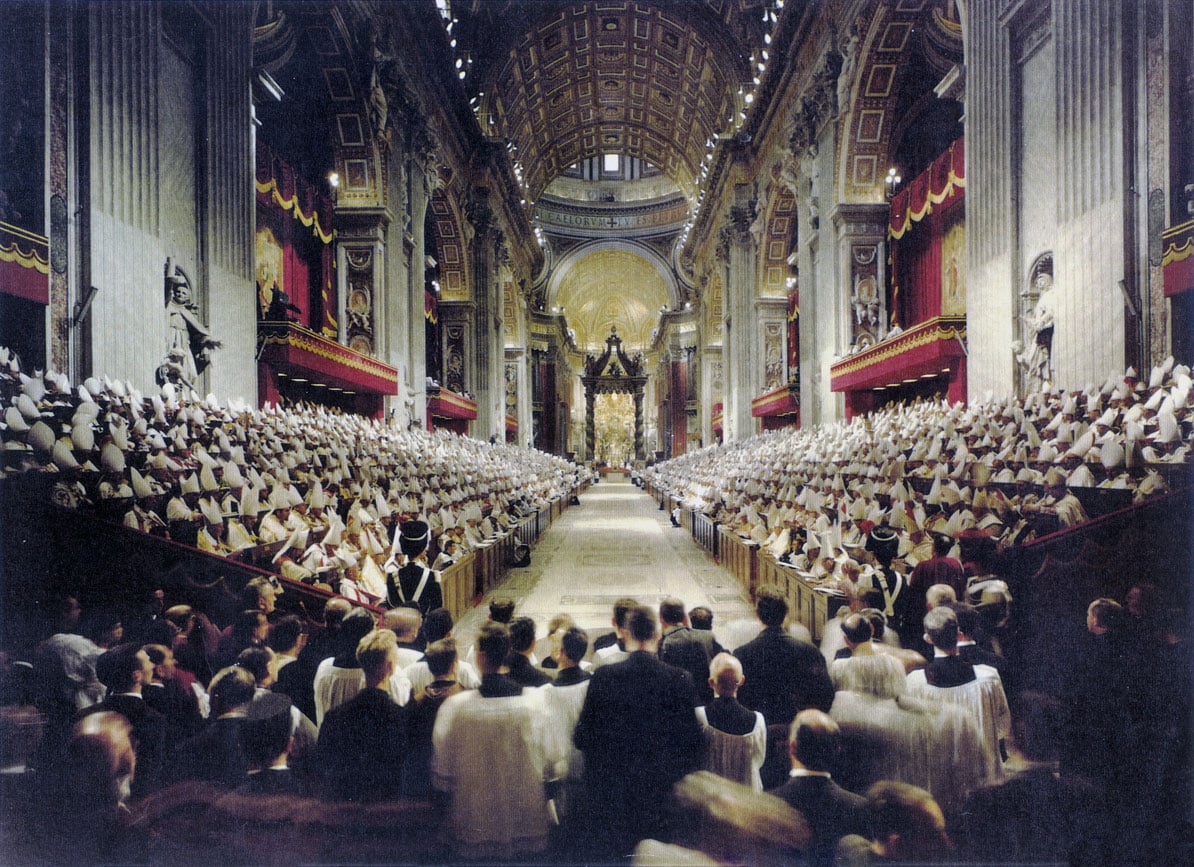
On September 2, Leo XIV began a new series of catecheses on Gaudium et Spes, the Second Vatican Council’s Pastoral Constitution on the Church in the Modern World.
Following his talks on Sacrosanctum Concilium, which focused on the liturgy, Leo is signaling his intention to galvanize the faithful to the false post-conciliar religion.
His audience this week delivered few surprises and followed the usual modernist lines, as he presented Gaudium et Spes (GS) as an expression of the Church’s duty to engage with contemporary humanity rather than stand apart from it, a clever though misleading framing of the issue.
Christians “cannot remain as unengaged spectators” but must listen, become involved, and respond to the suffering and aspirations of modern man, he read. Leo also repeated the Council’s teaching that the Church has a permanent duty to “scrutinize the signs of the times and interpret them in the light of the Gospel” [GS 4].
But this is to essentially slander the great pre-Vatican II popes and laity. Consider that St. Pius X routinely called on the faithful to engage in Catholic Action. Pius XI also reminded the world after World War I that Christ has a social kingship that cannot be ignored. Catholics in the U.S. were active in the political arena fighting for modesty in Hollywood with the Legion of Decency. Where in the years prior to the Second Vatican Council was the Church an “unengaged spectator,” as Leo’s words imply?
Leo also made the highly questionable statement that closeness to humanity can lead to “a deeper understanding of events and of Revelation itself,” and claimed that this is “not a naive optimism,” but a form of fidelity to Christ.
This is, of course, Leo the dyed-in-the-wool synodal modernist’s interpretation of things. But let us take a look at the Catholic view of the document.
A counter-Syllabus of Errors
At the outset, a question needs asking: Did Vatican II merely apply Catholic truth to the modern world, or did it adopt modernity’s conception of man and proceed to reshape Catholic theology around it? It does not take long for this problem to appear in the document.
The most problematic undercurrent in GS comes in its claim that “the almost unanimous opinion of believers and unbelievers alike” is that earthly things should be related to man “as their center and crown” [GS 12], together with the declaration that “the focal point of our total presentation will be man himself” [GS 3].
The keen observer will note that these, like many other passages in Gaudium et Spes, are foundational statements for the religion of “human dignity” being pushed by Leo.
Whereas traditional Catholic theology always starts with God as the Creator and final end of everything, with man receiving his dignity because he was created by God and for God, Gaudium et Spes inverts this by repeatedly using man as its starting point, just as atheistic communists do.
Again and again, the document begins with man’s dignity, aspirations, freedom, and development, and then explains Christ in relation to him.
This elevation of man to quasi-divine status is especially apparent in paragraph 22, where the Council says that Christ “fully reveals man to man himself” and, even more controversially, if not blasphemously, that through the Incarnation “the Son of God has united Himself in some fashion with every man” [GS 22].
While Christ did assume human nature, this hardly means that every person is supernaturally united to Him. Such a union would only come about through grace via our incorporation into Christ’s Mystical Body through orthodox faith and baptism. Integrity co-founder Stephen Kokx pointed this and other deeply problematic aspects of the document out in an X post earlier this year, noting that it places the Church “in the service of the entire modern age.”
Another subtle but heterodox statement comes when the document says all men “have been redeemed by Christ and enjoy the same divine calling and destiny” [GS 29].
The faithful Catholic knows that Christ died for all, but there is a huge difference between Christ accomplishing this and man embracing and possessing its actual fruits. Christ’s redemptive work can be accepted or rejected; it was not some kind of blanket act forced upon humanity.
Ensure more articles like this are published: Donate to Integrity today!
Again, it is important to point out how this document relates to the disaster Catholics are experiencing today. The Synodal Church has elevated to the doctrinal level the idea that, instead of man needing to be brought into union with Christ through conversion, he is already somehow mysteriously united to Him. Hence, in the postconciliar religion, there is no real need for an emphasis on sin, conversion, repentance, evangelization, and proselytization. Rather, endless inter-religious meetings and events are held to show a general sense of unity and fraternity are held in common. This is merely in keeping with Gaudium et Spes.
The Dispatch
“Therefore, this sacred synod … offers to mankind the honest assistance of the Church in fostering that brotherhood of all men which corresponds to this destiny of theirs,” it states, instead of affirming that the Church’s primary duty is to preach the truth in season and out (2 Timothy 4:2) knowing full well this will divide men (Matthew 10:34) and their families (Luke 12:51-53).
Putting ‘dialogue’ and temporal concerns above teaching the supernatural
Herein lies the seed of the Synodal Church’s obsession with moving from conversion toward dialogue.
Gaudium et Spes claims that believers and unbelievers should cooperate for “the rightful betterment of this world” through “sincere and prudent dialogue” [GS 21] so that the “social order,” which “must be founded on truth, built on justice and animated by love,” can “grow every day toward a more humane balance.”
Firstly, “this world” is fleeting; it is destined to pass away. Our common home is in heaven. This does not mean that Catholics do not have the duty to improve society and the common good of nations, but it does mean that the first obligation of the Church is supernatural. Furthermore, the social order must be grounded in the recognition of the sovereignty of Jesus Christ over it, not a vague sense of “love” that strives for a “humane balance.”
Worth noting here is that Leo’s prayer intention this month was for the care of water. He also blessed a a glacier last year. If only he desired the salvation of souls as much as he desires the salvation of the planet! Alas, he is simply fulfilling what GS tells him to in seeking to better the world.
Second, Gaudium et Spes places dialogue as the fundamental feature of the Church’s relationship with the world [GS 40], and in doing so indirectly betrays the mandate Christ bestowed upon it to go forth and “teach” all nations the true faith (Matthew 28:19).
Now, if dialogue merely meant the charitable treatment of unbelievers, there would not be a problem, as this has always been a fruitful way of introducing the Faith in the hope of converting the lost sheep. But that is not what it means.
For modernists, dialogue is a two-way theological discussion sans the intention to convert. The Council explicitly says that “the Church herself knows how richly she has profited by the history and development of humanity” and speaks of a “living exchange” with different cultures. It then encourages theologians to listen to the “many voices of our age” so that revealed truth may be more deeply understood and expressed [GS 44].
These phrases imply that the Church was and can be improved by forces originating outside of it. Leo’s statement Wednesday about acquiring a “deeper understanding of events and of Revelation itself” reflects this absurdity. What the proponents of post-conciliar “Catholicism” refuse to acknowledge is that, traditionally, the relationship between the Church and world has always been fundamentally unequal. The world and unbelievers reject the reality that Christ possesses the truth, and that He entrusted it to His Church along while commanding Her to guide the nations. Today, this is viewed as an offense against man’s dignity and liberty.
The religion of man
The authors of Gaudium et Spes seem to be intoxicated with their obsession with “human dignity,” calling man “the only creature on earth which God willed for itself” and saying that he discovers himself through a “sincere gift of himself” [GS 24].
It also elevates the dignity of conscience [GS 16], demands the “rightful freedom even in matters religious” [GS 26], and declares that the Church “proclaims the rights of man” [GS 41].
Every single one of these claims contradicts perennial Catholic truth while simultanesouly situating the Church in the modern milieu of political, religious, and philosophical liberalism.
While mental gymnastics and self-inflicted dissonance can be employed to force an “orthodox interpretation” upon each of these concepts, this approach ultimately fails when the document is read as a cohesive body of work and in context of what the modernist clergy were seeking to do at the Council.
It is clear that instead of building upon the rights of God, objective truth, divine law, sin, grace, conversion, and man’s supernatural end, Gaudium et Spes rejects that framework in favor of a misplaced focus on the human person, dignity, conscience, freedom, dialogue, self-gift, and so-called human development. It is as if the United Nations wrote the document instead of successors to the Apostles.
Abandoning the Kingship of Christ
Where the great popes of the past firmly taught that countries themselves have a corporate obligation toward God and the true religion, Vatican II aggressively promoted, through documents such as Gaudium et Spes, the dignity and freedom of the individual person [GS 26] as a mechanism to free them from that duty.
This pivot reached its fullest expression in Dignitatis Humanae. While that document no doubt pays lips service to the “duty” of “men and societies toward the true religion,” the remainder of it speaks of the need to allow false religions to be granted civil liberties. On top of that, the post-conciliar authorities demanded Catholic countries like Spain de-confessionalize, thereby confirming the real function of Dignitatis Humanae was to act as a weapon to uncrown Christ the King.
The Church received an unchanging Revelation from Christ and was instructed to call the world to conform itself to it. In Gaudium et Spes, we instead find dialogue [GS 21, 40], exchange with the world [GS 44], the rights and dignity of man [GS 26, 41], reliance on the signs of the times [GS 4], promoting brotherhood, building a more “just” social order, and the Church profiting from humanity’s historical development [GS 44].
Gaudium et Spes marked, almost definitively, the moment when the Conciliar Church of Man was born, rejecting the Catholic Church and its perennial mission to convert the world to Christ.