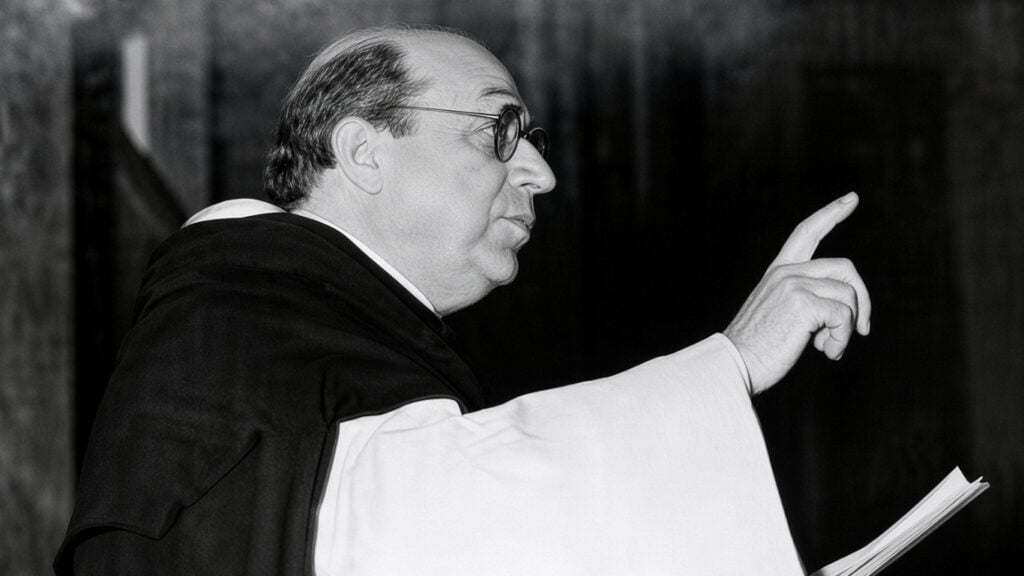
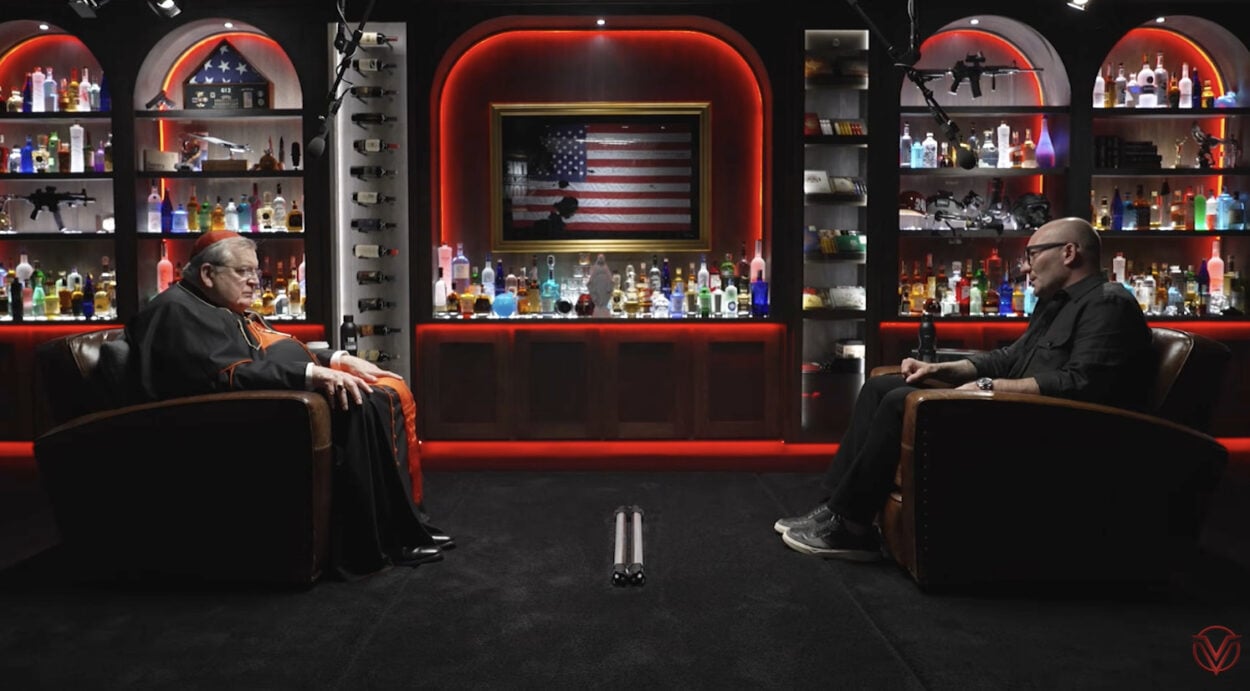
Cardinal Raymond Burke appeared on The Shawn Ryan Show earlier this week in an episode entitled “The Old Testament.” This was Burke’s second appearance in less than a month on such a platform, having previously appeared on kosher Catholic Michael Knowles’s show on August 15.
While Ryan’s show, and its roughly 6.5 million YouTube subscribers, gave the 78-year-old prelate a much bigger audience, the discerning Catholic expecting some fireworks from the cardinal — whom neo-trads often portray as some kind of savior — would have been sorely disappointed.
In all fairness, by Ryan’s own admission, his aim was to expose his millions of viewers to the Bible and Christianity. With this in mind, as well as the fact that he only recently returned to the Catholic faith, the content of the episode was more or less average. Now, Ryan didn’t ask difficult questions, but rather the typical ones one might expect from a convert or revert, and Burke gave easy answers.
Overall, Burke’s treatment of a variety of subjects was reasonably above board, albeit surface-level. It was not without error, though, and Burke’s post-conciliar tendencies were on display.
What Cardinal Burke got right
Burke spoke without embarrassment about Satan, Hell, mortal sin, the Holy Eucharist, confession, natural law, the Blessed Virgin, the divine inspiration of Scripture, and the Kingship of Christ.
The conversation began rather dramatically, with Ryan describing psychedelic experiences, apparent demonic manifestations, and subsequent exorcisms. Kudos to Burke, who at least did not try to “psychologize” the devil away. He correctly identified Satan as the liar and murderer described by Christ and insisted that the Christian life involves genuine spiritual combat.
The discussion then turned to a catechetical tour of Scripture: biblical inspiration, the canon, creation, Adam and Eve, the covenants, Noah, Abraham, Moses, David, the Decalogue, natural law, the Blessed Virgin, and the fulfillment of the Old Testament in Christ.
Burke’s treatment of Scripture was mostly orthodox, explaining that the Bible is truly the Word of God, written through inspired human authors, and that nothing in Scripture can lead man astray.
Like a good Catholic, he also stressed that the Church — not private judgment — authoritatively recognizes the canon. This is thoroughly Catholic and stands against both liberal biblical criticism and Protestant sola Scriptura.
The Dispatch
Join the Counter-Revolution: Become a monthly donor at Integrity today!
Considering this was meant to be an introduction to the uninitiated, Burke also fared well on subjects related to sacramental theology, telling Ryan’s audience that the Eucharist is Christ Himself; that confession is an encounter with Christ through His priest; and that the seal of confession admits of no violation. Most importantly, he described the Mass sacrificially, with Christ becoming present upon the altar so that His sacrifice on Calvary is made sacramentally present.
One of Burke’s better moments was his description of same-sex marriage as a “heresy” against “faith and reason.” He was similarly unequivocal concerning the moral law. He condemned adultery, fornication and homosexual acts, grounding sexual morality not merely in ecclesiastical discipline but in natural law. This is also consistent with Burke’s longstanding public position on marriage and natural law.
Where Burke fell short
But ambiguities, which are trademarks of synodal clergy, appeared elsewhere. Burke’s most problematic remark came when he said that although the first five books of the Bible are traditionally called the books of Moses, “we don’t necessarily think that Moses wrote all five books.”
Catholic tradition and the Magisterium strongly defended substantial Mosaic authorship against rationalist documentary theories. In 1906, the Pontifical Biblical Commission explicitly rejected the proposition that critical arguments justified denying Moses as author of the Pentateuch, while allowing that Moses need not personally have written every word, could have employed sources and assistants, and that later additions and textual modifications were compatible with the Pentateuch’s substantial Mosaic authenticity. Moreover, Christ Himself repeatedly speaks of “Moses” in connection with the Law (John 5:46–47; Mark 12:26).
A loose formulation came later when Burke said that the seven-fold gift of the Holy Ghost “wasn’t true until” Christ came, before quickly adding that Old Testament saints did receive grace. Now, the Holy Ghost definitely acted in and sanctified souls before Pentecost. What was new after Christ was the fullness of the New Covenant economy and, at Pentecost, the public outpouring of the Holy Ghost upon the Church.
Another questionable statement — even if it might have been a mere slip of the tongue — was Burke’s claim that the divine nature is “embodied” in three persons. Catholic dogma actually teaches that the one, numerically identical divine essence subsists wholly in the Father, Son and Holy Ghost.
Finally, there was a telling moment around the halfway mark while the two men were discussing the different covenants in the Old Testament. As soon as Burke sensed that the Jewish question might rear its head, he quickly — almost sternly — told Ryan that, when it came to understanding the difference between the “Jewish faith and other political realities” — presumably the 1948 state of Israel — “I don’t intend to get into that at all.” This was a fitting answer for a man who seems determined to defend the synodal system, including its kosher teachings, until the bitter end.
In the final analysis, it seems Burke was more than happy to avoid controversy and drama, choosing instead to play the role of a glorified high-school catechism teacher. If he convinced anyone in the audience to convert to Catholicism, they are — tragically — in for a big surprise once they sign up for OCIA in the Synodal Church.