
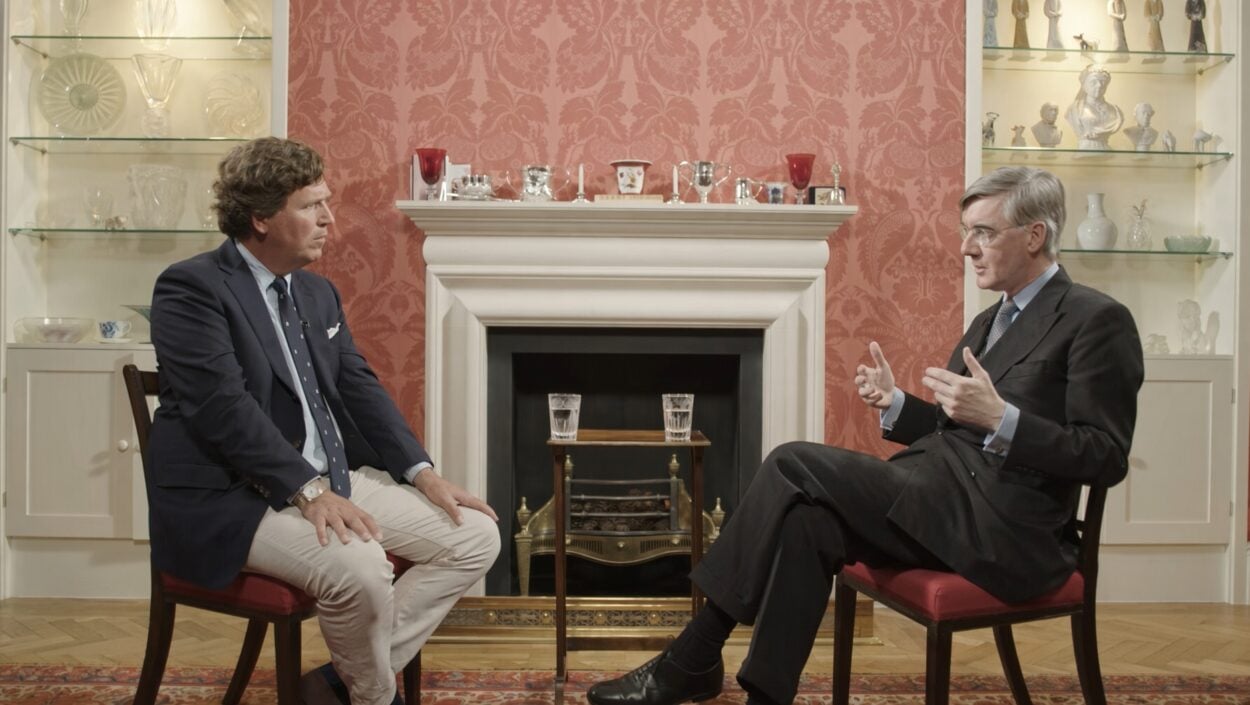
On October 2, British aristocrat and conservative politician Jacob Rees-Mogg appeared on Tucker Carlson’s eponymous program where, among other overtures to the post-war consensus, he attempted to justify the atomic bombing of Hiroshima and Nagasaki on moral grounds.
Adopting the standard pop culture view of those events — which seeks to legitimize the use of atomic weapons against Japanese civilian noncombatants by the United States 1 — Rees-Mogg went so far as to invoke the Angelic Doctor in his wanting, consequentialist argumentation. “I think it meets Aquinas’s conditions of just war,” he said.
The exchange on atomic weapons began after a lengthy back-and-forth over Rees-Moggs’s saber-rattling towards Russia. Around the twenty-seven minute mark, Carlson asked him directly, “Is the actual use of nuclear weapons ever justified?” to which Rees-Mogg replied, “I think it is justified in Hiroshima and Nagasaki. Yes. I think it was justified in bringing the Second World War to an end. Yes. Unquestionably.” Incredulous, Carlson asked for clarification, “Unquestionably?” “Unquestionably, yes,” Rees-Mogg insisted.
Contrary to Carlson’s insinuation, Rees-Mogg is actually right that the use of atomic weapons in warfare can be licit in certain narrow circumstances. This was affirmed by Pope Pius XII in a 1954 address to Participants in the 8th Congress of the World Medical Association. 2 However, he severely misjudges the application of the principle.
Catholic teaching maintain that an atomic weapon may only be employed strictly “when it is deemed indispensable for self-defense” and demanded by a threat “imposed by a manifest and extremely grave injustice, otherwise unavoidable.” The mass and indiscriminate killing of Japanese women, children and other non-combatants in the context of the war in 1945 is “the pure and simple annihilation of all human life within the radius of action.” In this regard, Pius XII authoritatively taught that “under no circumstances is this [atomic warfare] to be permitted.”
Absent a just cause and satisfaction of the other criteria outlined by Pius XII, the use of an atomic weapon is nothing other than a “crime proscribed by international penal law, [that] should be made subject to the most severe penalties which can be brought to bear under its provisions.” To this day, the victorious Allied Powers and their heirs have yet to acknowledge this terrible reality, much less make reparation for it.
It is truly difficult to comprehend the devastation wrought by the atomic bombs dropped on the two Japanese cities, which lead directly to the capitulation and total surrender of the last remaining Axis Power. The Encyclopedia Brittanica entry on the bombings records that out of a population of 343,000 inhabitants in the city of Hiroshima, some 70,000 people were killed instantly, and that by the end of the year the death toll had exceeded 100,000. In Nagasaki, 40,000 were instantly killed, and at least 30,000 more died within the year after succumbing to injuries and radiation poisoning.
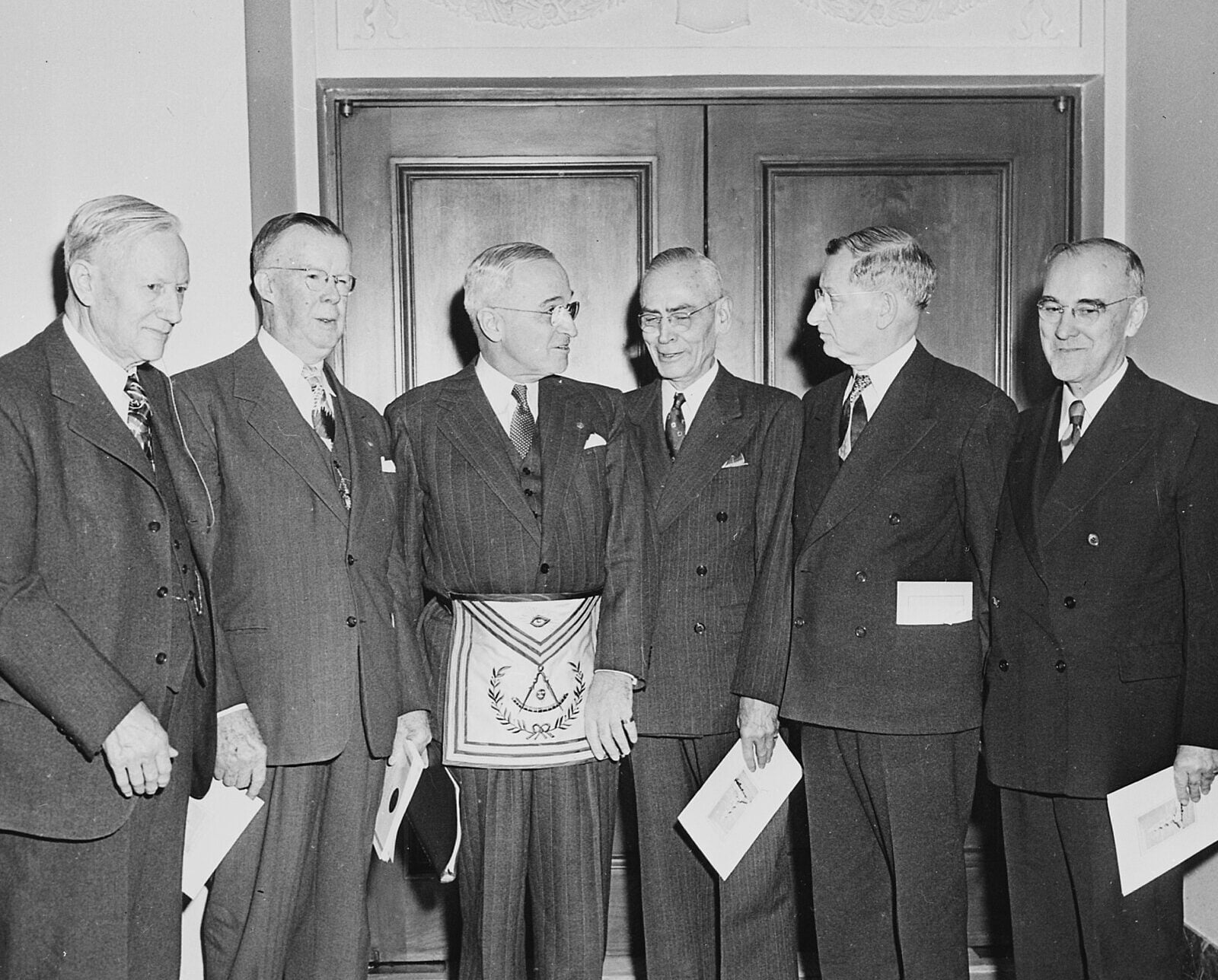
Conspicuously, both cities enjoyed a substantial population of Catholics. Fr. Maxmillian Kolbe famously founded his Garden of the Immaculata monastery in Nagasaki in 1931 to serve as the base of his operations in East Asia. What is the relevance of this? Then-United States President Harry Truman was a 33rd degree Freemason of the Scottish Rite. This fact has prompted some to speculate whether the decision to drop the bombs was a symbolic act meant to send a message to the Church that Christendom and the Social Kingship of Christ was to be replaced by the Masonic Kingship of Man.
Due mode and Catholic Just War Theory
As alluded to earlier, Rees-Mogg’s central error is his veering into consequentialism; that is, believing that the pursuit of a good end, namely winning a war, is justified even when employing evil means.
When Carlson somewhat sanctimoniously pressed him on “killing people’s kids,” Rees-Mogg defensively replied, “we were at war with the whole country, and it [the bombing] ended the war.”
Shortly after the retort, Rees-Mogg doubled-down, arguing that “we were in a state of total war” to ward off Carlson’s accusation that “populations of crowded cities are not responsible for the war [including women and children].” The principle of “proportionality” was then offered by Rees-Mogg as the moral justification.
The Dispatch
Support Integrity’s independent reporting: Become a donor today!
Unlike Rees-Mogg’s remarks, Catholic Just War Theory maintains that the due mode of conducting war is not limited to proportionality, despite it being a necessary but ultimately insufficient condition. Rather, the due mode calculation must includes the justice of the particular means employed to accomplish military victory. Writing in a standard, neo-scholastic treatment of this doctrine, the former head of the Pontifical Gregorian University Fr. Augusto Ferretti, S.J., explained in 1887 the application of this as follows:
THE DUE MODE. This, according to Bellarmine, consists chiefly in the fact that no innocent person is harmed. Hence e.g. children, the elderly, women, etc. cannot be justly killed, unless they are killed by chance or accident: as when a soldier shoots into a group of enemies and happens to kill a child or a woman.
Therefore, after a war has begun, throughout the entire period before victory is won, it is just to inflict on the enemy all the damages that will seem necessary either for satisfaction or for obtaining victory, provided that they do not involve an intrinsically evil injury to innocent people (emphasis added).
For a war to be just, then, the requirement of avoiding the intentional harming of innocents, a fortiori in a mass and indiscriminate fashion by use of atomic bombing, must be satisfied in addition to the same war being made on lawful authority, for a just cause, and with proper intention.
In the case of Nagasaki and Hiroshima, the atomic bombs were primarily dropped to demoralize the nation so as to hasten the end of the war and avoid a costly invasion. As such, and despite the expected good effects, it is diffuclt to view the act as anything but intrinsically evil — indeed, a heinous war crime. 20th century American Redemptorist theologian Fr. Francis Connell observes in his treatment of the “bombing of civilians” that such an action would be “condemned as sinful by Catholic theologians.” 3
Invoking St. Thomas to defend the indefensible
As their testy exchange continued, Carlson is seen grasping that Rees-Mogg had made an error in his reasoning, yet he was unable to name it for what it is: consequentialism. After Rees-Mogg volunteered that “we were in a state of total war” to justify his position, Carlson grew yet more disturbed, even disgusted. “I’m asking you a theological question which is — is it ever allowed under the precepts of, say, Christianity to kill people who did nothing wrong. [Can you] kill women and children. Does it meet Aquinas’ test of a just war?”
Answering in the affirmative, Rees-Mogg replied: “I think it does.” He later reiterated, “We were at war with the country and it [successfully] ended the war,” and “once you are in war, you are justified in winning.” Again, this is to miss the essential point that intrinsically evil means may never be employed in pursuit of a good end — no matter and especially how worthy one believes his cause.
On social media platform X, British Catholic user @HazThomist drew attention to Rees-Mogg’s invocation of “total war,” reminding the public that it is “particularly egregious” to target citizens for military action since “ kill[ing] the innocent is a sin crying to heaven for vengeance.”
@HazThomist also quoted prominent 20th-century Dominican moralists Frs. John A. McHugh and Fr. Charles Callan, who addressed the specific case of morale demoralization bombing in a manual they wrote. St. Thomas, of whom they drew from, indeed said that “this argument is based on the [false] principle that a good end justifies evil means” Cf. ST I-II, q. 18, aa. 2, 4).
Despite identifying as a traditional Catholic, Rees-Mogg has clearly forgotten St. Paul’s admonition in his Letter to the Romans (3:8) where he denouncing those who say “let us do evil that good may come.”
Therefore, unlike Rees-Mogg, we can safely say that St. Thomas would not have defended the atomic bombing of Hiroshima and Nagasaki — least of all on the grounds of just war theory.
- NB.: The particular moral judgements reached in the following analysis are not to be regarded as binding on all Catholics, much less definitively, and the author is open to correction where and if necessary. That said, it is based on his estimation of sound, moral principles and representative of a view defended by many traditional Catholics today. ↩︎
- Pope Pius XII, Address to Participants in the VIII Congress of the World Medical Association, (1954), Note 2 – “What we have just said applies in particular to A.B.C. warfare: atomic, biological, and chemical. The question whether such a method may become necessary in order to defend oneself against an A.B.C. war cannot be discussed here. The answer may be deduced from the same principles which are decisive today for permitting war in general … What we have said will help us to answer that other question: May the doctor place his knowledge and professional skill at the service of A.B.C. warfare? He can never abet ‘injustice,’ even in the service of his own country; and when this type of war constitutes an injustice, the doctor may not collaborate in it.” ↩︎
- Fr. Francis Connell, C.Ss.R., Father Connell Answers Moral Questions, (1959), pp. 59-60. ↩︎