
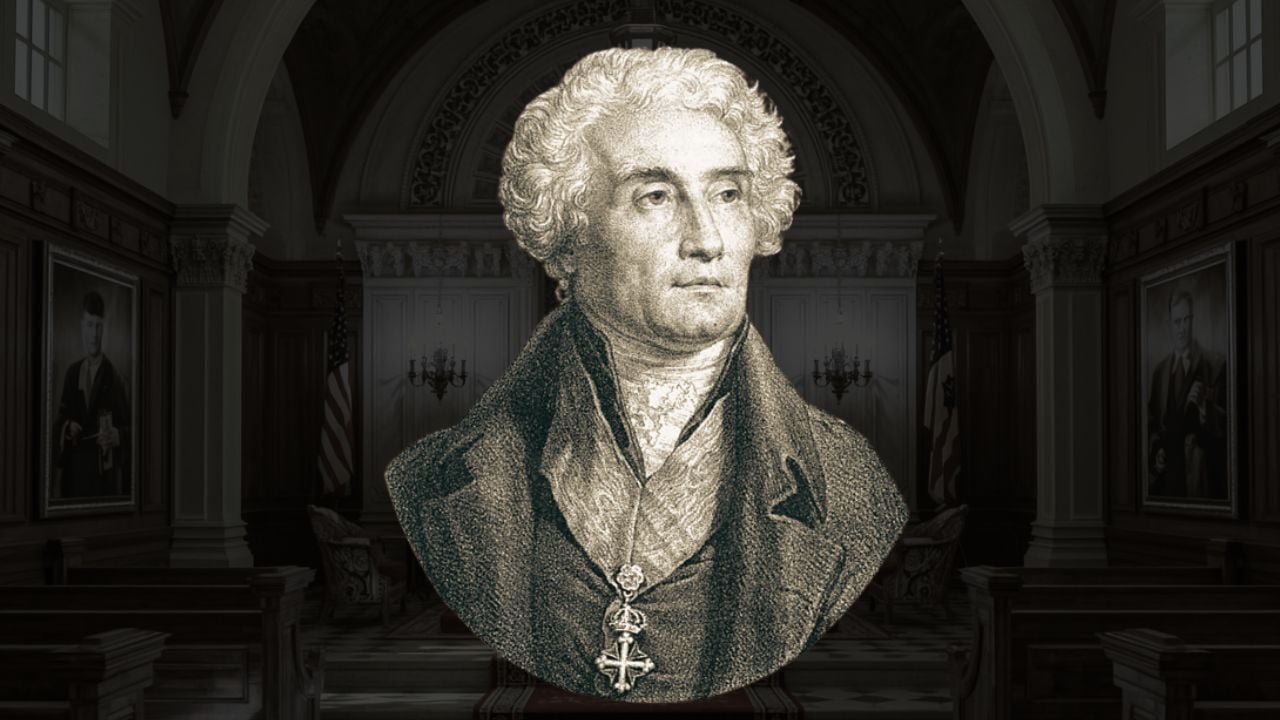
There is a criticism that repeatedly surfaces whenever Joseph de Maistre’s name enters serious Catholic intellectual circles: that he was a Freemason, and that this association permanently taints his counter-revolutionary credentials. It is the kind of charge that sounds devastating precisely because it contains a kernel of historical truth. It is also, when examined honestly, one of the most chronologically confused arguments in recent Catholic intellectual debate.
Let us be direct about the facts. Maistre joined his first lodge in Chambéry in 1774 and maintained Masonic membership until around 1790, when the French Revolution was already dismantling everything he believed in. This is not in dispute. What is routinely omitted from the accusation is the context. Despite papal condemnation, these eighteenth-century clubs were routinely frequented by priests, bishops, and Catholic noblemen. Pre-revolutionary Freemasonry in Catholic Europe was largely a social institution for educated elites, bearing little resemblance to the militant anti-clerical force it became after 1789. Maistre’s early lodge membership was a commonplace of his class and time, not a confession of ideological hostility to the Church.
The more important fact is what came next. After the French Revolution, commencing with his arrival in Russia in 1803 at the latest, he abandoned Freemasonry entirely. The break was real, documented, and permanent. It was in Russia that Maistre finally came to accept the theses of Abbé Barruel, who blamed Freemasonry for the Revolution, theses he had previously always refuted. In other words, not only did he leave Freemasonry behind, he eventually came to understand it as one of the instruments of the civilizational catastrophe he spent his mature life opposing.
Read more: Joseph de Maistre: Catholic statesman, writer, opponent of the Enlightenment
And that mature life is the entire point. Every work for which Maistre is studied, cited, and celebrated was produced after his Masonic period had closed entirely. His Considerations on France, published in 1797, established his reputation as a conservative and presented his providential interpretation of the French Revolution. His Essay on the Generative Principle of Political Constitutions, written in 1807 and published in 1814, deepened his counter-revolutionary constitutional thought. Du Pape, published in 1819, is now recognized as one of the foundational texts of political ultramontanism and as the book that most directly prepared the declaration of papal infallibility at the First Vatican Council. Until his death he was a zealous member of Padre Pio Brunone Lanteri’s anti-Enlightenment Catholic association, an organization explicitly dedicated to combating the very intellectual currents with which Freemasonry had by then become identified. Every argument his readers engage today was produced by a man who had long since walked away from the lodge and never looked back.
The Dispatch
The logic of the accusation, stripped of its rhetorical force, amounts to this: a man who joined a fashionable social club at twenty-one, left it at thirty-seven, spent the following three decades producing the most uncompromising body of Catholic counter-revolutionary thought in the modern era, and died in communion with the Church as a member of an anti-Enlightenment Catholic association, should be defined by the club he attended in his youth. By that standard, Augustine of Hippo ought to be defined by the Manichean sect he abandoned before his conversion rather than by the Confessions and The City of God he wrote afterward.
The charge persists not because the evidence supports it but because it is useful. Dismissing Maistre as a Mason allows those who find his conclusions uncomfortable, on the secular left and within certain traditionalist circles alike, to avoid engaging with arguments they cannot otherwise answer. It is considerably easier to impeach the messenger than to refute the message.
The Maistre Institute exists to ensure the message receives the serious engagement it deserves. The facts of the chronology are clear. The intellectual achievement of the mature Maistre stands entirely on its own terms. Those who wish to argue against his counter-revolutionary philosophy are welcome to do so, on the merits, and with the honesty the subject requires.