If the faithful in Spain were looking for a visit from a Catholic pope on a mission to restore all things in Christ, they are surely greatly disappointed.
Only a few days into his week-long trip and Leo XIV is beating the drum of dogma-less secular humanitarianism.
True, he has made many references to the Catholic faith in his homilies and addresses, but only to further promote the globalist social justice ideology he is advancing.
For the conciliar establishment and much of the secular press, the visit is being marketed as a historic moment of “encounter” between the Church and modern European society: a symbolic reaffirmation of shared values such as human dignity, social cohesion, cultural memory, and humanitarian concern for the poor. Many media outlets have shared footage of his visit to Madrid, much of it impressive on the surface. The message being sent? This is a leader of a Church that is strong and who commands respect.
Leo’s itinerary has been presented as a comprehensive engagement with the “whole fabric of society,” rather than a mere ecclesial event. In other words, it is about a Church that is a moral-cultural partner in the construction of a humane Europe rather than the leading counter-revolutionary institution on the planet that is willing to be considered a fool for Christ (1 Corinthians 4:10) for preaching truth in season and out (2 Timothy 4:2).
Echoing Francis
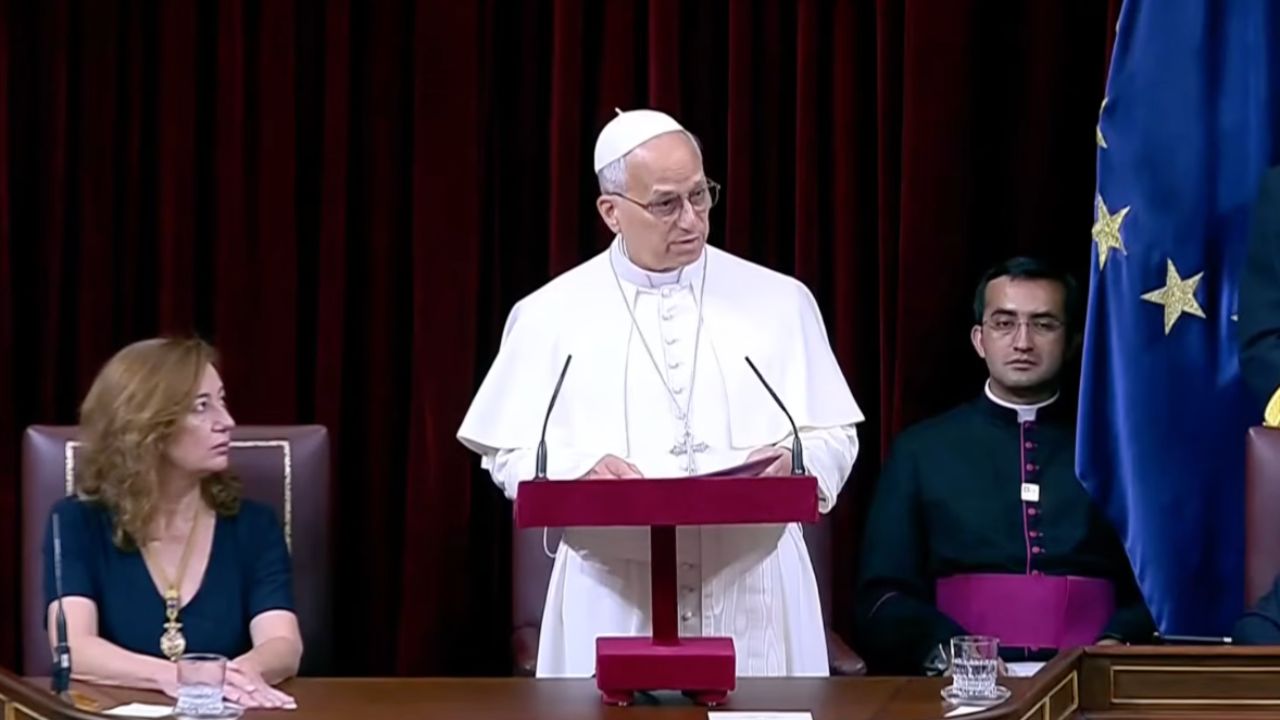
The opening address at the Royal Palace of Madrid set the tone. Speaking before civil authorities and diplomats, Leo began by recalling Spain’s long Christian history, invoking St. James and the ancient evangelization of the Iberian Peninsula. Very quickly though, this historical reference was absorbed into a broader interpretive framework that emphasized cultural encounter and social harmony rather than doctrinal continuity and a confessional Spain.
“I come among you to confirm, encourage and inspire a renewed fidelity of believers to the Gospel, as well as deeper reconciliation and cooperation between the various forces of this Nation,” he said. It is as if the reference to the Gospel was a box-ticking exercise he had to get out of the way before he could move on to the real agenda: “reconciliation” and “cooperation” among social forces.
What followed in the speech is characteristic of the contemporary post-conciliar Magisterium: a philosophical anthropology built around “truth as greater than us,” the need to avoid “prefabricated ideologies,” and the importance of dialogue between ideas and reality.
As if he is unaware that a social encyclical exists prior to the unholy Second Vatican Council, Leo XIV then cited Francis’ Evangelii Gaudium approvingly, especially the well-known formula that “the reality is superior to the idea.” For synodal modernists, this principle has become in practice a methodological anchor for a style of speech in which doctrinal clarity is consistently subordinated to “lived complexity,” “historical nuance,” and “pastoral openness.”
As the address continued, Leo turned to the usual themes of human dignity, interiority, migration, and social fragmentation. He spoke of the need for men and women who can perceive light in darkness, who can resist ideological polarization, and who can embrace complexity rather than simplistic identity narratives.
False ecumenism and globalism entered the conversation when Leo praised Spain as a historical “meeting point” of cultures and religions, including references to Islamic and Jewish intellectual contributions in medieval Iberia. Noticeably absent was any reference to General Francisco Franco. The overall message was unmistakable: that the Church is a mediator of complexity and dialogue rather than the exclusive ark of salvation proclaiming conversion to Jesus Christ.
Not even doctors of the Church were beyond the reach of the new synodal interpretive key. When Leo XIV invoked St. Teresa of Ávila and St. John of the Cross, two great Spanish saints, their mystical theology was not rejected but made subservient to a kind of universal anthropology of mental health. Their “inner castle” and the “dark night” became paradigms of human psychological depth, applicable to all people of goodwill navigating existential uncertainty.
The speech culminated in a call for investment in education, research, social inclusion, and digital literacy; and the Church’s voice was reduced to an ethical contributor to civil society, encouraging structures of justice and participation.
A suffering Christ
This pattern intensified in Leo XIV’s visit to a Cáritas outreach center for the homeless. The tone became almost entirely centered on lived experience and human vulnerability.
“Here, the joy and pain of each one is the joy and pain of all,” Leo said. He “became man … living as one of us in weakness and identifying himself with every person who suffers.”
The emphasis was clearly focussed on man and the temporal. The theological center of gravity shifted from Christ as Redeemer to Christ as the one who validates human suffering through solidarity. Man’s encounter with Christ thus becomes sacramentalized not in terms of grace and sacrament, but in terms of mutual recognition and dignity.
The Dispatch
Humanism on display
At the youth vigil in Madrid, the same synodal vocabulary rang even louder. It started well with young people being encouraged to discern God’s voice amid “a thousand voices,” to embrace silence, and to cultivate interior prayer, but quickly that was reduced to secular anthropology: “The mission I trust you is precisely this: that you are human. Yes, be human!”
Borrowing from liberation theology, he proceeded to argue that God “identifies with the poor, the downtrodden, those who are alone and forsaken.” He also expressed hope that Madrid would “remain a welcoming and inclusive city, where social life is inspired by genuine human values.”
Traditionally, Catholic are called to become saints, to be configured to Christ, and to participate in the divine nature through grace. For Prevost, however, the mission seems to be that we achieve a more authentic or fulfilled humanity — an idea taken right out of the 1789 Masonic playbook on the erroneous perfectibility of man.
Agents of change
The Corpus Christi homily continued this trajectory while introducing explicitly Eucharistic language to give it an air of Catholicism. Leo spoke of the Real Presence of Christ, of the Eucharist as living bread, and of Spain’s historical devotion to the Blessed Sacrament; but again the interpretive framework was heavily oriented toward social transformation.
The Corpus Christi procession was turned into a call to become “protagonists of the transformation of history.” The Eucharist became a catalyst for ethical renewal, for social conversion, and for the construction of a more just world. The vertical dimension — adoration, sacrifice, and propitiation — was present but ultimately absorbed into Leo’s United Nations religion of societal change for the building “of a new world.”
Many influencers in the so-called Traditional movement shared footage of the procession on their social media accounts. The implicit message being: “we are so back.”
While the aesthetics of the event were certainly impressive, the Gospel that was being preached was most certainly not the faith of all time.
Avoiding Christ as King
In his cultural and economic dialogue at the Movistar Arena, Leo XIV laid out his comprehensive vision of society built around “networks,” “creativity,” and “shared responsibility,” carefully failing to mention the true cornerstone of political life: the Kingship of Christ.
The Church was disturbingly described, in continuity with conciliar language, as an “expert in humanity” and as a participant in the great dialogue of cultures. The underlying anthropology of the human person defined by dignity, relationality, and openness to transcendence again supplanted the role of supernatural grace.
Leo then asked: “What heritage are we leaving to the future and therefore what kind of community are we building?” Sadly, for the man supposedly overseeing Christ’s flock, the earthly legacy one leaves behind far outweighs the eternal destination of souls.
Speech to lawmakers
During his address to the country’s socialist-run Parliament Monday, Leo spoke generically about the importance of the family, about “polarization” in the world, about how the temporal order must “never see itself as hostile to religion,” and about the need to ensure pathways for migrants.
Another missed opportunity to defend the Kingship of Christ and to remind the government of the State’s obligation to subject itself to Christ and the Church.
With several days remaining, Leo’s trip thus far has been drenched in synodal language. The usual words and themes such as “accompaniment,” “discernment,” “listening,” “journeying together,” and “openness” have been front and center. Truth has frequently been described as something emergent from dialogue rather than something definitively given in revelation. Meanwhile, the Church is portrayed as the Great Companion and the facilitator of definition-less encounter.
For Prevost and his fellow infiltrators, Christ is clearly a mere symbol of universal fraternity rather than the King before whom every knee must bow. Their “Church” is a field hospital, a cultural interlocutor, a network-builder of human dignity — but not the ark of salvation outside of which there is no ordinary means of eternal life.