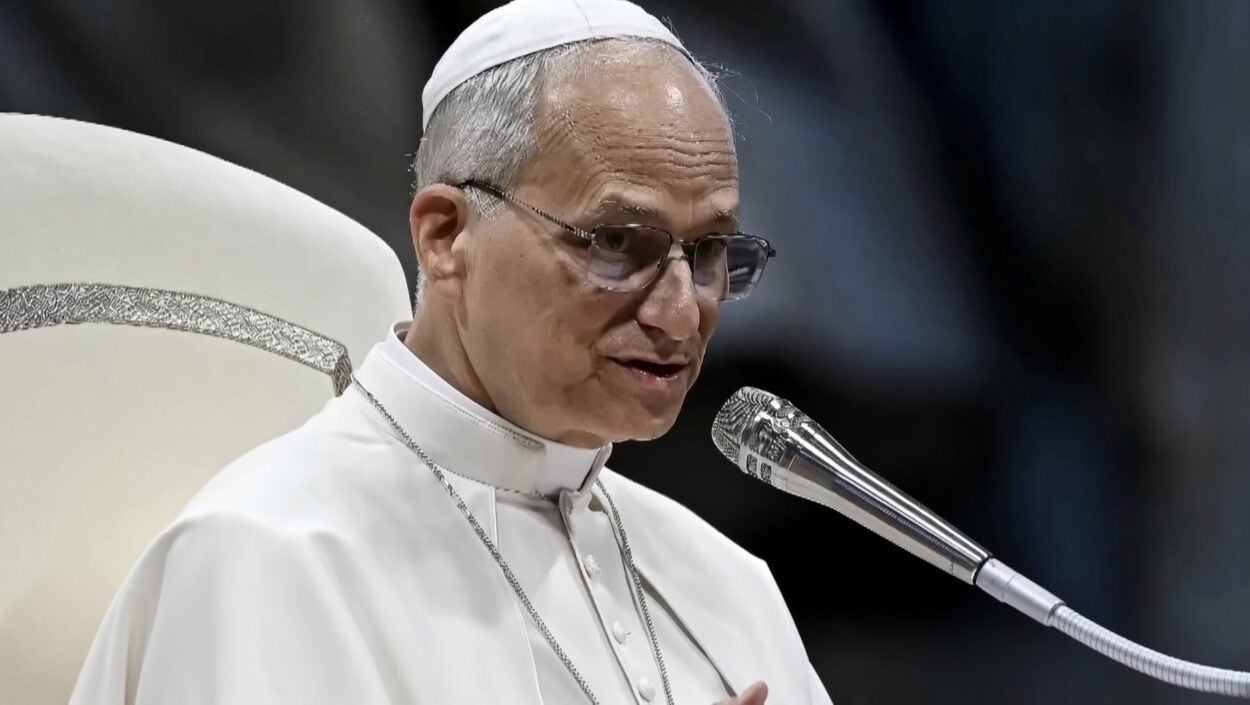
Last month, Leo made comments about the “far right” while aboard the papal flight from Metz to Rome. They reminded me of a meme that regularly surfaces on the internet.
In the depiction, three Aztecs are seen sacrificing a human victim by removing his heart from his chest. The main “sacrificer” looks over at a priest and two soldiers approaching and comments, “Oh, look! Here comes the far right…”
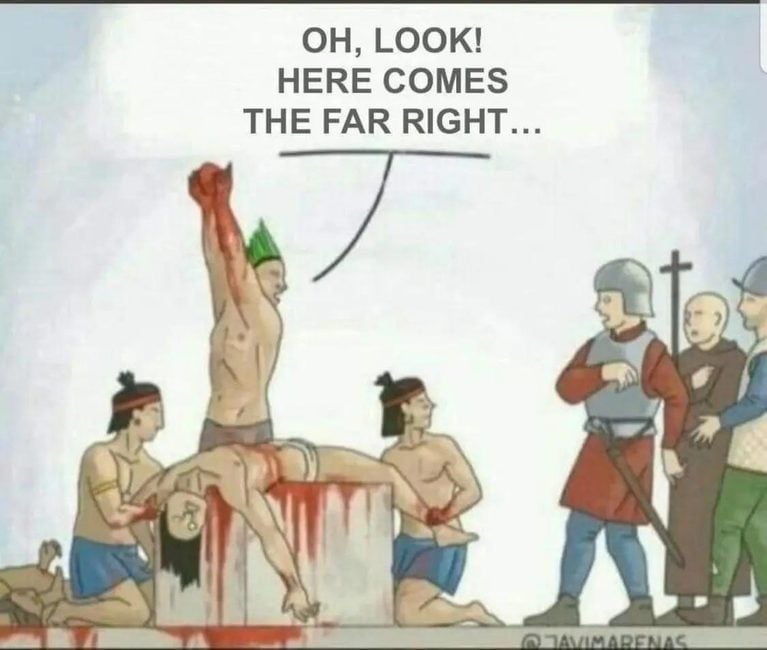
All too often, liberals — both the political and ecclesial kind — brand whomever they deem an enemy of their licentious ideologies as the “far right.” This is exactly what Leo did.
Aboard the plane, Leo was asked about the decreasing number of Christians in Germany and what German Catholic journalist Ludwig Ring-Eifel described as the “astonishing rise of extremist parties.” X user Christopher Hale has published the video of the remarks.
Leo first told journalists that it would be worthwhile to investigate whether there is some relationship between religious decline and “the growth of these groups on the far right.” He then observed that there has been an attempt to combine “these far-right points of view with a certain kind of religion” and that this was something both Catholic and Protestant leaders in Germany have described as “not an authentic expression of Christianity.”
“We go back to the values of the Gospel, which are not about hatred and division, but they are about understanding and compassion and accompanying,” he said.
Leo then urged participation in political life for the common good rather than adherence to “extremist ideas” that could cause serious damage.
But what is the ‘far right’?
What exactly Leo understands to be the “far right” remains to be seen. There is no single, universally accepted definition of the term. At best, it is a lazy umbrella concept that can encompass a range of movements that Liberals simply view as a threat to their control, and so they affix a labels such as “radical right” or “extreme right” to them.
Some of the characteristics usually attributed to these movements are “ultranationalism,” “exclusionary politics,” and “authoritarianism.” Other terms are national populists, extremists, and — as we have seen recently in the Church — even radical traditional Catholics.
The progressive pseudo-Marxist political complex loves to equate opposition to mass immigration, support for national sovereignty, and adherence to social conservatism with misguided and invented definitions of racial supremacy, totalitarianism, and fascism. In their world of cheap sloganeering, intellectual dishonesty, and Soviet-style denunciations, rejection of the contemporary liberal consensus automatically means “racist,” “anti-Semite,” “fascist,” or “extreme far right.”
The Dispatch
While Leo fails to define what he means by the term, one can, using his track record of championing ultra-liberal “woke” causes, assume that he too sees any individual or group that opposes his modernist ecclesial project, or his globalist masters’ green communism, as the “far right.”
Stand with Christ the King: Donate to Integrity today!
While he criticized the fusion between certain positions identified as far right and “a certain kind of religion,” Leo supplied no doctrinal catalogue by which Catholics can determine where legitimate patriotism ends and alleged “forbidden” nationalism begins.
He also conveniently made no distinction between political conservatism and stances that might truly be incompatible with Catholicism. Mainstream commentator Joe Enders said as much on X, confessing “I have literally no idea what he’s [Leo XIV] is referring to here.”
And why so muted on Liberalism?
Furthermore, Leo is surely quiet when it comes to Catholicism’s complete rejection of liberalism as an ideology and its application to moral, political, and social life.
In Liberalism Is a Sin, the nineteenth-century Spanish priest Father Félix Sardá y Salvany did not regard Liberalism as merely another respectable political option, but as the emancipation of individual and social reason from the sovereignty of God and His revealed truth found exclusively in the Roman Catholic Church.
“Liberalism, whether in the doctrinal or practical order, is a sin,” was his ultimate — and ultimately correct — conclusion. Sardá y Salvany also denounced Liberalism a radical heresy because it attacks the foundations of faith and characterized it as “the radical and universal denial of all divine truth and Christian dogma.”
This presents a serious challenge to the Bergoglian and Prevostian Church of Man, which is animated by exaggerated notions of human dignity, hence Leo’s deafening silence on the foundational evil that underlies Liberalism and modernity in all its manifestations.
Sardá y Salvany recognized that the fundamental conflict was between two types of society. Either man and civil society acknowledge the sovereignty of God, or individual and social reason claim independence from divine authority. There are no prizes for guessing which version the post-conciliar church has been campaigning for.
It is also important to note that when Liberalism is a Sin was sent to Rome for review, the Sacred Congregation of the Index reported that it found nothing contrary to sound doctrine and praised his exposition and defense of that doctrine.
This raises an important question: If Leo wants to measure political movements against Catholicism, shouldn’t their Liberal character be a reason for rejection rather than how “far right” they are?
The stark reality for faithful Catholics, however, is deplorably tragic. All too often, those defending the Social Kingship of Christ, the natural family, objective moral law, the rights of parents, the sanctity of unborn life, and the legitimate identity of distinct nations are ostracized as supposed extremists — not only by the liberal establishment, but also by the very organization claiming to be the Catholic Church.