One of the strange phenomena among mainstream traditionalists is that, while they publicly pay lip service to recognizing Leo as the pope, they actually adhere to a carefully crafted “magisterium” consisting of the pronouncements of fellow prelates and influencers.
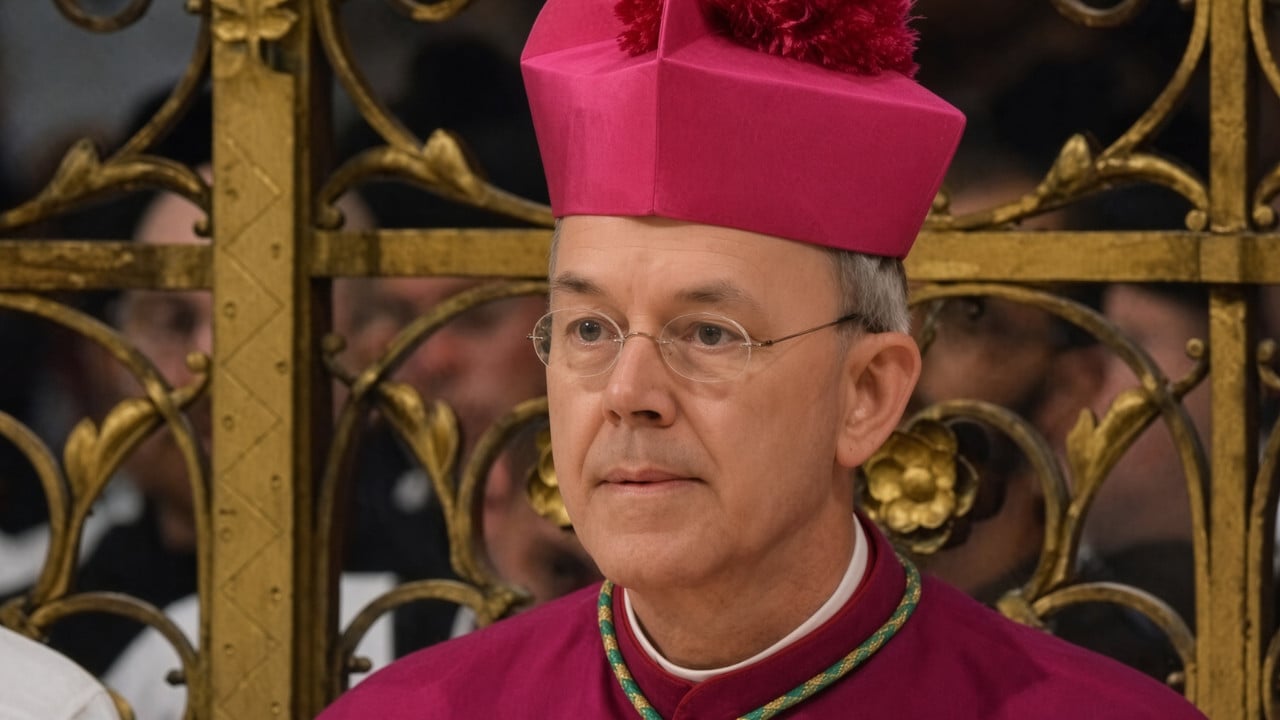
Three clergy form the backbone of this pseudo-magisterium: Bishop Athanasius Schneider, Cardinal Raymond Burke, and Cardinal Robert Sarah.
What usually happens is that when any of these men offer an opinion on a podcast or written interview, or issue a new pastoral letter, Trad Inc. acts like they have just received a brand new encyclical letter.
This past week, said influencers were likely in a state of ecstasy, as not only did Cardinal Burke speak with Michael Knowles, but shortly thereafter Bishop Schneider issued a public statement.
As is the case with Burke and Sarah, Bishop Schneider practices his unique version of “recognize and resist”: recognize the crisis but resist the correct conclusion.
Preaching another Gospel
Schneider’s statement primarily concerns the Society of St. Pius X. It would be wrong to pretend that it wasn’t one of the strongest interventions on the postconciliar crisis in recent memory.
However, this is precisely the problem. Schneider sees the crisis, understands the players, but fails to reject the legitimacy of the ecclesiastical establishment that is responsible for the crisis.
In brief, Bishop Schneider’s statement suffers from a close-but-no-cigar approach: it perfectly describes the problem — that the postconciliar era has created circumstances in which fidelity to the Catholic faith stands in direct conflict with obedience to putative ecclesial authorities — but fails to draw the right conclusion.
As with his colleagues Burke and Sarah, Schneider stops short of understanding that if the Synodal Church headed by Leo XIV promotes principles incompatible with Tradition, then it cannot be treated as something that Tradition needs recognition from. As Saint Paul said in his letter to the Galatians (1:8): “But though we, or an angel from heaven, preach any other gospel unto you than that which we have preached unto you, let him be accursed” (emphasis added).
Tradition and obedience
Schneider begins by highlighting the SSPX’s dilemma as a choice between “preserving the unambiguous integrity of the Catholic Faith” and “being canonically recognized by the pope.”
He invokes St. Athanasius to make the point that Athanasius resisted Pope Liberius when he demanded communion with Arian and semi-Arian bishops. Schneider notes that Athanasius could have been considered schismatic, according to an excessively narrow understanding of schism, but that he courageously preserved the faith instead.
Schneider then identifies two tendencies that he says distort Catholic thinking in this time: “legalism” and “papalism.” Papalism he defines as the tendency to “absolutize the person of the Pope and obedience to him.” He warns that this has been elevated above “the necessity for unambiguity in faith and liturgy.”
The Dispatch
Schneider proceeds to point out that “no one may contradict Divine Law and remain a Catholic.” He adds that “a Catholic may be required in conscience to act contrary to positive law, precisely in order to remain uncompromisingly faithful to Divine Law.”
While he is generally correct in these statements, Bishop Schneider does not address the fact that the problem we are confronted with today goes well beyond having to disobey a positive law. For more than a half century Catholics have been force to endure an endless stream of heterodoxy, heresy, and outright apostasy flowing from the Chair of St. Peter — things which simply cannot occur under a true pope.
Schneider further maintains that “these roots lie in certain vague and ambiguous doctrinal statements of the Second Vatican Council.”
He then criticizes the postconciliar approach to ecumenism and interreligious dialogue for having contributed to “undermining the uniqueness of Jesus Christ and His Church as the only way to salvation.” Further on, Schneider acknowledges that “doctrinal and ritual flaws of the liturgical reform with its Protestantizing tendencies” have “obscured the central sacrificial nature of the Mass.”
While he is correct in stating such truths, Schneider becomes highly frustrating because, although he identifies the serious problems with the Council’s theology and postconciliar Mass (which he ostensibly still offers), he stops short of recognizing that these efforts could never proceed from true Vicars of Christ, for the indefectibility of the Church precludes such harmful measures from being approved and enforced in the name of Our Lord.
Enjoying this article? Donate to Integrity today!
Schneider then praises the Society of St. Pius X, expressing how it offers a “great service” to the Church for being “virtually the only community in the Church today that openly draws attention to the evident doctrinal ambiguities.”
Schneider uses a clever “fire chief” analogy to make his point. He speaks of a house being on fire as the authorities insist upon new albeit inferior firefighting methods to put it out. A small group of firefighters (the SSPX) rejects these methods and relies on the traditional ones. In doing so, they successfully contain the fire. Yet they are “branded disobedient and schismatic and are punished for it.”
Schneider then imagines a new fire chief (a future pope) who recognizes the failure of the new methods and welcome those who are using the old methods (the SSPX) “back into the ranks.”
At this point, all of the good work Schneider’s statement might have achieved collapses. How so? Because he does not answer the key question: Why must the firefighters be welcomed back into the ranks of the very system that condemned the methods by which the house was saved?
Schneider himself speaks of the “so-called ‘Church of Vatican II’ or the ‘Conciliar Church.'” He also says there is a “tendency, in our day under the new name of the ‘Synodal Church’” to be “a relativist religion adapted to the world.”
This is utterly contradictory and confusing. On the one hand, he correctly describes the Vatican II Church as promoting a “relativist religion adapted to the world,” but then calls on those who adhere to that false creed to approve the SSPX, which promotes the Catholic religion.
Read more: How an FSSP ‘welcome packet’ for SSPXers exposed its own schizophrenic ecclesiology
In his conclusion, Bishop Schneider expresses hope that “the Holy See will one day shine forth again as the Cathedra of truth before the entire world.” But this is to forget the teachings of Vatican Council I, which affirms that the Chair of St. Peter is never without the assistance of the Holy Spirit and that it cannot fail to be the beacon “of truth” to the world.
For Catholics to follow Bishop Schneider’s advice and to seek recognition from men who, objectively speaking, are heresiarchs who have deviated from the true faith, is to place themselves under persons who adhere to a false Gospel. Such an arrangement is utterly backwards. The primary goal of all true followers of Christ in these times must be the conversion of those who have fallen away from Him, not the subjection of themselves to a false authority, under which they would be treated as a troublesome minority merely seeking permission to exist.