
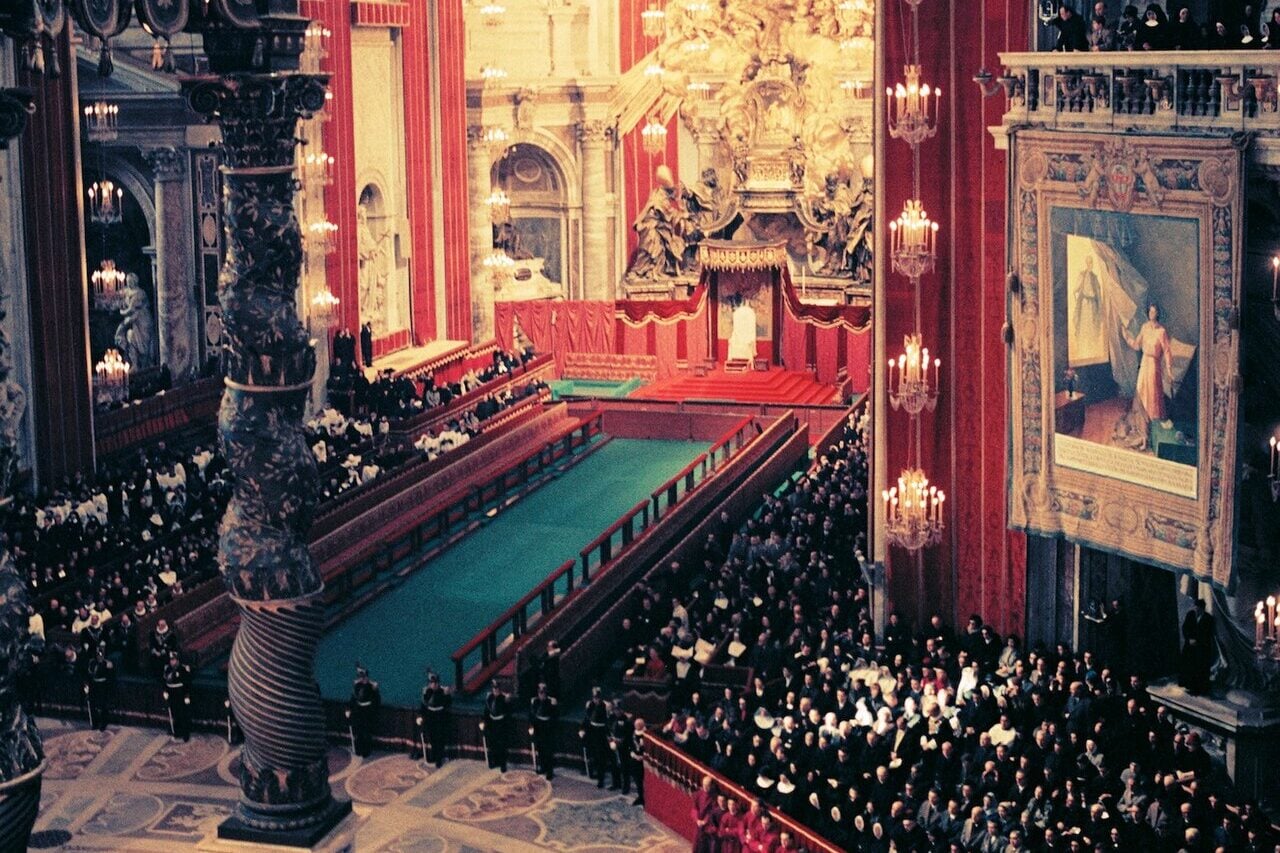
When it comes to the Second Vatican Council, one of the more common arguments conciliar conservatives will make is that the Council itself cannot be blamed for the destruction and chaos that ensued in the decades that followed; rather, an erroneous implementation is at fault.
Pope Benedict XVI spoke of this often. In 2013, he claimed that “there was the Council of the Fathers — ‘the real Council’ — but there was also the Council of the media.”
This “Council of the media,” he argued, “created so many disasters, so many problems, so much suffering: seminaries closed, convents closed, banal liturgy.”
Benedict’s remarks came nearly 50 years after Vatican II. As is often the case, as more time passes between an event and our recollection of it, our memory can form a bias about it that does not always reflect accurately what occurred at said event.
In other words, someone’s testimony about what transpired is generally more reliable the closer it is provided to the event in question. Even more credible is when there is physical evidence that testifies to what transpired at the event itself.
Vatican II and marriage
I recently came across a book bearing the imprimatur of then-Archbishop (later Cardinal) John Carberry of Lafayette, Indiana titled Our Family Prayer Book.
Edited by Fr. Bernard F. McWilliams C.Ss.R., it carries the Nihil Obstat of Fr. Alfred Rush C.Ss.R. and Fr. Donald Tracey S.T.D. It was published immediately after the Council in the 1960s.
While I was reading it, two footnotes in the “Marriage and the Family” chapter caught my eye, as they contained disturbing revelations about what Benedict XVI called the “Council of the Fathers.”
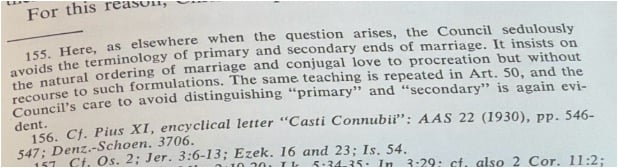
“The Council sedulously avoids the terminology of primary and secondary ends of marriage,” footnote 155 reads (emphasis added). “It insists on the natural ordering of marriage and conjugal love to procreation but without recourse to such formulations.”
Footnote 155 (pictured below) further states that the Council took “care to avoid distinguishing ‘primary’ and ‘secondary’” ends of marriage.
On the previous page, in footnote 153, the author says the following:
“The Council intends to discuss ‘certain’ key points only and not to give an exhaustive treatment of all matters in this area. Thus, it clearly intended to leave untouched those aspects of birth control and related themes that are under debate in the special commission set up by Paul VI to study them” (emphasis added).
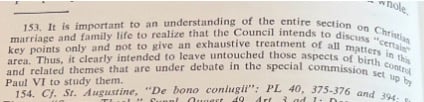
These footnotes are direct, physical evidence of an intentional effort to remove any mention in the Council’s documents the primary purpose of marriage.
The primary and secondary ends of marriage
Commentator The Catholic Esquire has written about marriage for Integrity Magazine previously.
In an essay on annulments published in June, he quoted Pope Pius XI’s 1930 encyclical Casti Connubii, On Christian Marriage, as having taught that “the primary end of marriage is the procreation and the education of children.” Pius also declared that the “secondary” ends of marriage are “mutual aid, the cultivating of mutual love, and the quieting of concupiscence.”
Esquire further cited respected pre-conciliar theologian Ludwig Ott. In his famous Fundamentals of Catholic Dogma, Ott stated that the primary purpose of marriage is “the generation and bringing up of offspring. The secondary purpose is mutual help and the morally regulated satisfaction of the sex urge.”
Yet, as footnote 155 in Our Family Prayer Book recalls, Vatican II “sedulously avoided” these definitions. The council document Gaudium et spes is proof of this.
The Dispatch
In the “Fostering the Nobility of Marriage and the Family” section of Gaudium et spes, it says the following:
By their very nature, the institution of matrimony itself and conjugal love are ordained for the procreation and education of children, and find in them their ultimate crown. Thus a man and a woman, who by their compact of conjugal love … render mutual help and service to each other through an intimate union of their persons and of their actions. Through this union they experience the meaning of their oneness and attain to it with growing perfection day by day. As a mutual gift of two persons, this intimate union and the good of the children impose total fidelity on the spouses and argue for an unbreakable oneness between them (emphasis added).
Gaudium et spes goes out of its way to avoid mentioning the primary and secondary ends of marriage while conflating procreation with an “intimate union” and a “mutual gift” that leads to the “perfection” of the couple.
Without saying so directly, Vatican II subtly reverses the purpose and hierarchy of marriage.
When The Catholic Esquire was shown pictures of footnotes 153 and 155 in Our Family Prayer Book, he provided the following statement to Integrity via email:
This simply proves what is obvious by reading the documents of Vatican II themselves and comparing them to established doctrine: Vatican II teaches ideas and concepts that are contrary to Catholic doctrine. In this case, the use of ‘primary’ and ‘secondary’ ends is key to the doctrine itself.
It was only a few years earlier in 1951 that Pope Pius XII in his Letter to Midwives specifically rejected the idea that there is not an order or hierarchy to the ends of marriage. He rejected exactly the ideas and reasoning of what Vatican II adopted as these footnotes demonstrate.
The casting aside of the primary and secondary ends of marriage has had harmful effects as the members of the Church. As The Catholic Esquire pointed out in his June article, the omission has contributed to a massive annulment abuse crisis which now mimics secular divorce. And why wouldn’t it? If the secondary ends of marriage are now on equal footing with the primary end, personal subjective happiness can now be leverage as a “justified” reason for why a marriage ought to be annulled.
The larger picture
What was the intent of those who sought to “sedulously avoid” speaking about the primary and secondary ends of marriage?
In 1963, John XXIII established a commission to study contraception. After John’s death, Paul VI continued and significantly expanded the commission. It eventually issued a report in 1966 that proposed viewing contraception as not being intrinsically evil. The vast majority of the 69 voting members approved the document.
This stunning development revealed a clear attempt to attack the very essence of the Catholic family, an attack the Council’s silence on the ends of marriage indirectly permitted.
It should be clear to see that “Council of the Fathers” and not the “Council of the media” is to blame for this.
Defend the family: Support Integrity Magazine today!
Although Paul VI eventually rejected the commission’s recommendation — later issuing Humanae Vitae — laity and bishops opted to follow the Council’s lead.
Recent data from the Guttmacher Institute indicates that 99 percent of Catholic women in the United States have used contraception at some point in their lives. This is essentially the same as non-Catholic women who live in the United States. In essence, the Church’s teaching on birth control has had almost zero bearing on how Catholics actually behave.
The real Council
Vatican II’s intentional silence on the true end of marriage has contributed to why Catholics are now indistinguishable from the rest of the world on the grave matter of contraceptive use.
Council apologists will argue that its documents are orthodox and that pastoral concerns necessitated the lack of precision in them. But as we have seen, omissions can be just as deadly as outright affirmations of heresy. We are therefore forced to conclude that, in the long run, the Council of the Fathers turned out to be the same as the Council of the Media.