
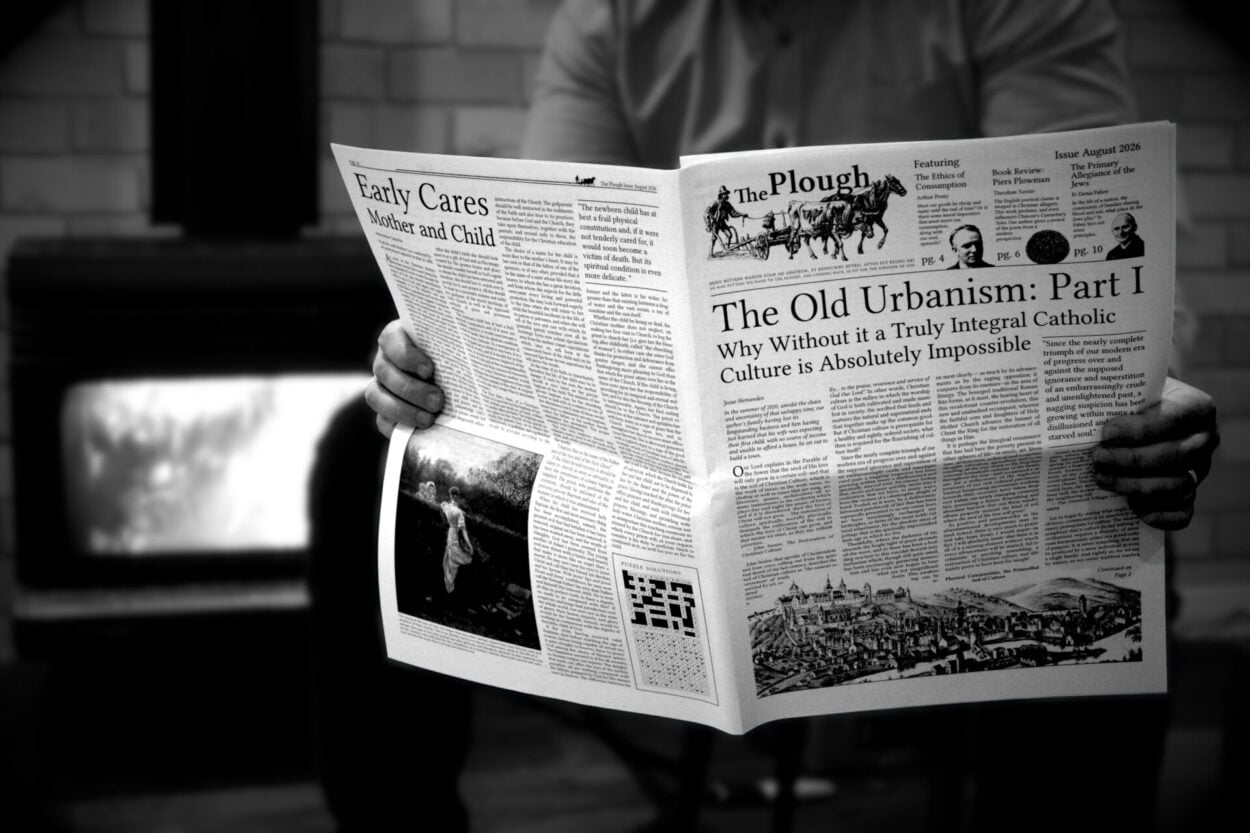
Editor’s note: Integrity editor-in-chief Stephen Kokx conducted this exclusive email interview with the editor of The Plough, which is based in New Zealand. You can visit The Plough’s website here or follow them on X here.
Stephen Kokx: What is The Plough and what inspired you to start it?
The Plough: The Plough is a print-first monthly Catholic journal in the shape of a newspaper. It focuses on the Social Kingship of Our Lord, family life, political and theological topics from authors both old and new. I started The Plough because I noticed a decline in the willingness to confront the errors afflicting Church, State, and family life. Catholics today are worn down by the unnatural and overwhelming forces of modern life — this being no mere accident — and in this wearing-down, we risk compromising on matters of doctrine. This, in turn, blinds and frustrates our efforts to restore all things in Christ. I noticed a hesitancy of the Catholic milieu to engage in the social sphere, and even in the family sphere, where instead only a vague individual holiness is preached.
I started The Plough to be a demonstration of the incompatibility of Our Lord’s teaching with the world, particularly the modern world, and to showcase what we as laymen can do about it.
Stephen Kokx: Why did you do a print newspaper in this digital age?
The Plough: Our Holy religion is one of the Incarnation. God, creator of everything, deigned to enter into our world below and live amongst us — physically! God willed that He should be known not just by the private intelligence of the individual, but by all of His creation. For example, compare the Catholic religion with modern protestantism: Catholics have cathedrals, protestants have halls. Catholics have the crucifix, protestants have a bare cross, if even that. Catholics have statues of the saints, and protestants have an invisible ‘direct line’ to God. In imitation of Our Lord, our religion should take up physical space!
The Plough as a newspaper indeed takes up space: it is kept on the dining table between meals, it is read on public transport, it can be shared with someone after Mass. I have even read it on a plane, which was the occasion for quite an interesting conversation with my co-traveller. A newspaper brings Catholic social doctrine out from the minds of the authors and into physical reality. We aim to make The Plough beautiful too. The modern world is synonymous with ugly, and so making The Plough visually attractive is a small act of counter-revolution!
Stephen Kokx: Has there been growth with subscribers? What do you think that says about Catholics today?
The Plough: Readership is steadily growing. Catholics today are very busy. Books can be too much, while doom-scrolling is too easy. I wanted to fill a gap somewhere in between. For some, The Plough is enjoyed while eating breakfast quickly and diving headfirst into the day’s rush-hour traffic. For others, it is enjoyed with the family at the end of the day by the fire. We have a free digital option too, which many readers go for, but it only imitates the full Plough experience. I know of several groups who print out the digital copies to distribute at their meetings. We are very encouraging of this. Donations are always welcome and go a long way towards The Plough being produced into the future.
Stephen Kokx: How do you determine which essays are included in each edition?
The Dispatch
The Plough: The editorial line is simple: whatever is Catholic and can be reconciled with Catholic teaching before the revolutions of the 20th century, both in Church and civil society can be included. Each issue invariably contains a mixture of anti-liberal writings from authors old and new, a piece on the roles of womanhood or motherhood, military campaigns, great Catholic leaders, the Jewish question, consumerism and Catholic economics, and the building of brotherhood on the natural and supernatural foundations. Featured also is a small puzzle section. Readers too are welcome to make submissions, or write a letter to the editor.
Stephen Kokx: Which writers (both clergy and laity) do you find the most beneficial to read in this particular time in Church history?
The Plough: The list is long, but it would certainly include: Fr. Denis Fahey, Fr. Vincent McNabb, Pope Leo XIII, Arno Arcand (of the Daily Fight), Mr. Theo Howard. All of these authors have featured in The Plough. They touch on the fundamental reasons why things are the way they are today, and in their totality, they provide the most compelling blueprint for setting aright our perilous situation.
Every author of history that has witnessed the truth has something to offer our times. Thought there are repeating patterns in history, each age contains something new. Historical authors, even the greatest, can’t possibly address all concrete particulars of the problems of our age. So while the likes of Cardinal Pie and even Fr. Fahey are indispensable today, I would argue that they are not sufficient. That is why The Plough publishes both old and new: to show men today what our forefathers of old thought, and to adapt this wisdom — amended with contemporary Catholic thought — to today’s fight.
Stephen Kokx: What do you think Catholics today are most in need of? Theology? Philosophy? History? Political Theory?
The Plough: God has given different jobs for different men, so there isn’t a single concrete answer to this question. Generally, Catholics today are in most need of the truth. For many, perhaps the majority, the truth — plainly told and often repeated — on basic matters of the moral life is what will serve them best: marriage and feminism, justice in our dealings with our neighbor, the correct use of authority and so on. For some, particularly intelligent young men, it is a different story. What’s missing from these men’s formation is the development of a magnanimity of soul that would direct them towards a leading role in restoring order to the nations. For these men, they will profit from Theology, Philosophy, History and Political Theory all rolled into one.
Another element that The Plough seeks to encourage is the practice of organising corporate action: co-operatives, music groups, homebrew, exercise, reading groups — anything! We mustn’t allow intellectualism to stifle action, but rather, our intellectual formation should be the principle and compass of our action. From this organising, leaders emerge. And God, in His own time, will use this pool of leaders for His own ends as He sees fit.
Stephen Kokx: What does success look like for The Plough?
The Plough: Success for The Plough is confirming laymen in the traditional doctrine of The Church — the Pillar of Truth — and motivating them towards action, whether it be within one’s own soul, in the family, or highest of all, in the civil society. In every generation God is raising up souls to perform a particular role in His plan. I think that God is raising up young men to re-establish a Christian world, one nation at a time, based on justice, order, and love. If The Plough can be coincident to that, then that will be The Plough’s greatest success.
Stephen Kokx: Anything else to add?
The Plough: Thank you Mr. Kokx for your gracious interview, and Godspeed to your work, and the work of all the writers, at Integrity Magazine. Hail Christ.