
One of the most ominous moments during Leo XIV’s interview with Crux in 2025 was his claim that, “we have to change attitudes before we ever change doctrine.”
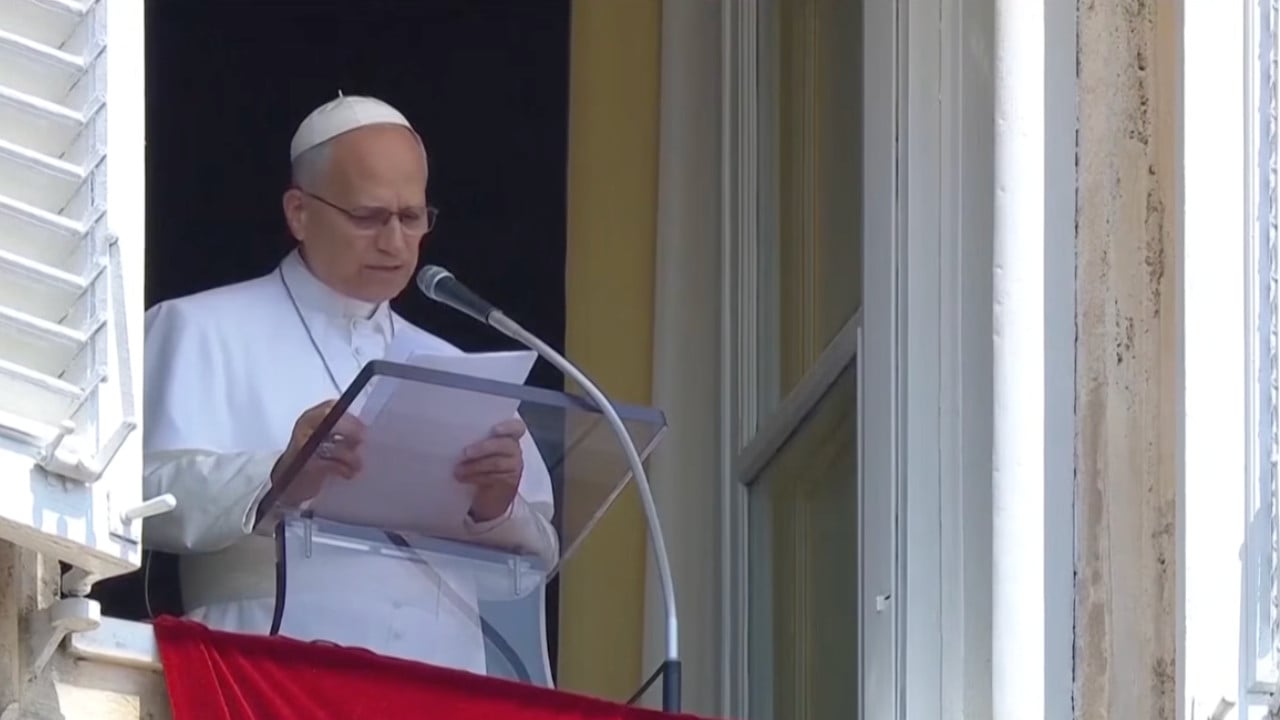
This past Sunday, August 23, his Angelus address became just that: a blatant attempt to convince the faithful that the eternal truths of Catholicism can be abandoned in order to find new, invented responses to modernity.
Leo’s message was riddled with an unsettling emphasis on personal discovery, continual growth, new encounters, openness to unfamiliar paths, and a warning against retreating into “religious certainties.” His words raise an important question: what exactly is being rediscovered, and what is supposed to remain fixed?
True and false understandings of Christ
Catholicism is a religion of doctrine, authority, and objective truth, but for Leo XIV it seems to be merely one of “experiences.”
Undoubtedly, Catholics are allowed to ask, “What does Jesus mean to me?” but they also must first ask, “Who is Jesus objectively, and what has He revealed to His Church?”
Leo’s first concerning comment on Sunday came when he said, “Faith is not something given to us once and for all. Rather, we continually need to rediscover the face of Christ and his Gospel.”
Undoubtedly, our life of faith is something we must deepen through study, prayer, and reflection, but this does not mean that Catholicism as a religion is perpetually open to revision. The Church’s deposit of faith has been given to us once and for all. Each generation does not receive it as raw material for theological experimentation and innovation. Christ taught His Apostles, and the Apostles transmitted that teaching — which develops organically over the centuries — to the faithful through the ages. The Church is therefore tasked with preserving, articulating, and defending those doctrines, not continually updating them.
Enjoying Integrity? Click here to donate today!
Leo’s repetition of the question, “Who is Jesus for me?” raises other red flags. While the question in itself is not wrong, it should never eclipse the more important question of “Who is Jesus?” as revealed to us. The former should be based on the latter and we should adapt ourselves accordingly to the objective reality it imposes on us.
The Dispatch
Casting doubt on religious ‘certainties’
Leo’s most explicit attempt to shepherd Catholics away from the perennial teachings of the Church came in the form of an exhortation: “Let us seek not to retreat into our own convictions and religious certainties, but to remain open to an authentic relationship with Christ.”
Here, he turns to one of the most common tactics of the Modernists, namely, to create the impression that religious certainty is a problem. This is, of course, preposterous given that Catholicism has ever claimed to possess certain truth. The Creed does not say, “We are open to whatever future understanding of God might emerge,” but, “I believe” (emphasis added).
Instead of reiterating Catholicism as the one true religion, Leo leads his audience into the classic Protestant formulation: to have a “personal relationship with Jesus.” Sure, but Catholics primarily believe in an ecclesial or corporate relationship with Christ through the dogmas, doctrines, sacraments, liturgy, Scripture, saints, and traditions that His Church — the Mystical Body of Christ — teaches us.
Leo then argues that an authentic encounter with Christ “may also ask us to follow unfamiliar paths and to make choices different from those we had imagined.” This is the kill shot, as it is intended to prepare the listener to be open to changes à la his Crux interview.
The dangerous theological vision that Leo is promoting lays the groundwork for leading the Church away from its inherited doctrine via the purported guidance of the “Spirit.” This is entirely at odds with what preconciliar popes taught.
In 1896, Pope Leo XIII taught in Satis Cognitum that there must be “one faith” among Christians and that the content of that faith was not to be determined by conjecture, but by “the certain knowledge” of what Christ commanded.
In 1907, Pope St. Pius X, in Pascendi Dominici Gregis, explicitly rejected the notion that men should be brought to faith merely through “personal internal experience or private inspiration.”
Finally, in 1950, Pope Pius XII warned in Humani Generis against theological tendencies that lead to “dogmatic relativism,” insisting that revealed truth cannot simply be replaced by “formless and unstable” theological constructions. He went so far as to insist that “truth and its philosophic expression cannot change from day to day” where divine revelation is concerned.
Of course, these teachings do not mean that these popes deemed a personal relationship with Christ irrelevant, but they understood well that the Catholic faith is meant to become a living relationship with God built upon objective revelation.
It is clear that Leo is wholly at variance with these documents and that his introduction of fluid and ambiguous concepts serves to “change attitudes” in order to change doctrines.