
With the First World Noahide Congress planned for Jerusalem from November 2-6, 2026, Catholics should be concerned about the growing popularity and promotion of these supposed universal moral obligations for “all humanity.”
What are the Noahide Laws?
The Noahide Laws are seven moral principles which, according to rabbinic Jewish tradition, applies to all gentiles as well as to Jews. These “laws” are based on the covenant God made with Noah in the aftermath of the great flood. According to Rabbinic tradition, this covenant established the fundamental responsibilities for humanity.
The seven laws prohibit idolatry, blasphemy or cursing God, murder, sexual immorality, theft, eating flesh taken from a living animal, and the establishment of courts of justice. The classic enumeration appears in the Babylonian Talmud, Sanhedrin 56a.
Without being required to convert to Judaism, a non-Jew who observes the Noahide Laws is traditionally regarded as a “righteous person.”
Political and public support
Political recognition, particularly in the United States, has played a substantial role in the mainstreaming of the modern Noahide movement. The late President Ronald Reagan publicly supported the laws, and in his 1982 National Day of Reflection proclamation, he described them as possessing “eternal validity” while calling them “a moral code for all of us regardless of religious faith.”
Enjoying Integrity? Join the Counter-Revolution by making a monthly gift!
Especially concerning is the fact that the United States Congress has explicitly referred to these laws in the past. House Joint Resolution 447 in 1982 described them as ethical principles underlying civilized society, and in 1991, Public Law 102-14 which designated March 26 as “Education Day, U.S.A.,” referred to ethical principles known since antiquity as the Seven Noahide Laws.
Although these measures recognized their moral importance, they did not make the Noahide Laws binding on American civil or criminal law. This is cold comfort, though, for those who have been noticing the increasing and nefarious chokehold Jewish lobbying groups have on spheres of American life.
Current President Donald Trump also seems to be Noahide-friendly, as he has issued several proclamations honoring the legacy of the Lubavitch movement and maintained connections with its wider community. Other international figures, such as former European Council President Herman Van Rompuy, former Australian Governor-General Michael Jeffery and Sheikh Mowafak Tarif, spiritual leader of Israel’s Druze community, have all expressed support for the Noahide Laws.
The First International Noahide Congress
According to its own promotional material and website, the first World Noahide Congress is being convened by the Noahide World Center and nonprofit group Brit Olam. It is described as a five-day event at several locations in Israel including Jerusalem’s Old City, Masada, and the Dead Sea.
The Dispatch
It is important to note that the event is promoted as much more than an ordinary conference. The Congress material describes participants as helping formally establish a worldwide Noahide movement, declaring that “The question is not whether this happens, it is happening.”
Marketing material also describes participants as becoming founding members of an international movement that will help to write its charter. The proposed movement includes structured membership, religious texts and prayers, an authority structure, and continental councils connected to Jerusalem as its spiritual center. The inclusion of “religious texts and prayers” should ring alarm bells for Catholics as this indicates the explicit religious character of a movement which is led by Christ-denying Jews.
Why Catholics should be concerned
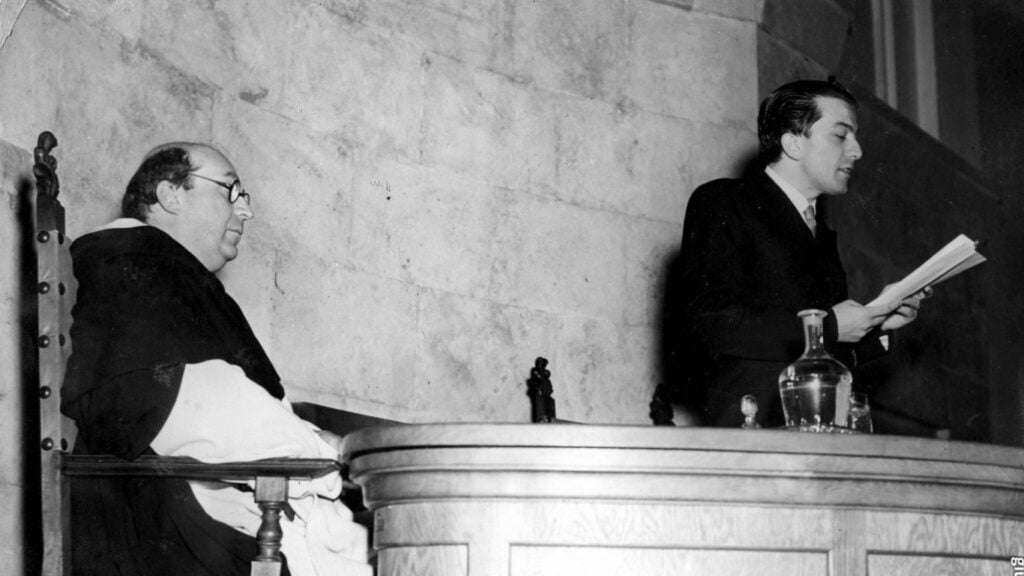
Fr. William Jenkins of the Society of St Pius V explained in a recently aired episode of “What Catholics Believe” why Catholics should be deeply concerned about the Congress’ theological implications.
Jenkins’ principal concern rightly involves the prohibition of idolatry, although this might seem strange at first glance. He explained that Christianity teaches that there is one God in three divine Persons — Father, Son and Holy Ghost — and that Jesus Christ is truly divine. Jenkins expressed his fear that a Jewish religious authority applying the prohibition against idolatry will regard Christian Trinitarian belief as incompatible with Noahide monotheism.
The fact that Judaism does not recognize Jesus Christ as God, automatically classifies worship of Him as both idolatry and blasphemy. Jenkins therefore warned that “This is not a good beginning. This is not a good start,” particularly if Jewish religious authorities were empowered to judge whether Christians were guilty of idolatry.
Fr. Jenkins raised a similar concern regarding the prohibition of blasphemy, explaining that Christianity cannot compromise the divinity of Christ or the Trinity merely to appease another religious system. He stressed that this is not a peripheral disagreement but “a matter of our faith,” adding that the issue concerns “who God is and who He’s revealed Himself to be through our Lord Jesus Christ, His own Son.”
Another concern for Jenkins was the command to establish courts of justice. He sees the Congress’ proposed institutions as potentially developing authorities capable of interpreting and enforcing Noahide standards. He then contrasted this with the American constitutional principle of separating legislative, executive, and judicial powers, arguing that concentrating such authority risked tyranny.
In no uncertain terms, Jenkins characterized the developing structure as “essentially a world religion” centered spiritually on Jerusalem and concluded that “this is not good news for Christians at all.”
These developments justify serious concern, as the proposed Noahide movement increasingly resembles a religious-political project with implications far beyond interfaith dialogue, and Catholics should not dismiss it as harmless.
Tragically, a Church already weakened by ecumenical confusion and an increasingly problematic and accommodating posture toward Judaism won’t have the zeal or the will to stem the dangerous rise of this movement.