

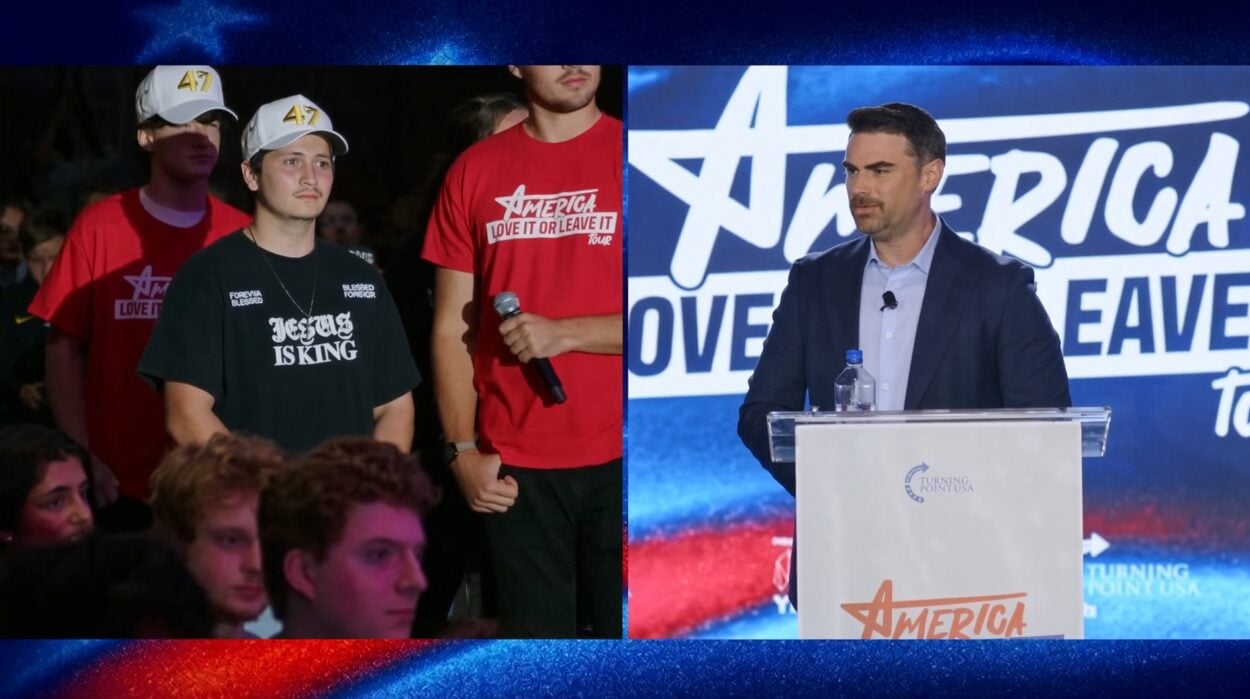
Ben Shapiro’s remarks at a Turning Point USA (TPUSA) event on October 8 about Noahide Laws have ignited a firestorm of criticism on social media, driven in no small part by prominent Protestants and Catholics, including Carrie Prejean Boller.
During the Iowa stop of TPUSA’s America: Love It or Leave It tour, Shapiro fielded several questions after his speech. His response to one young interlocutor who asked him why he was not Christian is at the center of the controversy.
“We don’t believe you have to be Jewish in order to get into heaven,” he said. “If you’re not Jewish, all you have to do is fulfill seven basic rules. They’re called the Noahide laws.”
After rattling off several Noahide prohibitions — including murder, theft, sexual immorality, and blasphemy, without explaining what they actually entail — Shapiro declared, “If you knew those things, you’re in heaven.”
Conservative reaction
Shapiro’s remarks are significant given that they were made at an event sponsored by TPUSA, which was founded by the late Charlie Kirk. The group is the largest conservative political organization in the United States. It speaks for what might be called the “average conservative” voter under 35 years of age.
Catholic X account The FishEaters rightly warned its followers to reject Shapiro’s remarks. “Don’t let your Christian friends fall for the Noahide Law lie,” it’s owner said. Journalist Chris Brunet, who has over 87,000 followers on X, importantly pointed out that “one of the seven Noahide laws is that you aren’t allowed to worship Jesus.”
Protestant minister Joel Webbon chimed in as well. “So you don’t have to be a Jew to go to heaven … But it sure sounds like you have to stop being a Christian,” he remarked.
Prominent Catholic Carrie Prejean Boller took direct aim at Shapiro, who had previously called her “retarded” for criticizing Erika Kirk over her choice to platform Shapiro. “Charlie said he wants to be remembered for courage for his faith,” she said. “Why is [Erika] allowing one of Charlie’s enemies — who hates Christ, up on stage trying to convince people to become Jewish?”
Boller also demanded Shapiro answer the following questions: “If a Christian says Jesus is God, is that blasphemy under the Noahide laws? And does the Talmud say the penalty is death? Where does the Talmud say Jesus is right now?”
Catholic teaching on salvation
Christ established baptism as necessary for salvation (John 3:5). The Church also teaches that “there is no other name under heaven given among men” except Jesus Christ “by which they are saved” (Acts 4:12). This being true, Shapiro’s proposed path to heaven for those who are not Jewish is objectively blasphemous.
Shapiro’s heretical theological views are to be expected. During a 2019 appearance on Joe Rogan’s podcast, he blasphemously said Christ “was a Jew who tried to lead a revolt against the Romans and got killed for his trouble.” He admitted at the TPUSA event that “I do not believe that Jesus is divine.” Shapiro has made several public jokes about Our Lord on X in years past while expressing support for Noahide Laws.
The Dispatch
What are the Noahide laws?
Traditionally enumerated in the Babylonian Talmud (Sanhedrin 56a), Noahide Laws are regulations to be imposed on non-Jews, i.e. Gentiles. They prohibit idolatry, blasphemy, murder, theft, sexual immorality, and eating flesh from a living animal, while requiring the establishment of courts of justice. Violation of any of these laws is to be met with death as outlined by the most authoritative Jewish rabbi, Maimonedes — specifically by way of decapitation. Chabad.org, the website of the Hasidic Chabad-Lubavitch movement, describes them rather blithely as “rules that all of us must keep, regardless of who we are or from where we come.”
Although several of these prohibitions clearly overlap with Christian natural-law morality, the danger is twofold. First, adopting them as a legal framework implicitly recognizes the right of Jews to make legislation for Christians and to hold authority over God’s true chosen people, rather than the other way around. Second, the way in which post-Christian Jews conceive of these laws fundamentally differs from the way Catholics understand the same moral precepts.
Stand with Christ the King: Donate to Integrity today!
Naturally, the prohibition against idolatry poses the most serious theological problem. Whereas all Christians recognize Christ as being truly divine, the Son of God, in Rabbinical and Talmudic Judaism this is considered blasphemy and treated as such. When it comes to offering Jesus Christ divine worship as the only true God, this can even be viewed as idolatry under Noahide regulations.
This raises an obvious and deeply consequential question: in a society governed by the Noahide Laws, who — or what body — would determine what constitutes idolatry?
Fr. William Jenkins of the Society of St. Pius V recently warned about this matter during a segment of the What Catholics Believe podcast. He noted that a Noahide Congress where Jewish religious authorities interpret and enforce laws raises serious moral questions for Catholics. The same concern applies to the prohibition against blasphemy.
Shapiro’s remarks take on even greater significance against the backdrop of the first World Noahide Congress, scheduled to take place in Jerusalem in November 2026. The event’s organizers have promoted an international movement involving religious texts, prayers, membership structures, and councils, with Jerusalem serving as its spiritual center.
There is an eschatological dimension to all this that Catholics cannot ignore. Many Church fathers maintain that the Antichrist will be of Jewish extraction1 and that unbelieving Jews will not only prepare the way for his earthly kingdom but will hail the Antichrist as their messiah. 2
The belief that the Antichrist will be Jewish is well founded and appears throughout traditional Catholic literature. In its discussion of the Antichrist, the 1907 Catholic Encyclopedia acknowledged his Jewish ancestry.
TPUSA legitimizes Jewish subversion
Beyond the gravely misleading theological implications of Shapiro’s remarks, the setting he made them in raises questions about the direction of the conservative movement and the influence Jews have within it.
TPUSA assiduously works to cultivate a substantial “Christian conservative” audience, and its events frequently invoke America’s religious heritage and traditional moral principles. Yet, on October 8, Ben Shapiro, an Orthodox Jew, used this platform to explain to its audience why non-Jews supposedly need only observe commandments defined by Rabbinic tradition.
The integrity of a movement that is supported by so many “conservative Christians” must surely be called into question when its platform is used to advance a conception of salvation that explicitly excludes the necessity of professing Christ’s divinity, without any apparent challenge from its “Christian” representatives.
This troubling development should serve as a wake-up call to all American Catholics, particularly self-identified traditionalist Catholics, who unfortunately continue to support Shapiro’s Daily Wire and the TPUSA organization. Loyalty to Christ the King and His Social Kingship — not American conservatism — must be their guiding principle.