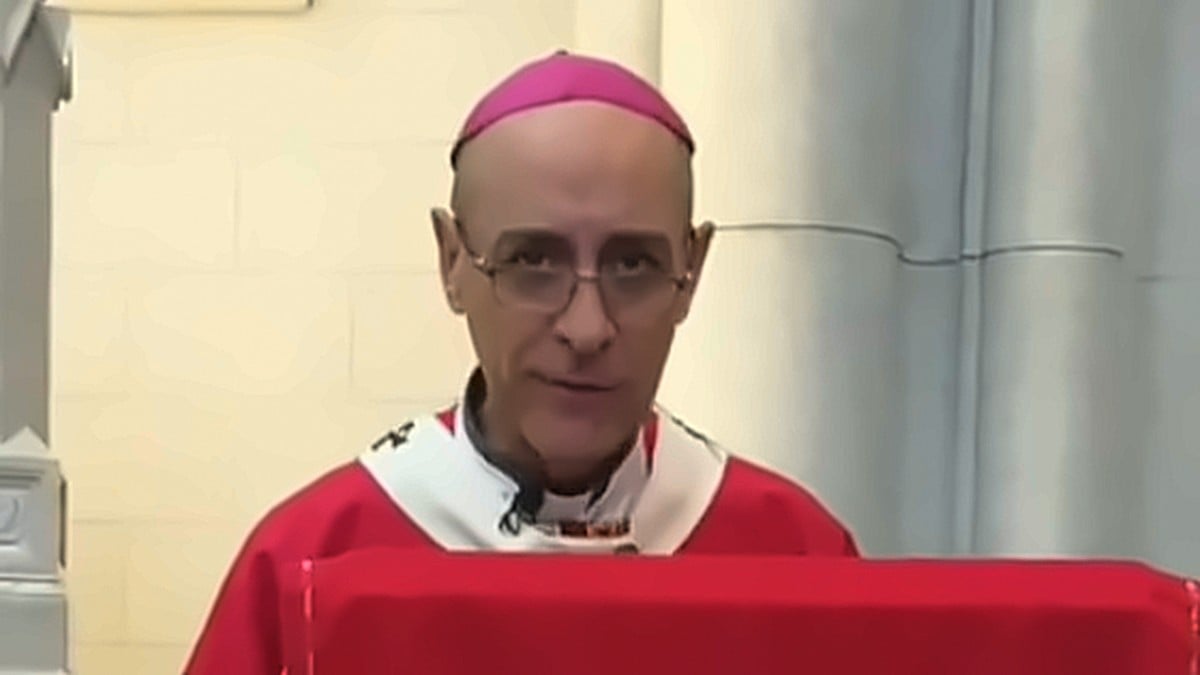
The shenanigans of the Vatican’s chief jester, Cardinal Víctor Manuel Fernández, are now even causing tensions within the Roman Curia.
According to a report published on October 30 by the German Catholic daily Die Tagespost, the Dicastery for Legislative Texts has repeatedly attempted, in collaboration with the Dicastery for the Doctrine of the Faith, to resolve the legal contradictions contained in the decree of excommunication he issued against the Society of St. Pius X (SSPX) on July 2. The report was highlighted on the SSPX’s website as well.
The main problem appears to concern Fernández’s explanatory note, which challenged the Society’s faculties to hear confessions and assist at marriages. Francis himself recognized the faculty of the faithful to receive absolution validly and licitly from SSPX priests initially during the Extraordinary Jubilee of Mercy in 2015. In November 2016, he extended this until further notice via his apostolic letter Misericordia et misera. A similar concession was granted concerning marriages in 2017.
These provisions, which some trads and even SSPX’ers will say are not necessary and even potentially problematic, have never been revoked.
Frustrations growing in the Vatican?
According to Die Tagespost, the friction within the Vatican stems from Fernández’s refusal to cooperate with the Dicastery for Legislative Texts to resolve the SSPX affair.
The SSPX itself reported that the Dicastery for Legislative Texts admitted that “the note from Cardinal Fernández did not constitute a revocation of the 2017 matrimonial provisions expressly approved by the sovereign pontiff” (emphasis added).
The author of the German report, journalist Guido Horst, quoted Ed Condon, co-founder of The Pillar, as arguing that the dicastery’s continued inability to clarify the canonical consequences of the consecrations could lend weight to mounting calls for Fernández to be replaced before his term ends in 2028.
Calls for Fernandez to go are growing
The apparent mishandling of the SSPX consecrations is just one of several recent episodes highlighting the growing unpopularity of Fernandez, who authored the lurid book Heal Me with Your Mouth.
The Dispatch
On November 4, Cardinal Joseph Zen, Bishop Emeritus of Hong Kong, called on Leo XIV in a blog post to grant “a long vacation” to Cardinals Mario Grech and Jean-Claude Hollerich and to replace Fernández.
“It is well known that this cardinal has written things in the past that he would not write today,” wrote the beleaguered cardinal.
Earlier this week, reports emerged that, ahead of Leo’s arrival in Argentina on Monday, protesters calling for Fernández’s removal from office had appeared along the streets. Fernández himself is Argentinian. Fr. João Silveira shared images of the posters on X.
Among other things, the posters urged Leo to take action “for the good of the Church” and featured a QR code linking to a video of a 2023 homily by Fernández, during which he made the following blasphemous remarks:
As you well know, during many centuries the Church was going in a different direction. Without being fully aware, the Church developed a whole philosophy and moral full of classifications, to classify people, to label them, ‘this is X, this is Y, this can receive communion, this one cannot receive communion, this one can be forgiven, this other cannot be forgiven.’ … It is terrible that this has happened in the Church. But thank God that Pope Francis is helping us to be free from those patterns.
As far back as 2024, Rorate Caeli reported that the recently-deceased Archbishop Héctor Aguer of Argentina claimed that “Cardinal Fernandez was unpopular with the priests and faithful of La Plata, and resented the more conservative leadership.”
A track record of blasphemy
Beyond his dismal handling of the SSPX consecrations and his deplorable book, Fernández’s tenure in the Vatican and wider career has been marred by controversy.
Earlier this year, a 30-year-old document authored by Fernández, titled Romans 9–11: Grace and Predestination, surfaced. In it, he examined St. Paul’s teachings in the Epistle to the Romans.
The document concluded with Fernández’s heretical claim that he himself “firmly believe[s] that everyone will be saved; a belief that is not based on wishful thinking, nor on my compassion for men, but on what I know about God and his concrete plans thanks to his Revelation.”