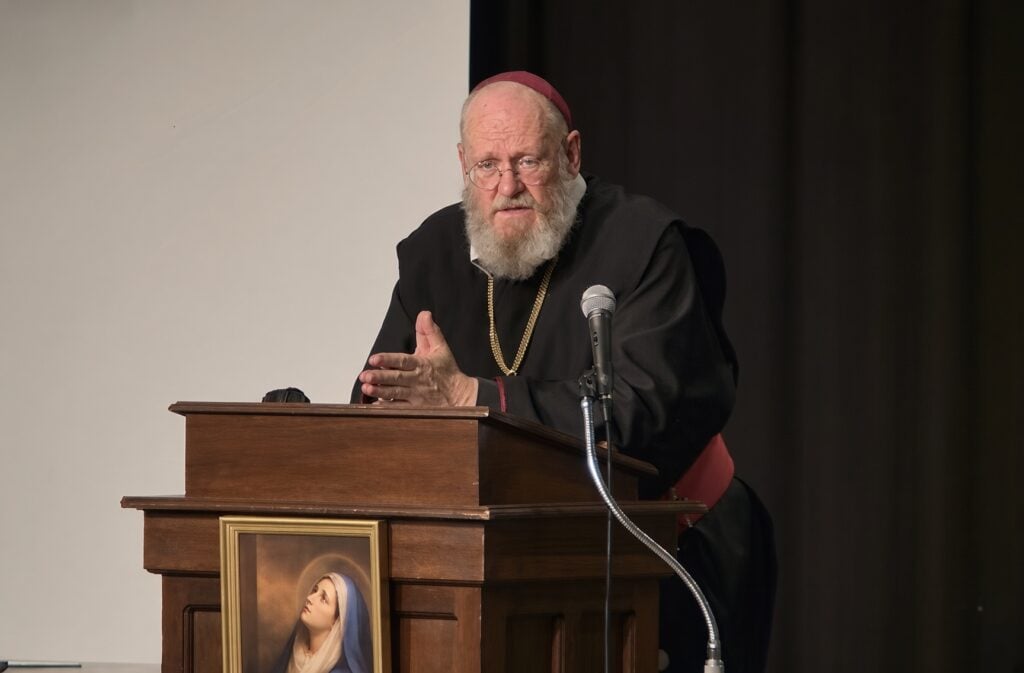


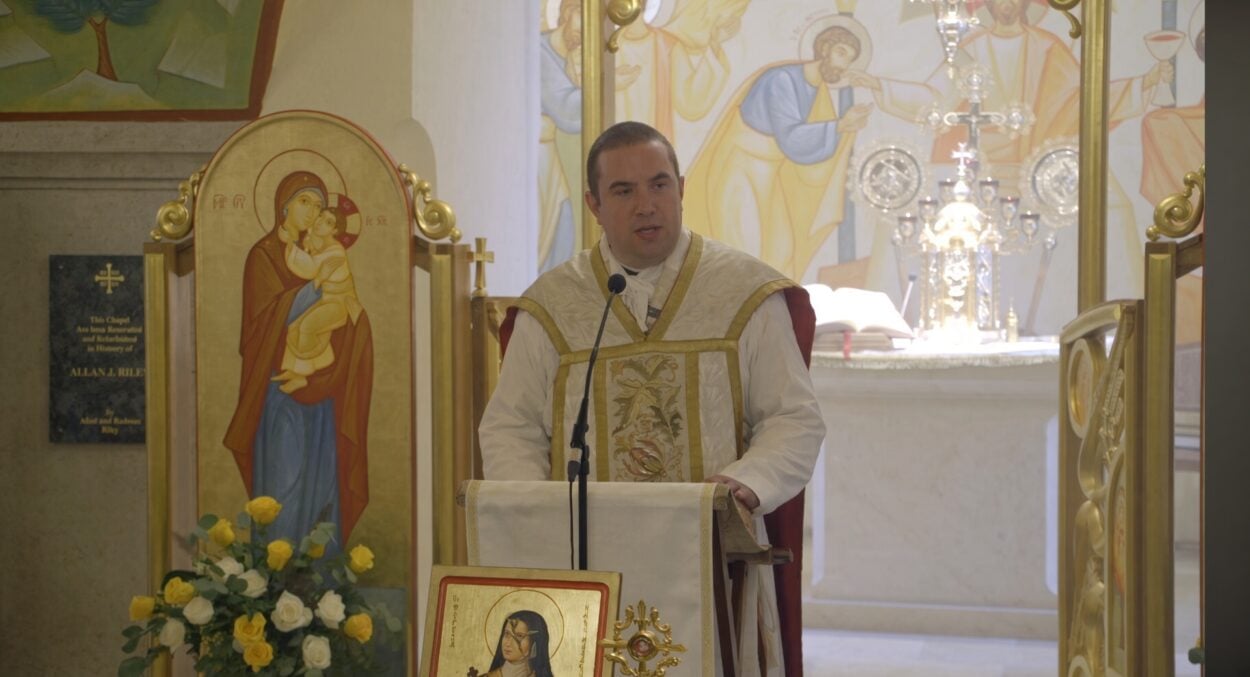
Cistercian monk and theologian Fr. Edmund Waldstein’s personal blog has been listed as “private” in what appears to be the latest effort waged by conciliar authorities to censure his writings on integralism and the death penalty.
Integrity Magazine staff noticed on the morning of October 14 that Waldstein’s Sancrucensis website was no longer available for public viewing. Just one day prior, the site was fully readable.
Waldstein co-founded The Josias website in 2013. He famously published an article titled “Integralism in Three Sentences” in October 2016. In it, he rightly defined integralism — which is merely a recapitulation of Catholic social teaching — as follows:
Catholic Integralism is a tradition of thought that, rejecting the liberal separation of politics from concern with the end of human life, holds that political rule must order man to his final goal. Since, however, man has both a temporal and an eternal end, integralism holds that there are two powers that rule him: a temporal power and a spiritual power. And since man’s temporal end is subordinated to his eternal end, the temporal power must be subordinated to the spiritual power.
As previously reported by Integrity, theologian and rector of the Benedict XVI Philosophical-Theological University, Wolfgang Klausnitzer, did not invite Waldstein to return to his teaching position in Heiligenkreuz, Austria. Waldstein has since been allowed to pursue further studies in philosophy in Rome.
The persecutory campaign waged against Waldatein intensified in 2025 when his writings specifically on the legitimacy of capital punishment for heretics in a Catholic regime gained wider attention. Wilhelm Guggenberger, dean of faculty at the Catholic University of Innsbruck, related in May 2025 that faculty at the institution issued a statement arguing that Waldstein’s view “contradicts the understanding of the Church as presented by the Second Vatican Council.” More recently, Innsbruck Professor Michaela Quast-Neulinger alleged — erroneously — in a September 2026 essay against Waldstein that “integralist positions clearly contradict Catholic teaching and the legal framework of a democratic constitutional state.” German Catholic theologian Michaela C. Hastetter has likewise accused Waldstein of being a “theocratic dreamer.”
Fr. Waldstein initially responded to his critics 1 in May 2025 with a clarification posted on Sancrucensis. While courageously maintaining his position on the per se legitimacy of capital punishment for heretics, he admitted that he sometimes had “gone too far when it [came] to the application of principles” and reaffirmed his commitment to Francis’ novel teaching on the death penalty and “the teaching of St. Pope John Paul II on the rule of law and democracy.” 2 In the same blog post, Waldstein argued that Vatican II’s Dignitatis Humanae document is in continuity with prior teaching.
On October 8, German outlet Die Tagespost reported that Waldstein had renewed his earlier “retraction” of past writings linked to Catholic integralism. Reporter Sebastian Ostritsch and editor-in-chief Benjamin Leven published two articles on the subject. “One thing is clear: under public and institutional pressure, one of the leading figures of the neo-integralist movement has completely relinquished his positions,” Leven said.
Leven further stated that Klausnitzer “confirmed” that Waldstein withdrew support for past remarks he made via an internal letter written to him.
In his own article, Ostritsch reported that Klausnitzer directed Waldstein to write a “reflective essay” in 2024 on his “relationship” with the death penalty. Ostritsch noted that Klausnitzer still does not believe Waldstein has done enough to separate himself from his earlier beliefs. He is continuing to demand that Waldstein affirm that “the execution of heretics is ‘incompatible with the message of Jesus.’” One can only speculate as to whether this factored into the removal of Waldstein’s website from public viewing.
Stand with Christ the King: Donate to Integrity today!
Ostritsch further reported that he believes Waldstein’s current position is that “Pope Leo X’s statement about burning heretics to be a contingent, time-bound statement and no longer an infallible judgment.” If Waldstein does hold to that position, he would be contradicting eminent theologians from before the Second Vatican Council, including 19th century Cardinal Johann Franzelin, SJ, who has maintained precisely the opposite on both counts. “It is not lawful for any Catholic to deny these definition are infallible,” Franzelin wrote in his manual on divine tradition.
The Dispatch
Noting that Waldstein and other prominent Catholic intellectuals are critics of Liberalism — that is, committed to defending true Catholic social teaching — Leven lamented in his article for that “neo-integralists aim to overcome the liberal separation of religion and politics and align law and state with Catholic moral principles.”
The impossibility of integralism in the Conciliar Church
In the English-speaking world, Liberal Catholic academic James Patterson drew attention to Die Tagespost’s report on Waldstein’s retraction.
A longstanding opponent of traditional Catholic doctrine on the duties of the State towards revealed religion, along with its implications, Patterson framed the news by saying on X that “Waldstein [has been] required to renounce integralism.”
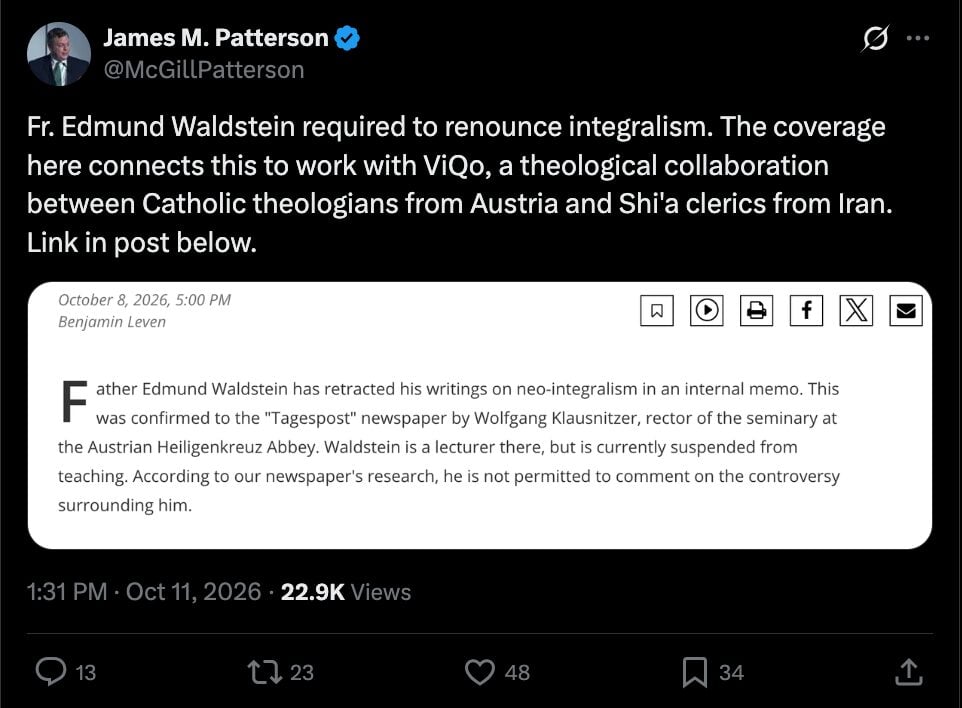
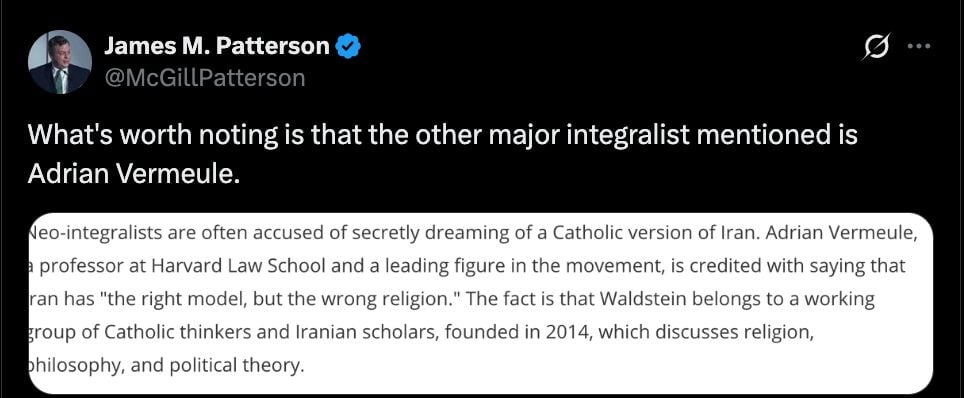
He also predictably highlighted a reference in the report to Harvard Professor Dr. Adrian Vermeule, whom Patterson waged contemptible attacks on in his latest book Why Postliberalism Failed.
While not surprising, it is disappointing that Waldstein is accepting the ongoing persecution, especially considering that his past writings are entirely within the bounds of Catholic orthodoxy. But this sort of persecution is par for the course in the Conciliar Church. Ever since Francis introduced his novel death penalty doctrine in 2017, the Vatican has energetically committed itself to enforcing obedience on the matter, with Waldstein now bearing the brunt of its efforts. Indeed, in the mind of the supreme conciliar authorities, the death penalty is not only a moral evil to be eradicated wherever possible, but an inhuman punishment they claim is contrary to the Gospel.
Fittingly, on the “World Day Against the Death Penalty,” Leo XIV reiterated his commitment to this position. “The death penalty is inadmissible because it is an attack on the inviolability and dignity of the person,” he declared on X. On other occasions, he has flatly said, “I condemn capital punishment,” and infamously remarked in 2025 that one cannot be “pro-life” if they support the death penalty.
If Fr. Waldstein were only to modify his position on the present crisis in the Church, he could continue to defend the traditional social doctrine of the Church unequivocally, as all Catholics are bound to do, and without fear of persecution.
- The principal offending English passage, translated from German: “All the baptized are subjects of the Church, and she should treat them with care, just as an abbot treats his monks. Sometimes this includes punishing them when they violate their baptismal obligations. The Church should be careful not to scrape the rust too vigorously, lest she break the vessel. But she must also remember Heli, who failed to punish his sons, causing great harm to the common good. Under certain circumstances, this may mean that she must call upon the secular arm to have heretics executed. This power can be abused, but it also has legitimate applications. Indeed, one of the errors of Martin Luther , who was condemned by Pope Leo X, is the assertion: ‘That heretics be burned is contrary to the will of the Holy Spirit.’” ↩︎
- The substance of Waldstein’s clarification on capital punishment for heretics reads as follows: “I do not advocate for such punishments today. I fully accept that the papal magisterium today rejects the application of the death penalty in general and the punishment of heretics by the
secular arm.” ↩︎