
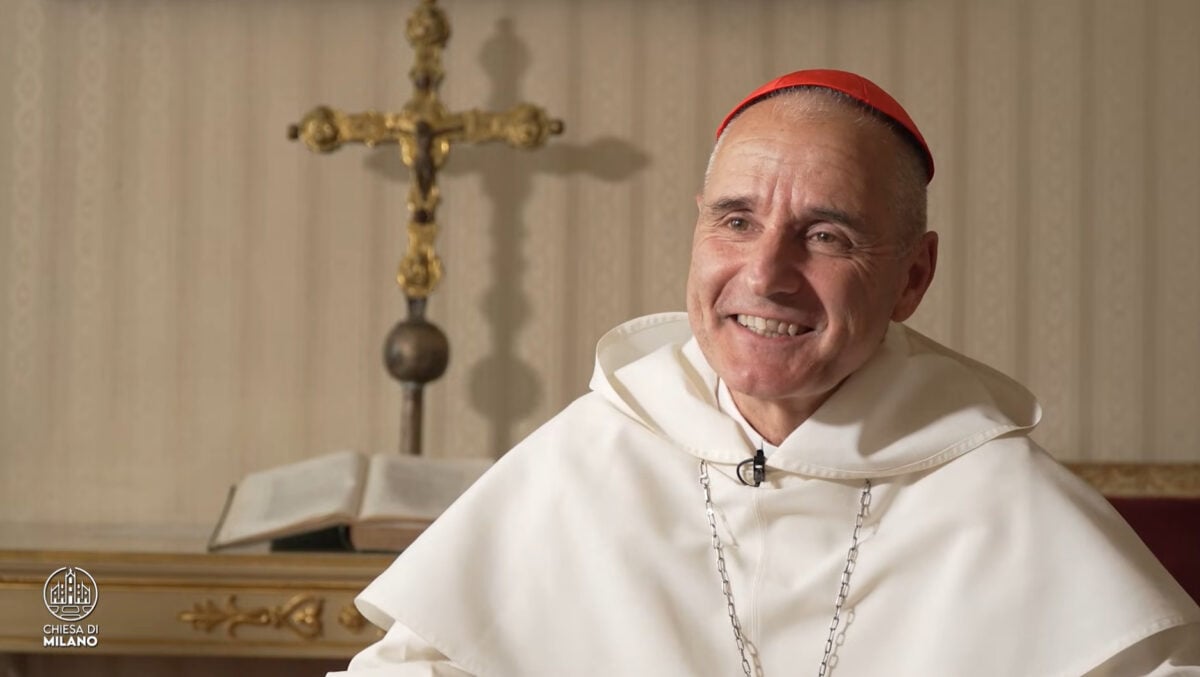
The current furor being expressed by conservatives and Traditionalists over Cardinal Jean-Paul Vesco’s remarks are stunning.
To act as if His Eminence — a title he is no doubt unworthy of holding — has said something outrageous or that it is at odds with the practices of the popes of the Vatican II Church with his recent claim that the Church is “not there to convert” is insulting.
Vesco is in the news because of comments he made during an interview in October. “We are the Church of this people,” he said. “Not a proselytizing Church, not a Church that is there to convert, but a Church that aspires to be one of the components of this people.”
Vesco serves as the Archbishop of Algiers. He also commented that, “Christians should approach other religions through fraternity rather than seeking conversions.”
Instead of acting shocked by these remarks, Integrity co-founder Stephen Kokx recognized that they are entirely consistent with the Conciliar Church’s teachings, practices, and officials statements on inter-religious affairs.
“The Cardinal is simply stating the practical effect of the false ecumenism promoted by Paul VI, John Paul, Benedict, etc.” he pointed out on X.
But Kokx’s response was a minority one. Not only did Bishop Robert Barron express outrage over Vesco’s remarks, so did EWTN’s Raymond Arroyo, Robert Royal, and Fr. Gerald Murray. Philip Lawler of Catholic Culture and scores of other semi-trad and conservative influencers did as well. But why? What Vesco said has been the implicit message imparted by the authorities who promote the Vatican II religion for decades.
What did the Second Vatican Council teach?
Unitatis Redintegratio (§4) explicitly states that “the term ‘ecumenical movement’ indicates the initiatives and activities planned and undertaken, according to the various needs of the Church and as opportunities offer, to promote Christian unity.”
But of course, according to the Vatican II religion, “Christian unity” does not mean a “return” of wayward souls that are lost in false sects coming back to the true faith. It simply means that Protestants, Orthodox, and Catholics will agree to disagree on fundamental theological points while forging a false unity in other areas. In other words, no conversion involved.
Unitatis Redintegratio confirms this in not so many words: “every effort [must be made] to avoid expressions, judgments and actions which do not represent the condition of our separated brethren with truth and fairness and so make mutual relations with them more difficult.”
Post-conciliar churchmen affirm opposition to conversion efforts
In 1966, the future Benedict XVI, Joseph Ratzinger, seized upon the implications found in Unitatis Redintegratio.
In his book “Theological Highlights of Vatican II,” he erroneously declared that “a basic unity … must replace the idea of conversion, even though conversion retains its meaningfulness for those in conscience motivated to seek it.”
The Dispatch
He practiced what he preached when, years later, Sigrid Spath, a German translator in Rome who worked for him while he was a cardinal, wanted to convert from Lutheranism. As pointed out by Rev. Nicolás E. Despósito on X this week, Ratzinger urged her not to, telling her that she would serve both sides better by remaining Protestant. “She followed his advice and stayed a Lutheran until her death,” Despósito noted.
Liberal Jesuit theologian Fr. Avery Dulles also threw cold water on conversion efforts. In the 1970s, he correctly argued that “the Council implicitly taught that the united church of the future will not come about by a capitulation of the other churches and their absorption into Roman Catholicism.”
How is this really any different from what Cardinal Vesco has said?
Cardinal Richard Cushing of Boston (1895–1970) gave the game away when, in a 1963 book titled “Twelve Council Fathers,” he admitted, “we are not trying to make converts.”
This was confirmed two decades later by John Paul II, whose indifference to converting non-Catholics was demonstrated by his multiple Assisi gatherings, beginning in 1986. The implicit, if not explicit, message sent by John Paul — which was noted at the time by SSPX founder Archbishop Marcel Lefebvre — was that missionary work aimed at bringing non-Catholics into the sheepfold was now a thing of the past.
24 hours left: Help Integrity raise the remaining $3,600 needed for our Fall fundraiser!
One of the clearest examples of how this anti-Great Commission approach became entrenched in the Church can be found in the influential 1994 declaration Evangelicals and Catholics Together.
Although it is not an official ecclesiastical document, it was supported by prominent Catholic and Protestant figures in the United States, including Novus Ordo “deacon” Keith Fournier, author Michael Novak, George Weigel, the aforementioned Avery Dulles, S.J., and popular scholar Peter Kreeft.
Among other things, the declaration explicitly called upon “Christians” to refrain from recruiting members of other Christian communities, arguing that “it is neither theologically legitimate nor a prudent use of resources for one Christian community to proselytize among active adherents of another Christian community.”
Not content to contradict Christ’s words to go forth and teach the Gospel, the syncretistic document went further, blasphemously declaring that “we condemn the practice of recruiting people from another community for purposes of denominational or institutional aggrandizement.” Imagine what St. Paul would have to say about these warnings against “institutional aggrandizement”
Ratzinger continued the program when he wore the white papal vestments. In 2012, he declared that “the Week of Prayer for Christian Unity is in itself one of the most effective expressions of the impetus the Second Vatican Council gave to the search for full communion among all Christ’s disciples.” Nary a word was said about “converting” to the Catholic religion.
Francis galvanized the deplorable direction taken by his predecessors when, in 2016, he declared “unity is not absorption. Christian unity does not imply an ecumenism ‘in reverse,’ by which some might deny their own history of faith; nor does it tolerate proselytism, which is, rather, a poison for the journey of ecumenism.”
In other words, a full decade before Cardinal Vesco characterized proselytism as “poison,” Francis had already used virtually the same language, proving that Vesco is merely a loyal son of the Revolution, not an innovator.
For decades, the conciliar hierarchy has militantly discouraged efforts to persuade members of other religious communities to become Catholics for fear of jeopardizing ecumenical relationships. Vesco’s only “sin” is that he has expressed this entrenched mentality with honest bluntness. The indignation surrounding Vesco’s remarks amounts to selective outrage. He is not the disease but a symptom of it. The sooner conservative and semi-trad influencers recognize this, the better.