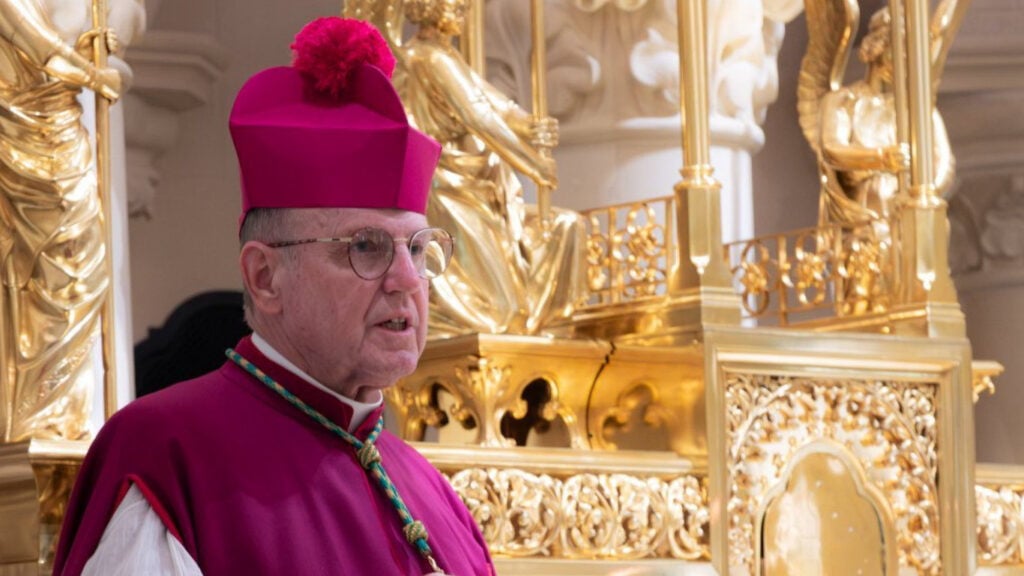
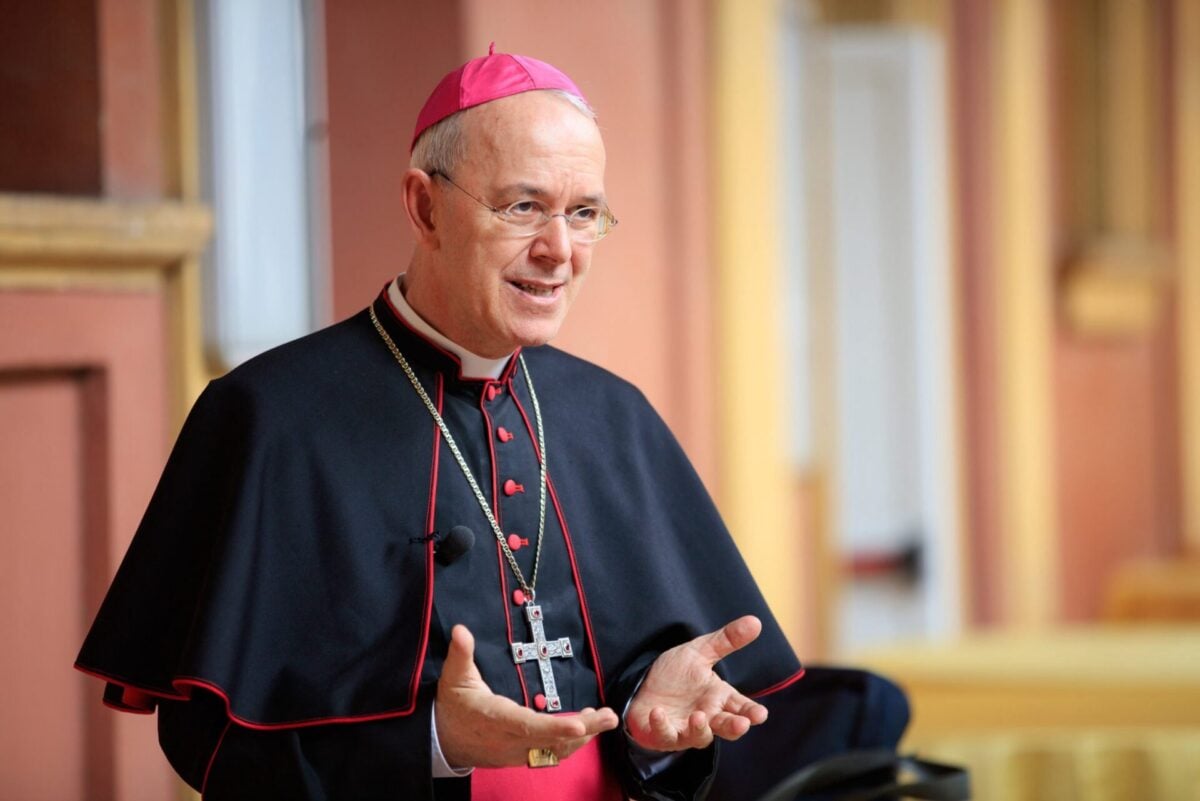
Bishop Athanasius Schneider, auxiliary bishop in Kazakhstan, continues to espouse an ill-founded and systematic “theology of resistance.”
In an interview with Ad Vaticanum during last month’s Summorum Pontificum pilgrimage, His Excellency made claims that are inapplicable to the current situation.
During his conversation with reporter Niwa Limbu, Schneider called the Society of St. Pius X “a providential work for the Church,” while declaring that “sedevacantism is in itself something completely wrong.” His arguments for this were surprisingly weak and easily debunked.
An extended vacancy is not impossible
First, Schneider argues that an extended vacancy of the Apostolic See, lasting 60 or 70 years, constitutes an “error” akin to the Protestant conception of an invisible Church.
The truth, however, is that the Church has never established a maximum duration for a papal interregnum. Nor has it determined that adhering to an extended vacancy is in itself a heretical position. No solemn definition, in other words, has been put forward establishing that the Apostolic See cannot remain vacant beyond a prescribed number of years. Bishop Schneider’s argument on this subject is somewhat lazy and amounts to, “God could never allow this,” when, in fact, God can permit an extended vacancy for however long He wishes, provided the moral means to produce a pope remain.
Second, Schneider’s remarks confuse the visibility of the Church with the occupancy of the papal office. Again, the burden remains on His Excellency to demonstrate why a prolonged vacancy is incompatible with Catholic doctrine. S.D. Wright of The WM Review has spoken to Integrity co-founder Stephen Kokx on the distinction between the visibility of the Church and the office of the pope on previous podcasts.
Resisting Peter to his face?
Next, Schneider appeals to Galatians where St. Paul rebukes St. Peter. Schneider maintains that when the faith is endangered, the faithful possess “the right and even the duty to admonish the superiors,” including the highest ecclesiastical authority. However, St. Peter was not issuing false doctrine, much less in the exercise of his magisterium, but was instead giving bad example. St. Robert confirms this in his account of the incident saying: “this was not an error of preaching but of conduct … St. Peter did not ratify by some decree that they must Judaize, rather, he formally taught the contrary in Acts XV.” 1
Moreover, in St. Peter giving this bad example, many doctors of the Church — including Sts. Thomas, Augustine, Ambrose, and Cyprian — argue it was out of imprudence and only venially sinful. 2
Of course, Bishop Schneider tried to invoke St. Thomas Aquinas in support of his argument, but as the Angelic Doctor explained in the Summa Theologiae (II-II, q. 33, a. 4, ad 2), Peter was corrected because his behavior endangered the faith through scandal. It is therefore an atrocious overreach to read into this incident a justification for habitually resisting the doctrinal and disciplinary laws of the man whom Schneider acknowledges as Christ’s supreme Vicar on Earth but who deviates daily from the magisterium of all time.
Fourth, Bishop Schneider then proceeds to cite Honorius, Liberius, and John XXII as examples of popes who erred in doctrine. While is surely correct to say that John XXII erroneously preached that the blessed would not enjoy the beatific vision until the General Judgment, at the time he made his remarks, which were given in a single sermon, the question had not yet received the definitive judgement later provided by Benedict XII in Benedictus Deus (1336).
John XXII also did not impose his opinion on the faithful, meaning he did not exercise his magisterium, and even withdrew the errant opinion before his death. This is not the same for the post-Vatican II “popes” who positively enforce their theologically erroneous beliefs and Modernist ideology onto clergy and laity in their catechisms, encyclical letters, public speeches, motu proprios, and the like. Bishop Schneider, therefore, is attempting to construct a defense of his position by manufacturing a precedent from an individual pope’s disputed and private sermons. To use John XXII in this way is such a spectacular act of mental gymnastics that His Excellency Bishop Schneider must be careful not to tear a muscle.
The Dispatch
While an in-depth analysis of the problems with Bishop Schneider’s use of Honorius and Liberius as examples is beyond the scope of this article due to space limitation, several points should be kept in mind.
The case of Honorius is not nearly as straightforward as the bishop would like his followers to believe. Catholic theologians have expressed differing views on whether Honorius was actually a heretic and in what sense or, or, as others maintain, his offense was rather negligence in repressing heresy. The case of Liberius, which those who think like Schneider also frequently cite, is hardly black and white either. This pope acted under severe imperial pressure, making it difficult to determine whether he was an obstinate, formal heretic. There is no proof that he formally embraced Arianism, nor did he ever impose it upon the universal Church.
What is Catholic teaching on the papacy?
Elsewhere in the interview, Schneider declared that “absolute obedience” belongs to God alone and warned that demanding it towards a pope “would be an error even a heresy.”
But Pius IX, in Quartus Supra (1873), rejected the argument that resistance to papal disciplinary legislation was permissible simply because the matter concerned discipline rather than dogma. In paragraph 12, he wrote the following:
But the neo-schismatics say that it was not a case of doctrine but of discipline, so the name and prerogatives of Catholics cannot be denied to those who object. Our Constitution Reversurus, published on July 12, 1867, answers this objection. We do not doubt that you know well how vain and worthless this evasion is. For the Catholic Church has always regarded as schismatic those who obstinately oppose the lawful prelates of the Church and in particular, the chief shepherd of all.
In paragraph 13, Pius IX condemned the notion that communion with Rome requires unity in faith without submission to the Apostolic See in disciplinary matters.
Pre-Vatican II teaching holds that Catholics owe the Roman Pontiff in the exercise of his office theological submission in matters concerning faith, morals, discipline, and government. This is completely irreconcilable with His Excellency’s model of organized and systematic resistance to the men whom he claims enjoy Christ’s authority.
Support the Counter-Revolution: Help Integrity reach its Fall fundraising goal!
Schneider’s final red herring concerning sedevacantism comes when he identifies its “deepest theological error” as the tendency to “absolutize(s) the papal authority in the sense that the pope is always infallible,” insisting that infallibility is “very rare and very … limited.” He went on: “The approval of the pope of some ambiguous statements of Vatican II, and after, is, for the sedevacantists, a proof that this cannot be a pope.”
Even though some who maintain a vacancy fail to adequately discern when the papal magisterium is engaged, or fail to distinguish between the supreme and ordinary exercise of papal authority, no one who holds the Seat of St. Peter is currently vacant believes the pope is “always infallible.” Moreover, Vatican II did not just approve “ambiguous” statements. There was a real rupture with the Church’s magisterial teachings against Biblical Modernism, Liberalism, and especially Ecumenism that took place. Bishop Schneider forgets that indefectibility, and not the claim that every single papal teaching is infallible, is the real issue at play.
Bishop Schneider still needs to explain how a legitimate ecclesiastical authority can habitually promote dissident teachings, bind the faithful to them through punitive measures, and routinely enforce practices contrary to divine revelation without undermining the Church’s claim of indefectibility. Sadly, by failing to do this in his Ad Vaticanum interview, His Excellency comes across as uninformed, clichéd, and, in more than one instance, unfamiliar with Catholic teaching.
- Fr. Damien Duterte, ICR, The Errors of the “Recognize and Resist” System, Chapter XI, no. 86. ↩︎
- Ibid., 87. ↩︎