
The UFO and space alien conspiracy is in full swing now that President Trump has released files supposedly documenting what the government has rebranded as unidentified anomalous phenomena (UAP). Perhaps not surprisingly, there is a strong contingent of mainstream Catholics and Catholic media outlets promoting the existence of aliens.
For a thorough discussion as to why Catholics cannot believe in space aliens, check out a recent Daniel O’Connor video where he explains the impossibility of intelligent life originating on other planets. But that’s not the purpose of this article.
What piqued my interest was the fascination certain professed Catholics have with insisting that space aliens could exist, including those with important positions in the Vatican. Now, why would the discovery of space aliens be important to the Modernist Vatican II revolutionary agenda?
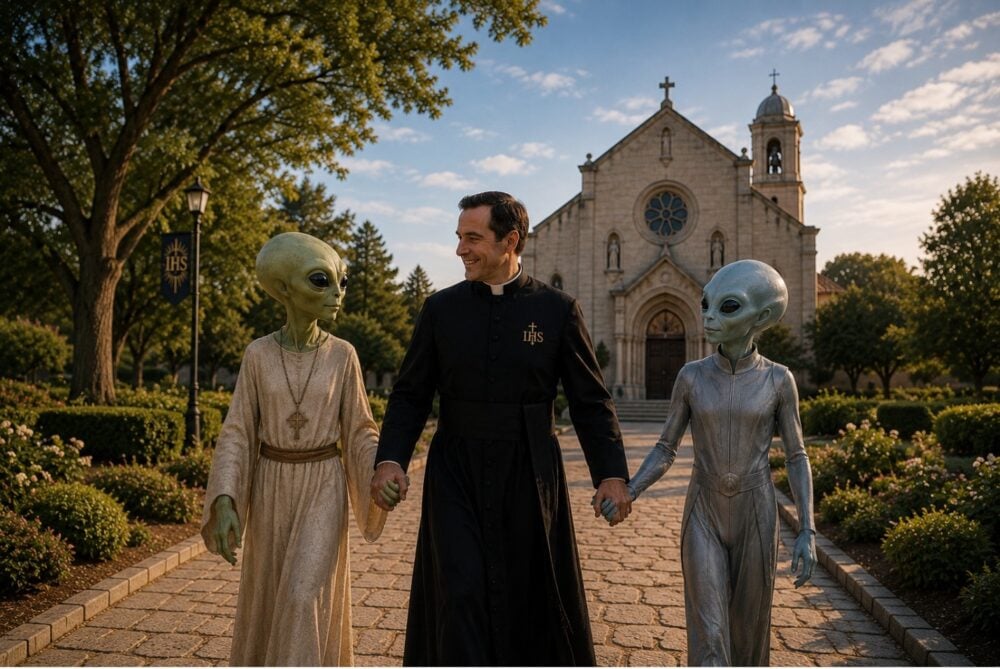
According to OSV News, Brother Guy Consolmagno, a Jesuit, served as the director of the Vatican Observatory from 2015 to 2025. He indicated that he would be happy to baptize a space alien, but only if the alien asked to be baptized.
The current observatory director, Jesuit Father Richard D’Souza, has stated that space aliens would be considered “children of God.”
Yet another Jesuit, Father Robert Spitzer, president of the Magis Center, told Lila Rose in 2025 that he thought ensouled aliens “would have a soul just like us, then they would be made in the image and likeness of God.”
Lastly, according to the late Dr. Paul Thigpen, when Pope John Paul II was asked, “Holy Father, are there any aliens?” the reply was, “Always remember: They are children of God as we are.”
So, what is going on here? Why do certain Catholics seem to want space aliens to exist? And even if they do exist, why must the aliens be “children of God” just like us?
On the “People of God” and the “Image and Likeness of God”
I contend that Modernists not only want but also need space aliens to exist to justify their own theological position and revolutionary agenda formalized at Vatican II.
The key phrases in the conciliar documents are “People of God” and references to man being made in the “image of God.”
We learn in Gaudium et Spes that man is created in the image and likeness of God. Of course, this is true. But what does this mean for the Modernist? While Tradition teaches that man is endowed with intelligence, free will, and self-movement, Vatican II says that this means man possesses a certain special dignity, particularly a dignity that manifests itself in the exercise of his liberty. Without any regard for the sinful nature of man, this concept of human dignity raises man to an almost divine nature. This was on display in Francis’ 2024 declaration Dignitas Infinita.
The next key is Vatican II’s Dogmatic Constitution on the Church, Lumen Gentium. Chapter II of Lumen Gentium is titled “On the People of God.” In that section, the Council reminds us that “those who have not yet received the Gospel are related in various ways to the people of God.” According to the Council, this includes Jews and Muslims because “the plan of salvation also includes those who acknowledge the Creator.”
Most significantly, Lumen Gentium teaches us that, “those also can attain to salvation who through no fault of their own do not know the Gospel of Christ or His Church, yet sincerely seek God and moved by grace strive by their deeds to do His will as it is known to them through the dictates of conscience.”
In summary, if extraterrestrial beings are intelligent and created in the image and likeness of God, then, like humans, they also possess an inherent dignity simply because of their creation, independent of their acceptance of Jesus Christ. Furthermore, as part of the “People of God,” they can attain salvation outside the confines of the Catholic Church.
With this in mind, the statements by Father D’Souza that aliens would be considered “children of God,” and Fr. Spitzer’s claim that they could be “made in the image of God,” begin to take on a whole new light from a Vatican II perspective.
Teilhard de Chardin and Karl Rahner examined
Digging a little deeper, we also need to take a look at Jesuits Pierre Teilhard de Chardin and Karl Rahner.
Teilhard was an evolutionist who held that human beings emerged in different parts of the world at different times. In his view, humanity continues to evolve towards the ultimate Omega Point. As this process unfolds, man will eventually become a kind of superman, or ideal man. He called this salvific process “hominization,” meaning the union of all people in a universal brotherhood moving toward a future, collective salvation.
Rahner, on the other hand, was more theological than de Chardin. He insisted that man must draw religion out of himself. Because Christ united Himself to every man at the Incarnation, “anyone who accepts his humanity fully, and all the more so, of course, the humanity of others, has accepted the Son of Man because in Him God has accepted man.”
Therefore, for Rahner, “the People of God” is not a “ghetto church” or an exclusive community of candidates for salvation. Rather, every man is able to be saved and “any piety in sincere conformity with conscience is able to save, upheld by grace, and is in a certain sense already Christian, but anonymously.”
This famous “anonymous Christian” concept opened the door not only for those who never encountered the Gospel but for those who rejected Christ — even atheists. This is because, according to Rahner, the conscience is divided into parts, one of which is open to receiving grace even if one consciously rejects God.
The Dispatch
This is why Lumen Gentium, which was influenced by Rahner, can say “those who have not yet received the Gospel are related in various ways to the people of God.” There is no objective Truth that one must accept to be saved. Salvation lies within each individual person, powered by God’s grace, even if the person is totally unaware of it.
Defining the “People of God” so broadly as Vatican II is wont to do, therefore, effectively renders the need to become Roman Catholic superfluous. Anyone, by virtue of their creation, can be saved because of the grace found within each individual.
What about Original Sin?
This Teilhardian/Rahnerian system of an ever-evolving, grace-infused humanity moving toward a type of perfection at the end of time, where union with all humanity and God is achieved, has significant consequences for the Catholic doctrines of creation and Original Sin.
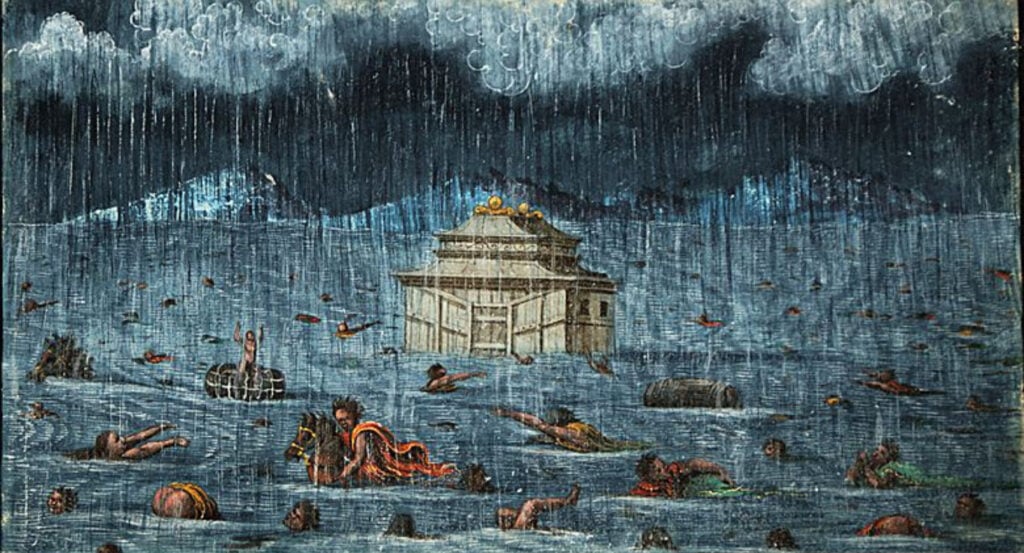
Among the many problems with this outlook is that any suggestion of polygenism — the theory that humanity evolved from two or more distinct ancestral groups — would render the doctrine of Original Sin null and void. As Pope Pius XII taught in the 1950 encyclical, Humani Generis:
“For the faithful cannot embrace that opinion which maintains that either after Adam there existed on this earth true men who did not take their origin through natural generation from him as from the first parent of all, or that Adam represents a certain number of first parents. Now it is in no way apparent how such an opinion can be reconciled with that which the sources of revealed truth and the documents of the Teaching Authority of the Church propose with regard to original sin, which proceeds from a sin actually committed by an individual Adam and which, through generation, is passed on to all and is in everyone as his own.”
So, why does all this matter? The answer comes down to the minimization, if not the implicit rejection, of Original Sin. If all of mankind does not share Adam and Eve as their common ancestral parents, this opens the possibility that not all humans are subject to Original Sin. If the creation story itself is a myth or pure allegory, then Original Sin may not be a reality at all. This is important to the Modernist revolutionary for several reasons.
First, if there is no Original Sin, then man did not necessarily fall from his exalted state of grace shortly after his creation. Recall Vatican II’s emphasis on human dignity as the basis for man’s liberty as discussed above. This notion of human dignity is so extreme that, under John Paul II, Francis, and now Leo, it has been referred to as an “infinite dignity.” From this, Christ did not need to die on the Cross to satisfy a debt but simply offered Himself out of love for manking. This is the “paschal mystery” theology that took over the Synodal Church and contributed to the invention of the Novus Ordo Mass after Vatican II, which effectively removes Christ’s sacrifice and satisfaction for sin from the Mass.
Second, without Original Sin, baptism is no longer necessary for salvation, and becoming a Catholic is no longer essential. This idea appears in Vatican II’s ecumenical teachings. Instead of baptizing for the salvation of souls, baptism simply becomes a sign that God has already pardoned us. In practice, sacramental grace becomes unnecessary because each person is seen as already possessing enough grace to make salvation possible.
Third, if salvation is possible without the sacraments, then the entire concept of magisterial teaching on faith and morals is called into question. A visible, authoritative Church hierarchy charged with preserving that Tradition also becomes unnecessary. What matters now, under the new Modernist paradigm, is individual liberty and freedom of conscience; not adhering to a “rigid” set of doctrines and restrictions on moral behavior imposed by a hierarchical Church.
The consequences of this implicit denial of the dogma of Original Sin undermine all of Christianity, especially the role of Jesus Christ in our redemption. I contend, however, that the present-day Modernists are mostly concerned with changing the Church’s teachings on sexual morality, and if truth and grace can be found within the heart and experience of each human being outside the strict confines of divine revelation in Holy Scripture and Sacred Tradition, then the shackles of pre-conciliar Catholic sexual morality can be re-envisioned.
The role of aliens in the Modernist worldview
This brings us back to the role of space aliens in the Modernist mindset. In short, the discovery of intelligent life originating from another planet would strike a mortal blow to the dogma of Original Sin and, consequently, justify Vatican II’s novel teachings on ecumenism and religious liberty. And most convenient for the Modernist seeking to accommodate Church teaching with the mores of the world, it would allow man to exercise his freedom in ways previously never thought possible under a traditional Catholic worldview.
With the promotion of evolutionary theories of creation, Modernists made a valiant effort to rid the Church of Original Sin and the need to conform to Church teachings on certain unpopular doctrines. Teilhard de Chardian began that effort in earnest, which eventually morphed into the more nuanced version of theistic evolution that many who subscribe to the Vatican II novelties also hold on to.
The discovery of space aliens would take this effort to the next level and fundamentally challenge traditional Catholic beliefs regarding sin, redemption, and the necessity of a visible Church in ways that even evolutionary theory could not. The discovery of space aliens would provide the undeniable proof that God permitted the existence of an entire race of material creatures, made in His own image and likeness, without Original Sin.
Certainly, Brother Consolmagno would have no problem baptizing a space alien because the space alien, like all those of infinite dignity, is already saved.
We as Catholics, however, know the only material creature ever conceived without Original Sin is the Blessed Virgin Mary. This is not a bug, but a feature for the Modernists. They know completing the Vatican II agenda requires undermining faith in Marian dogmas and devotions.
That is why such a new revelation would align quite well with the Modernists’ vision to transform the Church into a new, Synodal Church where values like liberty, equality, fraternity, personal conscience, and personal experience guide humanity toward its ultimate perfection and union with God.
Breaking the chains of Original Sin, Marian dogmas, hierarchy, bloody sacrifice, and sexual morality is the logical outcome of an invasion from space. Once the Carl Sagan’s of the world are proven correct, then the pre-conciliar popes and councils can finally and definitively be condemned to the trash bin of an intolerant, medieval history.
In this view, a new church — and even a new Pentecost — could emerge as humanity enters a new phase of reality no longer bound by a truth limited to traditional sources. The goal of a one-world religion is now transformed into a one cosmic religion.
Such ideas are completely antithetical to the Catholic faith, as demonstrated above, and we know, as faithful Catholics, that the existence of such extraterrestrial aliens is not possible.
But this will not stop the Modernists from planting the seeds of such possibilities in the hearts of millions to accomplish what the truth will not allow them to have. It is our duty to combat the space alien conspiracy, reject the possibility entirely, and condemn it to the trash bin of modernist liberal history before the Modernist revolution can ever take hold of it as its own.