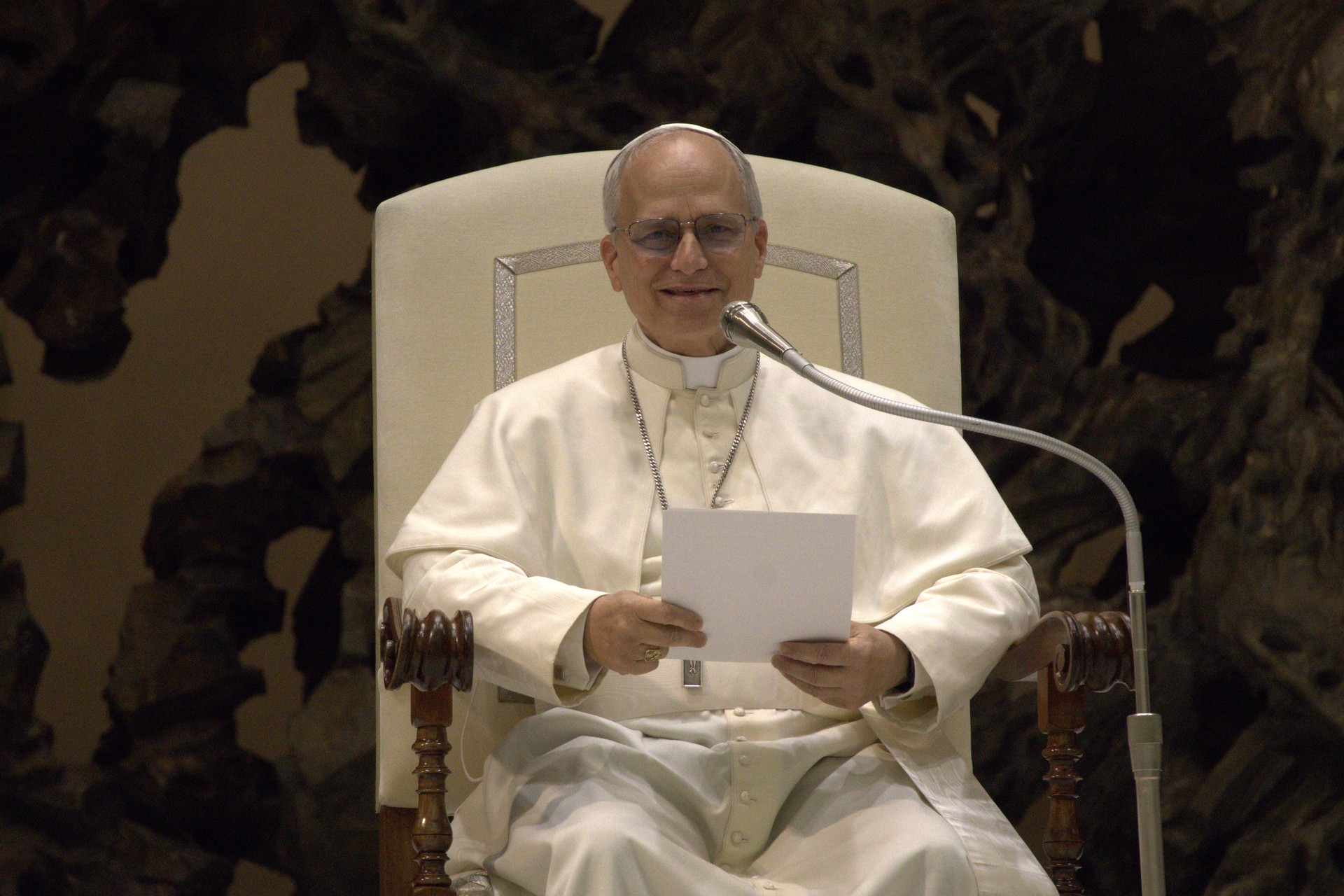
As part of his weekly catechism series on the Second Vatican Council, Leo XIV used his general audience this past Wednesday to praise Sacrosanctum Concilium.
Sacrosanctum Concilium (Latin for “This Sacred Council”) is the Council’s Constitution on the Sacred Liturgy. It was promulgated on December 4, 1963. For six decades, it has served as the foundational text of the destruction of Catholic worship through its encouragement of the “active participation” of the faithful “before all else.”
Leo’s remarks Wednesday centered on Sacrosanctum Concilium through a lens of “tradition” and “development.” True to form, he alleged that the Council was guided by a harmless “reform and promotion of the liturgy.” In reality, it was the culmination of a decades-long war waged by Modernists before the 1960s to turn the Mass into a tool for ecumenism.
It should be noted right off the bat that the lived experience of the Council’s “reforms” has been anything but “traditional.” Rather, it has been the widespread replacement of the Roman Rite with a new rite that represents a new religion. To claim that there has been an “organic development” is absurd. As Archbishop Marcel Lefebvre once said, “this new Mass is a symbol, an expression, an image of a new faith, a Modernist faith.”
During his remarks, Leo insulted Catholics who are well-versed in Church history. Among other things, he had the gall to cite Pope Pius XII’s 1947 document Mediator Dei to justify the liturgical changes. This is a common post-conciliar trick: retroactively recruit pre-conciliar authorities to give their imprimatur to the conciliar revolution.
In truth, a careful reading of Mediator Dei shows that Pius XII explicitly condemned liturgical experimentation and unauthorized innovations, stressing fidelity to received liturgical forms instead. While Pius certainly acknowledged legitimate developments could take place, he rebuked “exaggerated and senseless antiquarianism,” which was essentially the goal of the “reformers,” who cloaked their arguments in a desire to return to the “early Church.”
Unlike Paul VI and the rest of the post-conciliar papal claimants, Pius XII would never have allowed the structural rape and desecration of the Roman Rite that occurred in the decades after the Council.
Alleging continuity where there is none
The Dispatch
Leo proceeds to cite Sacrosanctum Concilium on how “sound tradition may be retained, and yet the way remains open to legitimate progress.” He then recalls that Vatican II affirmed certain elements of the liturgy can never be altered because “they are divinely instituted.” He reinforces this with a citation from an address made by fellow modernist Benedict XVI in 2011.
This ambiguous phraseology is presented as a stable hermeneutical key by Leo, when in fact it is anything but that. Indeed, what has been labelled “mutable” in the post-conciliar years actually includes elements that are not merely disciplinary but doctrinally expressive, such as the offertory prayers, the Roman Canon’s exclusive centrality, and the definition of the priest as a “sacrificer” instead of a mere “presider.” The result has been an overt reduction in sacrificial language, the introduction of multiple prayer options, and a general weakening of the vertical orientation of the Mass itself.
If lex orandi, lex credendi is to mean anything, then the Novus Ordo Missae can only be seen as a profound rupture in every way with the Mass that was codified at the Council of Trent.
Paying lip service to orthodoxy
Further along, Leo explains that changes must “grow organically from forms already existing.” This is laughable, as the historical record following the Council clearly demonstrates liturgical forms used at that time were characterized by rapid implementation, experimental practices, and widespread suppression of the traditional Mass.
Probably the greatest are-you-kidding-me moment came when Leo appealed for priests to “uphold that respect for the texts and regulations of the liturgy.” Too late for that. But moreover, does Leo even really mean that? Not a day goes by without reports of flagrant liturgical abuses taking place. And yet, hardly any disciplinary action is taken against the offenders. The reason is simple: liturgical abuse is not an unfortunate side-effect of the liturgical revolution — as conservatives and Trad. Inc. would like you to believe — it is a build-in feature.
Leo’s repeated invocation of “continuity” only functions as a stabilizing narrative designed to reconcile irreconcilable developments. His appeal is empty and rhetorical rather than substantive. For him and the other ransackers of the Catholic Church, “development” is the carpet under which they conveniently sweep their rupture, rebellion, and revolution.
Ultimately, true continuity cannot include the Synodal Church’s inversion of liturgical theology, the introduction of ecumenical ambiguity, or the practical dismantling of the Roman Rite as historically constituted. The Novus Ordo Missae is a vehicle for all of these cancers. Leo’s catechesis on Wednesday once again exposed the conciliar attempt to preserve the language of Catholic tradition while advancing a new religion with a new liturgy, a new ecclesiology, and new doctrines.