
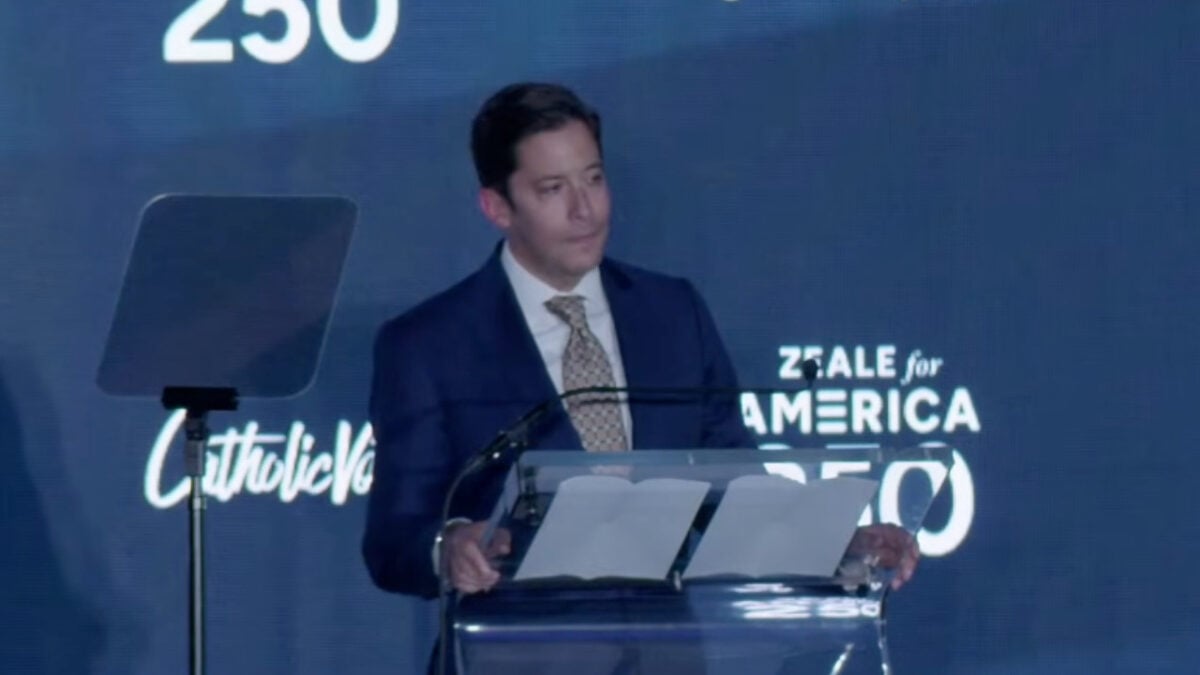
Conservative influencer Michael Knowles’ speech at a CatholicVote event earlier this month was designed to convince American Catholics into erroneously believing there is nothing incompatible with the Church’s teachings and the founding of the United States.
During his remarks, Knowles drew attention to the fact that “the conservative movement in America has been … disproportionately led and influenced by Catholics.” He also noted that the US government is currently being “run disproportionately by Catholics.”
While referencing quotes from prominent 19th century American Catholic thinker Orestes Brownson (1803–1876) and French Liberal Catholic author Alexis de Tocqueville (1805–1859), Knowles argued that “America is much more Catholic today than it was in 1607 or 1620 or 1776.”
“What sort of revolution makes a nation more Catholic?” he wryly asked.
The most egregious part of Knowles’ remarks came when he alleged that the Constitution “was designed to promote Catholicism.” He supported that claim by arguing that it was written by “conservative” men who were inspired — at least in part — by the ideas of St. Thomas Aquinas and St. Robert Bellarmine.
Designed to tranquilize
Knowles’ speech is part of a larger, decades-long effort aimed at ensuring Catholics in the United States do not reject the revolutionary principles that undergird their country.
The emergence of the post-liberal and integralist schools of thought in recent years have thrown a wrench into those plans. While not explicitly calling for the restoration of the Kingship of Christ, prominent persons in those movements are exposing at least some of the inherent flaws of the liberal project and are advocating for various degrees of change to the status quo.
US Senator Ted Cruz is perhaps the most high-profile politician to push back against integralism. In an X post earlier this year, he promoted an essay warning about Traditionalists who are seeking to dissolve the Catholic, Protestant, and Jewish alliance on the political right in order to establish a “theocratic monarchy.”
Knowles’ remarks are cloaked in friendlier terms than Cruz’s attack but they are designed to achieve the same end. In other words, they are meant to serve as a tranquilizer so Catholics will 1) not seek to fundamentally disrupt the prevailing conservative coalition 2) not strive to make America a confessionally Catholic state and 3) continue to remain good, obedient Republicans.
The Founders were not ‘conservative’
Throughout his speech, Knowles obfuscates historical truths, sidesteps inconvenient facts, and ignores quotations made by individuals he himself cites.
For instance, Knowles references Anglican politician Edmund Burke (1729–1797) to argue that the “colonists sought not to overthrow but to preserve their traditions, culture, and rights as Englishmen.” The “essentially conservative character of their political project gave them common cause with Catholics.”
This is far from the truth.
Integrity co-founder Carol Robinson once recalled that the Founding Fathers “were not just Protestants, but … Protestants who could not get along with other Protestants.” 1
A Hessian captain named John Ewald who fought for the British wrote to a friend in 1778 explaining that it was “not an American Revolution” but “an Irish-Scotch Presbyterian Rebellion.”
The supposedly “conservative” colonists whom Knowles claims had “common cause” with Catholics were actually the heirs of Whiggism. They were seeking to maintain the political arrangement that emerged after the woefully misnamed Glorious Revolution in 1688, which saw Catholic King James II driven from the throne by Protestant provocateurs.
Regrettably, this was the last time a Catholic ruler was sovereign of Great Britain.
The Founders expressed their satisfaction with that uprising nearly one hundred years later. In 1765, more than two dozen colonists attended the Stamp Act Congress to petition King George III. They sent him a letter acknowledging that they were “sincerely devoted” and “inviolably attached to the present happy establishment of the Protestant succession.”
In his remarks, Knowles cites the aforementioned Orestes Brownson. Notably, he did not provide a quotation from Brownson after he had reached his most mature thought on Catholicism and America. Nor did he share what Brownson had to say about what transpired in the 1680s.
“Modern civilization is substantially that of the gentile world before its conversion to Christianity. The ‘glorious reformation’ of the sixteenth century was an apostasy from Christ … a return to pure heathenism,” Brownson explained. 2
Either Knowles is aware of this statement and purposefully omits it because he knows it will destroy his narrative, or he is woefully ignorant of the fact that the colonists were striving to maintain the “traditions, culture, and rights” that emerged from an anti-Catholic rebellion that Brownson considered to be “an apostasy from Christ.” Whatever the case might be, Knowles is evading historical realities to promote an agenda.
This is to say nothing of the fact that the “conservatives” of the late 17th century in Britain were the Tories — and later the Jacobites — who were loyal to the crown.
Sons of the Enlightenment
Elsewhere in his speech, Knowles alleges that the Constitution “was designed to promote Catholicism.” He also asks: “what sort of revolution makes a nation more Catholic?”
Both of these comments deserve attention.
The US and state constitutions written in the late 1700s borrowed heavily from John Locke. They spoke of natural rights, the social contract, individual liberty, political equality, limited government, and freedom of religion and speech. Far from being neutral, these assertions rest on philosophical, moral, and metaphysical claims that are thoroughly rationalist, liberal, and steadfastly anti-Catholic.
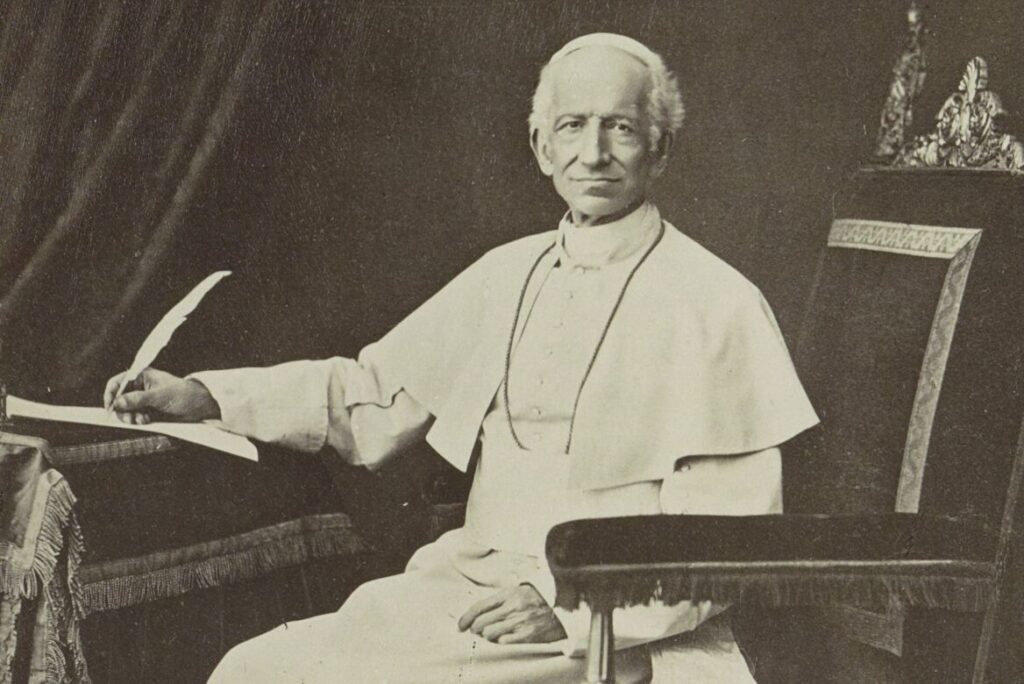
Indeed, Pope Leo XIII denounced in his 1881 encyclical Diuturnum “those who believe civil society to have risen from the free consent of men.” He also rebuked those who “say that all power comes from the people.”
The Founders not only said such things, they boasted about their contempt for the Church of Christ.
The Catholic religion is one of the “two greatest systems of tyranny” ever created, John Adams blasphemously remarked. The “Romish clergy” have set themselves up “for the aggrandizement of their own order.”
“History, I believe, furnishes no example of a priest-ridden people maintaining a free civil government,” Thomas Jefferson said.
The Founders were clearly set on creating a Novus Ordo Seclorum over and against the Catholic World Order of the Middle Ages. This was apparent in the documents they wrote but also in the philosophers they drew from and the laws they enacted.
Knowles cleverly downplays this by admitting that some of the Founders had “personal opinions” that were “anti-Catholic.” He also spoke about how the “revolutions” that took place in Europe in the 1840s led to the loss of the papal states. But he dodges mentioning the Protestant and utterly anti-Catholic nature of both the Glorious Revolution and the American Revolution. He is also noticeably silent on the link between the American and the French Revolution.
America’s transformative effect on Catholics
Knowles’ claim that the Constitution has resulted in the United States being more Catholic is misleading.
Just because there are “more” Catholics in politics today than in centuries past does not mean that America has become “more Catholic.” It simply means that a greater number of persons who identify as Catholic hold prominent positions in public life.
At present, there are many pro-abortion Democrats who claim to be Catholic. There are also many socially liberal Republicans who say the same. Meanwhile, contraception, abortion, sodomy, and homosexual “marriage” are all legal in America, with many Catholics supporting them.
There are countless other sins that greatly offend God that are permitted in the US, including the use of the Lord’s name in vain in film. Wouldn’t a country that is supposedly “more Catholic” than ever before have laws that prohibit these sins? Where are the good fruits of this supposedly Catholic America Knowles speaks about?
The Dispatch
The simple fact is that America has not become more Catholic over the past 250 years. What has actually occurred is that Catholics have become more American, which is to say they have become more liberal.
Knowles makes note of the fact that William F. Buckley Jr., Richard John Neuhaus, and other prominent Catholics have “led and influenced” the “conservative movement.” This does not help his cause. Conservatives do not seek the restoration of the United States to Jesus Christ. They embrace the principles of classical liberalism and the modern world. They are Americans first and Catholics second.
Orestes Brownson wrote about the harmful effect that living in the United States was having on Catholics in the 19th century. In a letter he sent to Fr. Isaac Hecker, the founder of the Paulist Order, in 1870, Brownson warned that “Catholics as well as others imbibe the spirit of the country, imbibe from infancy the spirit of independence, freedom from all restraint, unbounded license. So far are we from converting the country, we cannot hold our own.”
This is precisely what has occurred. Yet Knowles makes no mention of it.
Aside from the radical changes that resulted from Vatican II, the US Constitution is one of the primary reasons why Catholics in America have become liberals. Its Articles have proselytized them into thinking that freedom means being liberated from all constraints, that everyone has a right to say and do whatever they want so long as nobody else is harmed, and that the Church and State should be separated. Yet Pope Gregory XVI, Pius IX, and many other popes during the 19th and early 20th centuries condemned these positions.
The Americanist affair
In the 1890s, Pope Leo XIII was forced to settle a dispute between clergy in the United States. What transpired is relevant to what Knowles said in his speech about the growth of Catholicism in America.
Drawing inspiration from dissident Liberal Catholics in France in the early 1800s, James Cardinal Gibbons, Archbishop John Ireland, Fr. Dennis O’Connell, Fr. John Keane, and others maintained that Catholics in America should not have any qualms about supporting the Constitution. They praised democracy, applauded America’s civil liberties, and called for closer relations with non-Catholics, all while distancing themselves from European Catholicism and what the popes were teaching at the time.
They “had a talent for warmly applauding Rome’s words and then doing as they pleased,” former Archbishop of Philadelphia Charles Chaput said of their unruly behavior.
Meanwhile, French priest Fr. Charles Maignen, Archbishop Michael Corrigan of New York, Bishop Bernard McQuaid of Rochester, and other priests — many of whom were German — opposed their efforts.
“We cannot call our own form of government religious in any sense. There is a bare recognition of God and also an implicit recognition of many precepts of the natural law, still, we cannot call it a Christian government in the true sense of the word,” Fr. Thomas Scott Preston, the Vicar General of the Archdiocese of New York under Corrigan, said in 1891.
“The best form of government is that where all believe in the true religion, or where the government supports the Church … in leading men to their salvation.” 3
In 1895, Pope Leo published a letter to the American hierarchy titled Longinqua Oceani. While praising the US Constitution in a limited sense, he reminded his readers of its fatal flaw.
“Thanks are due to the equity of the laws which are obtained in America.” The Church in the US is “unopposed by the Constitution” and is “fettered by no hostile legislation.” At the same time, “it would be very erroneous to draw the conclusion that in America is to be sought the type of the most desirable status of the Church, or that it would be universally lawful or expedient for State and Church to be, as in America, dissevered and divorced.”
The “prosperous growth” of the faith in America, he continued, is not due to the Constitution “but [is] by all means to be attributed to the fecundity with which God has endowed His Church.” The Church “would bring forth more abundant fruits if, in addition to liberty, she enjoyed the favor of the laws and the patronage of the public authority.”
Leo’s encyclical, as well as Fr. Scott’s remarks, are nothing more than the reaffirmation of the integralist position on the duties of the state toward the true religion that Knowles’ longtime ally Ted Cruz attacked earlier this year.
Their words also serve as a firm reminder that the political arrangement in the US cannot be understood to be “Christian” in any real sense of the term. It is therefore inappropriate for Knowles to suggest the Founding and the US Constitution were somehow crypto-Catholic in inspiration and/or directly so.
Unfaithful to St. Thomas and his commentators
Near the end of his remarks, Knowles speaks of St. Thomas Aquinas and how the Founders were indirectly putting into practice his political philosophy. He has made this argument before.
During an event at the Heritage Foundation in Washington D.C. in March, Knowles claimed that the Founders established a “mixed regime” that was “closely in accord” with what St. Thomas had called for. He repeated this at the CatholicVote event, noting that they instituted a regal executive, an aristocratic senate, and a democratic House of Representatives.
While St. Thomas did undoubtedly regard a “mixed regime” as ideal, his conception of it differed fundamentally from that of the Founders.
For St. Thomas, the mixed regime took into account the consequences of Original Sin, its effects, and sanctifying grace. It was not grounded in Lockean political theory and its erroneous understanding of man.
In the Lockean model, legislative power belongs to the people, not the ruler (the President). Also, the judiciary (the Supreme Court) stands independent of both the ruler and the legislature (Congress). But in De Regno, the Angelic Doctor — following the wisdom of Aristotle — says: “every natural governance is governed by one” (emphasis added).
Faithful interpreters of St. Thomas understood him to be teaching something quite different from the Founders. Cardinal Tommaso Zigliara, a 19th century Dominican master, explained that in “St. Thomas’s tempered monarchy the political power is not divided: the King truly reigns and not merely governs; and the princes who are subject to him do not enjoy legislative power, even though the king, only once their counsel has been sought and obtained, may bring forward laws in matters of greater moment; whereas in a representative government, the Chamber is properly the legislator, not the King, who merely ratifies the laws and commits them to execution.”
Cardinal Zigliara was emphatic on this point: the true, Thomistic order maintains that “The threefold civil power flows from a single principle … and resides wholly in the king,” which is to say legislative, executive, and judicial power.
This is the exact opposite of the American arrangement, in which the three powers are not merely distinguished but set against one another on purpose. As a consequence, the common good and social peace, which essentially depend on unity, are no longer achieved by design but only secured, if at all, by accident.
Adopting Montesquieu’s erroneous position
What Knowles does not seem to realize is that the American constitutional order derives, in part, not from St. Thomas but from Liberal Catholic French thinker Montesquieu (1689–1755), whose views on separation of powers Jesuit priest Father Luigi Taparelli (1793–1862) demonstrated were not only unsound but absurd.
“If it [Montesquieu’s theory]were true, all liberty would be dead, since a government is not possible where there are no concentrated powers, which is the second proposition that we have just criticized. Montesquieu assumes it implicitly, since without this supposition his whole system would fall to the ground; but this hypothesis is so contrary to the nature of society that the Author himself is forced to undermine it,” Taparelli has explained.
Colgate Professor Robert Kraynak, a Catholic, has also drawn attention to the “exaggerated” claims that “Catholic revisionists of the twentieth century” make when it comes to St. Thomas and the Founders.
“Catholic natural law is not primarily about natural rights and government by consent of the people; but about the natural ends of man as a rational creature and the use of prudence to apply these ends to politics,” he wrote in his magnum opus Christian Faith and Modern Democracy. “Christianity places duties to God and to neighbor before claims of rights and cannot accept the proposition that a right to pursue happiness as one sees fit takes precedence over duties to God and man.”
If Knowles wants to quote St. Thomas, he needs to be faithful to the Angelic Doctor’s true teaching found in De Regno as faithfully expounded by his commentators. Failing this, he owes the audience an honest acknowledgement of the stretch his argument requires.
Conclusion
In his speech, Knowles cited non-Catholic figures such as Edmund Burke to erroneously claim that the Founders were carrying out a “conservative” operation, failing to provide proper context for their anti-Catholic Enlightenment philosophical outlook and their revolutionary efforts to bring about the end of Christendom.
He also quoted Alexis de Tocqueville, a French Liberal Catholic, and shared a comment from Orestes Brownson while omitting Brownson’s critique of the Glorious Revolution and his most mature thought on Catholicism and America.
While paying lip service to the “anti-Catholic” attitudes of “some” of the Founders, Knowles alleged that the Constitution “was designed to promote” Catholicism and that America is “more” Catholic today than ever before. At the same time, he neglected to mention the harmful effects that unbounded freedom has had on Catholics in America and failed to remind them of their obligation to defend the Social Kingship of Christ.
Knowles also did not reference Pope Leo’s corrective to the Americanist clergy in the US where he lamented the fact that the Constitution did not “favor” the true religion. Leo also stated — contra Knowles — that it would be erroneous to conclude that the American arrangement is to be held as an ideal, recalling that it would be better if the Church “enjoyed the favor of the laws and the patronage of the public authority.”
Knowles further suggested that the Founders were indirectly inspired by St. Thomas and that they put into practice a “mixed regime” that is in alignment with his thinking, when in fact it stands in contradiction to what St. Thomas taught.
For these reasons, we oppose Mr. Knowles’ remarks as an orthodox interpretation of how Catholics in the United States ought to view the American Founding and encourage faithful Catholics to consider the foregoing essay as a corrective to them.
- Carol Robinson, My Life with Thomas Aquinas, Angelus Press, 1992, p. 232 ↩︎
- Orestes A. Brownson, Introduction to the Last Series, Brownson’s Quarterly Review, Last Series, vol. 1 ↩︎
- Cited in Creative Fidelity: American Catholic Intellectual Tradition, Editors: R. Scott Appleby, Patricia Byrne, William L. Portier, Orbis Books, p. 151 ↩︎