In the English language, we use the term “sacred cow” as an idiom for a belief, custom, person, or institution considered to be immune from criticism, or even mild questioning.
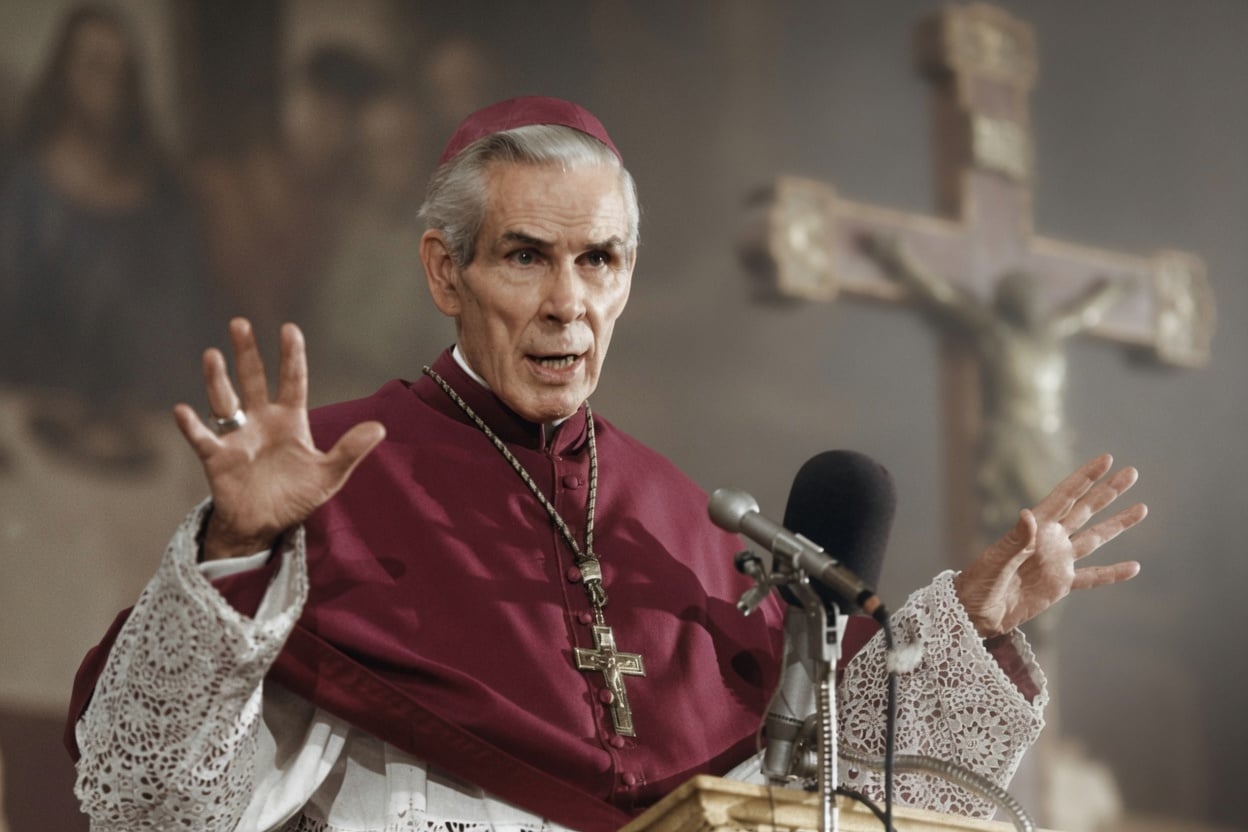
Today, aside from a few notable exceptions, there is no better example of this phenomenon than Bishop Fulton Sheen — a prelate beloved for his charismatic delivery, breadth of knowledge, and embodiment of American exceptionalism.
Sheen has become especially “untouchable” in light of the beatification attempt scheduled for September 24 of this year. Undoubtedly, his status will be further elevated after the likely canonization attempt that follows.
As I argued previously on the pages of Integrity Magazine, Sheen’s orthodoxy was especially questionable, to say the least.
For starters, he was among the most enthusiastic promoters of the Second Vatican Council and its revolutionary reforms. Notable among his exploits after the Council include — but are not limited to — actively participating in Jewish Sabbath services, praising the notorious neo-modernist Teilhard de Chardin, founding ecumenical seminaries, denouncing the SSPX as a “schismatical sect,” and, not to be overlooked, frequently reducing his message to meet the demands of non-dogmatic, pre-Christian philosophy.
In truth, Bishop Sheen was the perfect embodiment of the saccharine, indifferentist conciliar religion which has and continues to animate the post-World War II consensus. Whether wittingly or unwittingly, he played a significant role in the United States empowering the Judeo-Masonic apparatus and its current growing control over Western civilization.
Kirk Hansen has also exposed the cult of Fulton Sheen. In a recent Integrity essay, he detailed other troubling facts about his ecclesiastical career, including his appearance on Robert Schuller’s “Hour of Power” at the Crystal Cathedral in 1972, when Sheen told a roomful of Protestants that they were spiritually inside the Church of Christ.
The American prelate’s efforts did not come without worldly honors. In 1953, he won an Emmy Award for “Most Outstanding Television Personality” and affectionately relayed to reporter Bob Considine that at least one Jewish admirer referred to him as “Rabbi Sheen.” 1
Imbibing the Americanist Spirit
Bishop Sheen’s heterodox tendencies were most visible in his method of evangelization, a method similiar to what Pope Leo XIII authoritatively denounced at the turn of the 20th century. Before examining what Sheen called his “new method,” some background on this topic is necessary.
In 1899, Leo XIII issued Testem Benevolentiae Nostrae condemning a vague and elusive body of doctrines known as “Americanism.” Americanism can be described, both then and now, as a species of “American exceptionalism” in religious, moral, and political matters, typified by those who, in Leo’s words, “conceive and would have the Church in America to be different from what it is in the rest of the world.” 2
While originally addressed to Cardinal James Gibbons — an Americanist par excellence — Testem Benevolentiae Nostrae reads as though it were written with Sheen in mind. In its fourth paragraph, for instance, Leo XIII rebuked the method of “evangelization” that he would later make his own:
“The underlying principle of those new opinions is that, in order to more easily attract those who differ from her, the Church should shape her teaching more in accord with the spirit of the age and relax some of her ancient severity, making concessions to new opinions. Many think that these concessions should be made not only in regard to ways of living, but even in regard to doctrines which belong to the deposit of faith. They contend it would be opportune, in order to gain those who differ from us, to omit certain points of her teaching which are of lesser importance, and to tone down the meaning which the Church has always attached to them.”
It is hard to believe that Sheen could have remained unaware of this grave warning. Yet, he openly embraced the “new opinions” condemned by Leo XIII.
“On television, I was no longer talking in the name of the Church under the sponsorship of its bishops,” Sheen said. “This new method had to be ecumenical and directed to all people of good will. It was no longer a direct presentation of Christian doctrine but rather a reasoned approach to it with something common to the audience.” 3
Bear in mind that Sheen was serving as the U.S. director of the Society for the Propagation of the Faith at this time, thereby only adding to the scandal.
The Dispatch
It should be no surprise, then, to learn that Sheen told Protestants in 1958 that though they are “separated from the rock upon which the Church was built, they are not separated from Him [Christ] who laid that rock.”4
One cannot help but wonder which spirit — America’s or Christ’s — Bishop Sheen was more afraid of offending.
Liberal sympathies, or something more?
On Church-State relations, Sheen seemed to be influenced by the Americanist school of thought.
In a 1952 article for The St. Louis Review entitled, “Bishop Sheen Says No Church-State Union Wanted in This Nation,” Sheen lamented that there “was a lie abroad” that accused the Catholic Church in the United States of “perverting the nation,” “raiding the Treasury,” and wanting the State to be “subservient to the Church.” 5 Bishop Sheen responded to these charges in a Lenten sermon by stating “This is not true.” 6
While Sheen was correct to say that, what he should have done next was to affirm that the State has a duty — in principle — to formally profess the one true faith 7 but that owing to contingent circumstances in the United States, namely “religious pluralism,” it was neither practical nor expedient to effect this ideal arrangement. Consequently, prudence dictates Catholics to make the best of an irregular Church-State arrangement, an arrangement in which it is necessary to tolerate a lesser evil for the sake of the common good 8 while striving to corporately convert the country to Catholicism.9
This is the famous “thesis-hypothesis” distinction 10 regarding Church-State relations witnessed to by orthodox Churchmen such as Monsignor George Shea, Cardinal Alfredo Ottaviani and Father Matteo Liberatore — to name just a few anti-liberal clergy.
Instead of doing that, however, Sheen exclaimed:
“We are not in favor of an Established Church in the United States. We do not want an Established Church in the United States. We do not want an Established Church and have never wanted it. We are loyal to the United States and we propose to remain loyal to it.”11
What immediately stands out is that, at best, Sheen only stated the hypothesis — and stated it so forcefully that it sounded as it was the ideal, rather than the actual thesis.
Enjoying this article? Click here to donate to Integrity!
Now, an objector may retort by noting that a single sermon that can be interpreted in an orthodox manner is not something to take issue with. Fair enough, but Sheen made other remarks indicating that he tended towards obscuring the objective disorder of the American constitutional system, which Cardinal Pie of Poiters did not hesitate to call a “bastard system.”12
In a sermon given at St. Patrick’s Cathedral in New York later that year, Sheen reiterated his beliefs:
“If I began preaching a revolution against the government of the United States, if I began lecturing in favor of the union of Church and State, if I began pleading or haranguing for the suppression of liberty of conscience of all of those who do not believe as I believe, I would be suspended and silenced. Not because of what I said was inopportune but because it is opposed to the spirit of America and to the spirit of the Church.”13
Again, in proclaiming the practical necessity of the toleration of false cults, Sheen omits — at least in the quoted part of his sermon — the Catholic doctrine on the necessity of Church-State union and gives no indication that, as Father Joseph Clifford Fenton concluded that same year, in America there is an “objectively deplorable situation.” 14
Having said that, Catholics in the United States should keep in mind that it is right to note the unique benefits they enjoy from their system of government, even if they are accidental. Historically, the Church has grown tremendously in the U.S., as Pope Leo XIII stressed in his 1895 encyclical letter Longinqua.15
In time, Integrity will look at Bishop Sheen’s Americanist tendencies in future articles and determine to what extent, if any, he was an adherent to the error of “Liberal Catholicism.”
- Considine, Bob. “God Love You: The Story of Bishop Fulton Sheen, Television’s Stunning New Voice”, Cosmopolitan, July 1952, p. 99. — “Then, because Bishop Sheen is an infinitely polite man, he felt he might have possibly made too sharp a reply. So he picked up his latest book, asked if I wanted it, and autographed it flatteringly. Then he smiled radiantly. ‘Did you hear of the nice lady who went into Brentano’s and asked for Rabbi Sheen’s A Piece of My Mind?’” ↩︎
- Pope Leo XIII, Testem Benevolentiae Nostrae, (1899), para. 34. ↩︎
- The Georgia Bulletin, (August 15, 1996), vol. XXXIV, no. 28, p. 5. ↩︎
- The Catholic Advocate, (August 15, 1958), vol. VI, no. 33, p. 8. ↩︎
- The St. Louis Review, (March 28, 1952), vol. XII, no. 13, p. 9. ↩︎
- Ibid. ↩︎
- Pope Leo XIII, Libertas, (1888), no. 21. ↩︎
- Pope Leo XIII, Immortale Dei, (1885), no. 36. ↩︎
- Ed. A little known ruling from the Holy Office (Rev. Joseph Komonchak, Catholic Principle and the American Experiment: The Silencing of John Courtney Murray, 1999, p. 12) in 1954 condemned four erroneous propositions associated with the liberalizing theses of Fr. John Courtney Murray, theses directly applicable to the American paradigm:
a) The Catholic confessional State, professing itself as such, is not an ideal to which organized political society is universally obliged.
b) Full religious liberty can be considered as a valid political ideal in a truly democratic State.
c) The State organized on a genuinely democratic basis must be considered to have done its duty when it has guaranteed the freedom of the Church by a general guarantee of liberty of religion.
d) It is true that Leo XIII has said: “States…are bound absolutely to worship God in that way which He has shown to be His will” (Enc. Immortale Dei). Words such as these can be understood as referring to the State considered as organized on a basis other than that of the perfectly democratic State but to this latter strictly speaking are not applicable. ↩︎ - Pope Leo XIII, Au Milieu Des Sollicitudes, (1892), no. 28 — “It is true that in certain countries this state of affairs exists. It is a condition which, if it have numerous and serious inconveniences, also offers some advantages — above all when, by a fortunate inconsistency, the legislator is inspired by Christian principles — and, though these advantages cannot justify the false principle of separation nor authorize its defense, they nevertheless render worthy of toleration a situation which, practically, might be worse.” ↩︎
- The St. Louis Review, Ibid. ↩︎
- Qtd. in Fr. Théotime de Saint-Just, O.M.C., La royauté sociale de N.-S. Jésus-Christ d’après le Cardinal Pie: Essai de synthèse doctrinale, (1925), p. 189. — French original: “Le système américain et belge, ce système d’indifférence philosophico-politique, sera éternellement un système bâtard ”. ↩︎
- The St. Louis Review, Ibid. ↩︎
- Fr. Joseph Clifford Fenton, Principles Underlying Traditional Church-State Doctrine, (1952), American Ecclesiastical Review, vol. CXXVI, pp. 456-7. ↩︎
- Pope Leo XIII, Longinqua, (1895), nos. 5-6. ↩︎