
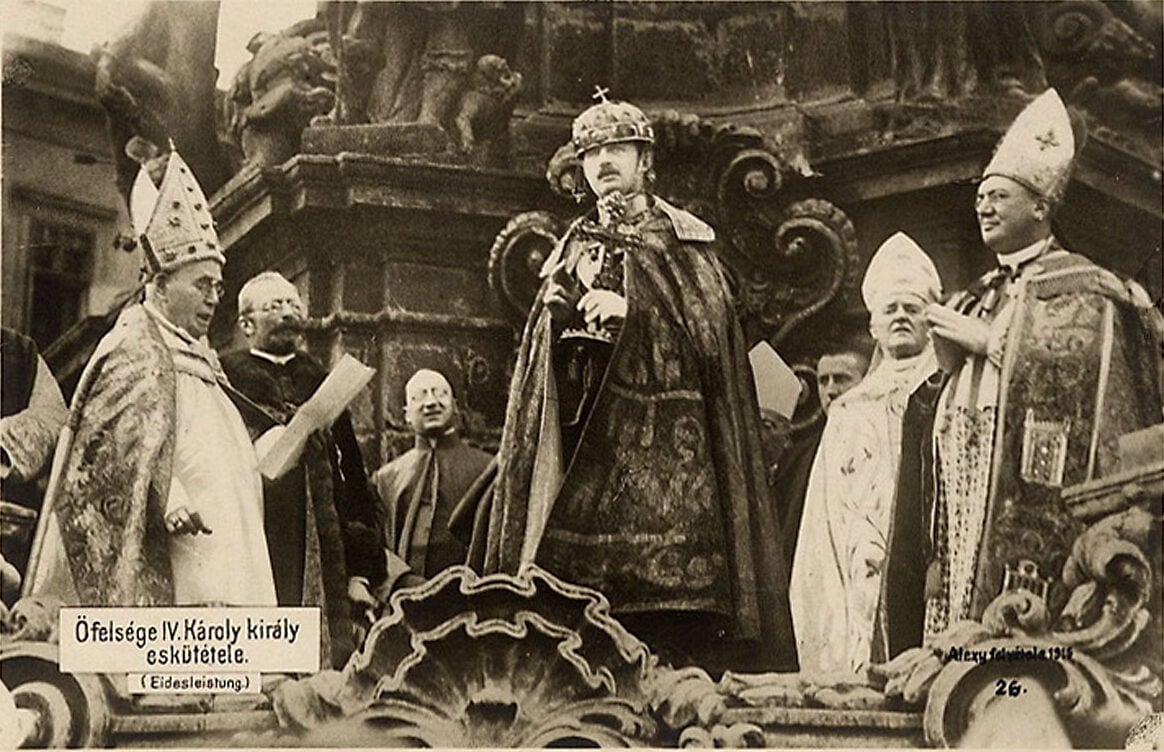
Editor’s note: The following essay is reprinted from The Fatima Files and is the first installment of a two-part series. It has been lightly edited for stylistic and editorial standards. Click here for the second part, “The last Catholic Emperor: Blessed Karl’s holy attempts at peace during World War.“
On the 100th anniversary of the “armistice” that ended World War I and set the stage for World War II, we are forced to recognize the tragedy that has lasted 100 years. It is the post-Christian Age.
That the post-Christian Age has seen Stalin, Hitler, Pol Pot, Mao, Harry Truman — of Hiroshima/Nagasaki fame — and the social and political degeneration of the West and the decomposition of a Western Christian fashioned world order, is only part of the tragedy which looks us in the face when we think about this one-hundred year anniversary of a fraudulent and tragic end to one of the most catastrophic wars in human history.
When the Armistice was signed on November 11th, 1918, the Germans, believing the fraud presented by Woodrow Wilson — as the “Fourteen Points” — did not believe they were surrendering. They were not told they were surrendering; but they were. “Self-determination” would only be for those favored by the Masonic Powers.
Certainly it did not apply to the Austrians, who would have joined with their fellow German-speakers to form a strong Germanic Central European State. They were not allowed to because Wilson believed that such a power — since it would have a clear Catholic majority — would be under the “control” of the Papacy. Neither the Germans nor the Austrians could keep their ancient monarchies due to the fact that they were threatened by the United States with a starvation blockade if they should not adopt republican forms of government.
The republican forms of government produced National Socialism and Communism in Central and Eastern Europe. Wilson’s hatred of monarchy was best displayed in his elation upon hearing the fall of Nicholas II in Russia — to be replaced by a parliamentary republic — saying, “Finally, Russia is fit for a League of Honor!” A more nauseating statement, in the circumstances, cannot be imagined.
When we realize that in World War I, what should have been a regional and short conflict between overly armed and ridiculously antagonistic European powers, became an ideological crusade against monarchy, due to the quiet promise of American intervention given by Woodrow Wilson — who campaigned in 1916 with a “He Kept Us Out of War” slogan — the tragedy of the war becomes clear.
Not the tragedy of the outcome, which was catastrophic, but truly the tragedy of war being fought in the first place.
By destroying the great monarchies of Europe, in Germany, Austria, and Russia, the War destroyed the last vestiges of Christendom — the official recognition that God Almighty reigns over men, through men or women who are dependent for their positions on the Will of God and not the Will of Men.
From November 11, 1918 onward, Men would take the world away from God and fashion it in their own image. What was the visage of this refashioned world? Let us start a partial list: Socialism, Communism, Lenin, Stalin, Mao, the Gulag, the concentration camp, National Socialism, Finance’s domination of the planet, total ideological wars against other nations and against one’s own “retrograde” people to the tune of 200 million deaths, a Cold War putting in place a regime of Mutual Assured Destruction, endless wars around the periphery, Agent Orange, Operation Gladio, 9/11, the Islamization of post-Christian Europe, the Americanization of the Catholic Church with Vatican II, and let us say it, the disappearance and substitution of the Seer of Fatima by a criminal ecclesiastical elite.
Of course, one of the most tragic aspects of the end of World War I was the fall of the Habsburg dynasty. Along with stabilizing the Holy Roman Empire by becoming the practical hereditary heirs of this empire, they were also the vanguard of the Catholic Counter-Reformation.
Closer to our own day, in 1903, Emperor Franz Josef of Austria, exercising a right established by treaty with the Holy See, vetoed the election of Cardinal Rampolla, enabling the election of Pope St. Pius X and the doctrinal immunization of the Catholic Church from the heresy of Modernism.
What is very indicative, is that 100 years ago, Christendom did not show itself to be degenerate and worm-eaten, but rather, our Christian civilization had reached a stage of maturity manifested in the leaders of Church and Catholic State, the saintliness and political and moral insight of Emperor Karl of Austria and Pope St. Pius X.
Our Christian civilization did not die of old age, it was murdered by its enemies.
In tribute to one of the big “losers” in World War I, Karl, Emperor of Austria and King of Hungary, let us look at his life and his historic sacrifice.
Karl’s ascent to the throne begins
When Karl von Habsburg was born at Persenbeug Castle on August 17, 1887, the empire into which he was born, and over which he was destined to reign, was what could be referred to as mere “survival.”
For contemporaries of the last few generations used to nation-states of single nationalities and a brittle liberal democratic system conceived in the waning years of the Enlightenment, it is extremely hard to imagine how such a huge enterprise could possibly hang together. Ruled by a dynastic clan that had ruled, more or less, unchallenged for 500 years, comprised of twelve major nationalities, having an unbroken tradition stretching back to the Holy Roman Empire, surrounded by buildings which exuded the glories of the militant Baroque spirit of the Catholic Counter-Reformation, such an entity could only have been viewed by many a Liberal as fit for imminent demise.
Indeed, the hostility to old Austria and all she stood for was expressed best by the Old Liberal British Prime Minister Gladstone when he said, “There is not an instance, there is not a spot upon the whole map, where you can lay your finger and say, ‘There Austria did good.'”
The problem for the European or Anglo-American Liberal with regards to Habsburg Austria was that the second largest political entity in Europe at the time did not collapse or even “unravel.” This in spite of the constant political and physical attacks directed against the Imperial dynasty.
The Emperor Franz Josef, ruling since the failed nationalistic revolution of 1848, suffered the brunt of the physical and psychological attack. His brother, Maximilian had been executed by Mexican leftists, supported by the United States, in 1867; Archduke Rudolf, heir to the entire empire and only son of Franz Josef, was, apparently, “suicided” at the hunting lodge at Mayerling in 1889 (according to the late Empress Zita, the death at Mayerling was not suicide but part of a political plot by foreign agents).
The sufferings of this notably austere emperor (on the last day of his life he consented to sit during his morning prayers instead of kneeling as was his life-long custom) were brought to the level of the superhuman when an Italian Anarchist assassinated his wife in 1898.
During these staggering events (which did not stagger the imperial system), Archduke Karl, the grandson of the second youngest of the Emperor Franz Josef’s brothers, experienced his childhood. He was an infectiously charming child, interested in toy soldiers, farming his small patch of garden for the benefit of the local poor box, and learning to read and write both German and English, becoming fluent in the latter by the age of six due to the educational efforts of his Irish nanny Miss Bridie Casey. As an adult he spoke seven languages fluently.
Here, it is interesting to note, that if Karl had been invited to the Versailles Conference in 1919, he would have been the only participant among the leaders of the United States and Europe, other than the notorious anti-clerical Georges Clemenceau, who could have spoken personally, without translator, to every other participant at the conference. It is, perhaps, adding insult to injury to mention that if he had been so invited he would have been the only leader present who actually commanded troops on the front during the cataclysmic struggle.
Events turned markedly serious for the young archduke in 1900, when his uncle and heir to the imperial throne, Franz Ferdinand, announced to the emperor that he was prepared to violate the dynastic laws of the House of Habsburg by wedding a woman below his station and, no less important, a woman from a specific social class within the Empire, namely, the Czech countess Sophia Chotek.
These dynastic laws, formed to protect the objectivity and the dignity of the dynasty, could not easily be overlooked. An extraordinarily solemn ceremony, which itself manifested the fact that the venerable “old” ways were very much alive at the very end of the nineteenth century in Europe, was held at Hofburg Palace in Vienna. All the senior members of the Habsburg family gathered together with the Archbishop of Vienna, Cardinal Anton Grushcha, and the Primate of Hungary. At the stroke of noon, Emperor Franz Josef, standing in front of his throne in the Private Council Chamber, announced:
The Dispatch
Ever desirous of doing what is best for members of my Archducal House, and with a view of giving my nephew a new proof of my special affection, I have given my consent to his marriage to the Countess Sophia Chotek. It is true that the Countess Sophia Chotek is of noble descent, but her family is not one which, consistent with the customs of our House, can be regarded as of equal birth … This marriage is to be looked upon as a morganatic marriage, and the children which with God’s blessing may issue from this union, cannot therefore participate in the rights of the members of the Archducal House.
From this moment on, the twelve-year-old schoolboy Karl, nephew of Franz Ferdinand, was to be trained to be heir to the Catholic thrones of Austria and Hungary.
Marriage and the prophecy of St. Pius X
In the marriage of the young archduke to Zita of Bourbon-Parma, we can glimpse the subtle ways in which the Almighty God weaves His providential plan for mankind, using the delicate fabric of personal and intimate human affairs. What we, also see, however, is the ways in which men, through ignorance and malice, can act against the obvious and explicit (or as theology would have it, the “antecedent”) will of God.
With regard to his marriage, Karl wished to avoid the problems surrounding the marriage of his uncle, by marrying someone of royal birth, one who he could love and trust as his wife and as the mother of his children.
He found such a one in Zita of the Northern Italian branch of the Bourbon dynasty, the Bourbon-Parmas. This family of twenty-four children (three of whom would become Benedictine nuns) headed by Zita’s father, Duke Robert of Bourbon-Parma, was essentially French in culture and understanding, however, had ruled the tiny Italian duchy of Lucca and Parma from 1748 until the territory was seized by the Liberal forces of the Italian Risorgimento led by the Masonic Count Camille Cavour and the royal house of Savoy.
It was with the brothers of Zita, Sixtus and Xavier that the child Karl spent much of his time when he was holidaying with the Bourbon-Parmas. Little could any one realize that some two dozen years later, these three men would be at the center of the one potentially successful private venture to bring an end to the European nightmare of the “Great War,” which was being fought during the years 1916-1918.
Without these real and royal Catholic families concerning themselves with the real men fighting in the trenches, Europe would have to look back at this period as one of uniform inhumanity.
Enjoying this article? Donate to Integrity today!
The announcement of the engagement between Karl and the young princess Zita (who had received her education at a Benedictine convent on the Isle of Wight from a group of nuns attached to monks from Solesmes) was greeted with universal acclaim. It appeared as if Europe was going to be secure under the dominating influences of three outstanding Catholics: Franz Ferdinand, Karl, and the young Zita. A Catholic future, and a durable link to the past, had been forged in the fires of romantic love.
Surely now, another generation would be able to say, “Other nations gain their lands by war, but you, happy Austria, marry!” This golden hope, a hope which we have not as yet had the privilege to experience in our life time, had surely possessed the mind of no less a man than Pope St. Pius X when he received the newly engaged Zita at an audience in 1911. Prior to the private audience the Pope celebrated Mass for members of the family in his private chapel, and then he entertained them in his library.
He opened the conversation by telling Princess Zita, “I am very happy with this marriage and I expect much from it for the future…. Charles is a gift from Heaven for what Austria has done for the Church.” The inspired foresight of the holy Pontiff revealed itself when, later in the conversation, Princess Zita was placed in an awkward situation when the Pope, seemingly, forgot about Archduke Franz Ferdinand and referred to Karl as the heir to the throne.
Zita pointed out, in a very accommodating and discrete manner that her future husband would not be direct heir to the throne, first would come his uncle, Franz Ferdinand. At this, however, the Pontiff looked serious and repeated that Charles would soon be on the throne. The young Princess, startled, said that surely Franz Ferdinand was not going to abdicate — but the Pope, looking troubled and thoughtful said in a low voice “If it is an abdication … I do not know.”
The murder at Sarajevo
On June 28, 1914, exactly fourteen years to the day that the emperor had consented officially to their marriage, Archduke Franz Ferdinand and his wife the Duchess of Hohenburg, after spending three days reviewing the Austrian troops stationed in the province of Bosnia, were to make an official visit to the capital of the province, Sarajevo.
This day would, surely, be one of the most tragic days the world would ever know. On it, a civilization, sixteen centuries in the making, was crashed by the most fateful turn of a steering wheel in all of human history.
In a chapter insightfully entitled, “The Last Days of Mankind: June 28 – August 4, 1914,” Niall Ferguson, a British historian in a recently published book The Pity of War, gives us insight into the real state of the Austrian monarchy, especially in the territories of Bosnia-Herzegovina, in the years immediately leading up to the fateful day in the summer of 1914.
According to Ferguson, the question concerning the political status of Bosnia was a part of the larger question as to what to do in the Balkans after the gradual retreat of the Moslem Turk Empire from the European continent. The question was: After the Turk, who? For most of the 19th century, the opponents in this contest had been Austria, long distracted by internal imperial troubles, and Russia, who was the more aggressive of the two empires. In this contest, France and Britain normally allied themselves with the Austrians against the Russians. Throughout the nineteenth century Prussia and then the Second German Empire played almost no part in this drama.
The newly established Kingdom of Serbia, however, would purse a policy of nationalistic aggrandizement. The goal of a “Greater Serbia,” which would bring together all ethnically Serb people within the Serbian State, was directly contrary to the very idea of the multi-ethnic Habsburg Empire.
Even, however, with an aggressive and lawless Serb regime in place in Belgrade, real nationalistic ferment was minimal in the years leading up to 1914. According to Ferguson, “there was no irresistible force called nationalism, insisting that Bosnia-Herzegovina could not remain as it was: a religiously heterogeneous province, formerly of the Ottoman Empire, then, after…occupied and administered by Austria-Hungary, and in 1908 formally incorporated…into the Habsburg monarchy.”
A terrorist student group called Mlada Bosna (Young Bosnia) did not support this Imperial Austrian solution to the Bosnian problem. On June 28, 1914, after days of rumors about possible assassination attempts, the archducal car was attacked by means of a bomb thrown from the large surrounding crowds. It fell on the roof and rolled off, exploding behind the vehicle and seriously wounding a member of the entourage, Colonel von Merizzi.
Then the course of events turned tragic and bizarre. After a rushed stop at the city hall, in which the officials still seemed ready to present the Archduke and his wife with a formal dinner, the royal couple decided that they wanted to check on the medical status of von Merizzi. It was decided to drive, not through the town, where the crowd was awaiting the Archduke, but along the Appelkai, which was quite deserted. Before they entered the cars, this decision was repeated to the chauffeurs several times, with the express order “not along Franz Josef Street, but along the deserted Appelkai.” The Archduke’s chauffer had instructions to follow the car in front. But when it came to the place where the roads forked the lead car did not, as it had been expressly ordered to do, drive straight on along the Appelkai, but turned aside, against orders, into the crowded Franz Josef Street. The consumptive young Serb, Gavril Princip, intervened and the tragic twentieth and twenty-first centuries were launched.
The news found Charles and his wife Zita taking a family vacation at Reichenau, where the telegram with the catastrophic news reached the couple as they were sitting at lunch in a little summerhouse on the grounds of the mansion. Immediately they understood the import of the events, for their own lives, for the life of their nation, and for Europe as a whole. At any moment the imperial mantle could fall upon the twenty-six-year-old shoulders of Karl and his twenty-two-year-old wife Zita.
One can only imagine the suspense and historical electricity” that must have possessed the historically minded when the huge crowds, which gathered in Vienna, witnessed the meeting between the young heir and the aged monarch.