

The Trump administration released a comprehensive report last Thursday on the Biden administration’s targeting and investigation of “non-mainstream Catholics,” providing details on a 2023 leak of an internal FBI Richmond Field Office intelligence document focusing on “radical traditionalist Catholic ideology.”
After reviewing over 1,800 pages of documents, the Justice Department’s Weaponization Working Group concluded that the “Biden FBI,” headed at the time by Attorney General Merrick Garland, was “engaged in improper and unjustified law enforcement and intelligence activity.”
The full report is 223 pages long and is available online.
Eric Schmitz, who works in the office of Republican House Speaker Mike Johnson, swiftly denounced the Biden FBI in an X post, decrying the “disturbing” way it characterized “ordinary Catholic beliefs and practices.”
While Schmitz — and countless others — are right to see the findings of the report as disturbing, they should not be surprised. Traditional Catholics, in rejecting the revolutionary and Liberal principles of modernity, do pose a threat to the status quo political settlement in the United States given that they seek to convert Americans to Catholicism and strive to ensure that the country pays its corporate debt to Jesus Christ.
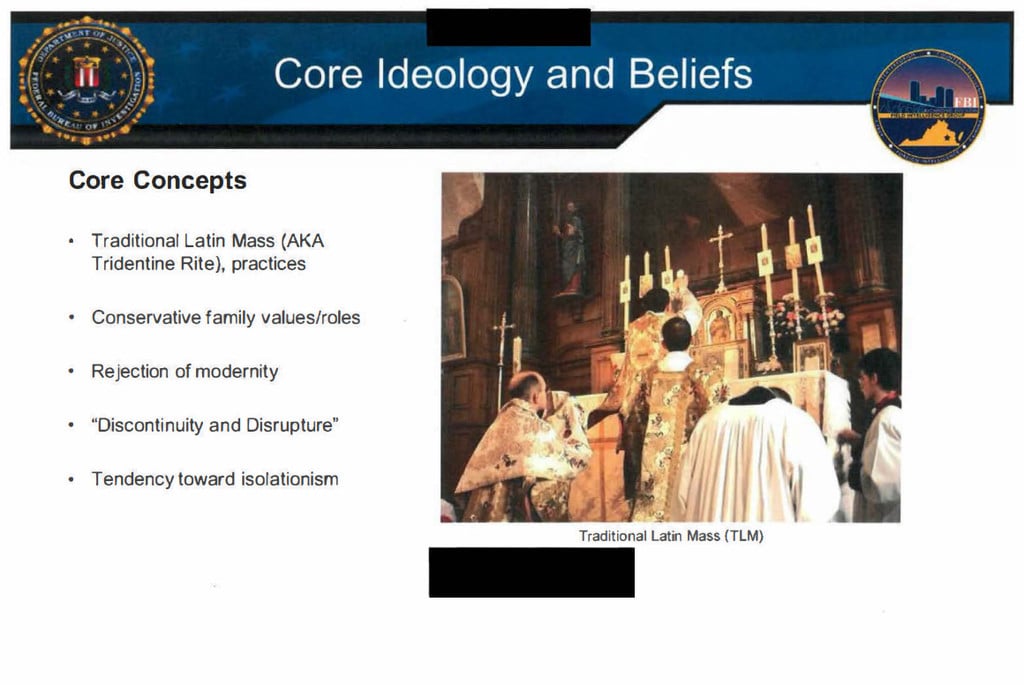
Slides from an FBI PowerPoint have also been released. They identified the “core ideology and beliefs” of “radical traditionalist Catholics” — which is a shameful term and should not be used by other Catholics — as including “conservative family values/roles,” “rejection of modernity,” and a “tendency toward isolationism.”
Far from making them an enemy of the United States, such beliefs only make traditionalists the greatest friends of the American republic and its legitimate authority, heeding the teaching of St. Paul (Rom. XIII) and Our Lord Himself (Matt. XXII, 21).
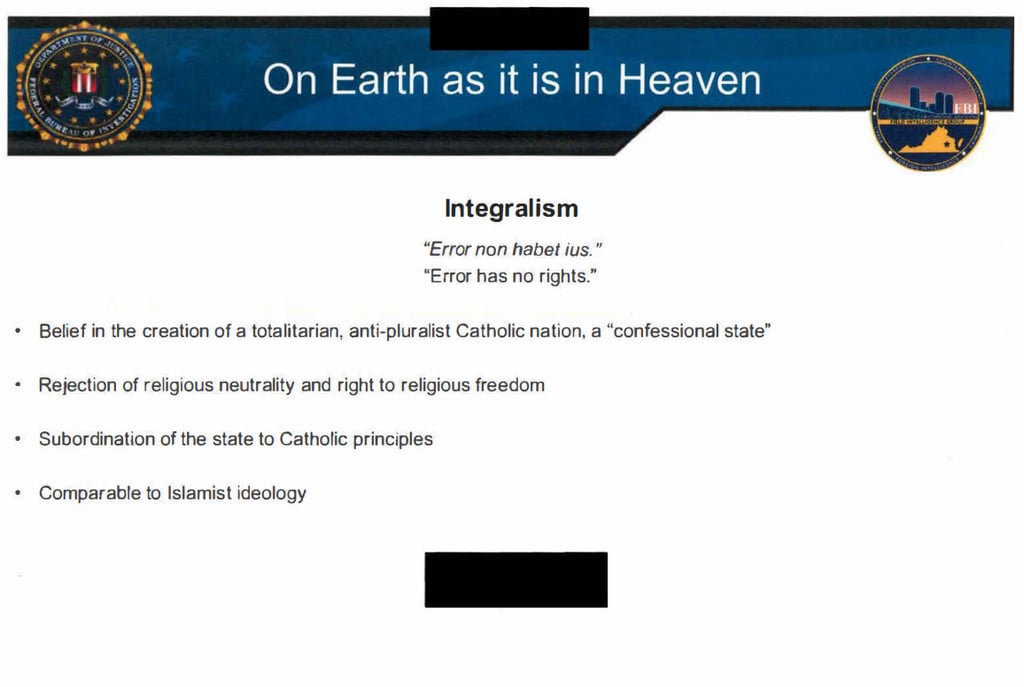
Catholic Integralism was also denounced in the PowerPoint slide, having been described as a “totalitarian” ideology similar to Islamic Sharia Law, which is an outlandish argument that has often been made by “Liberal Catholic” writer John Zmirak. The natural subordination of the State to the Church and the common sense belief that error has no rights were similarly attacked.
Readers may recall the original Richmond memo was careful to distinguish “radical traditionalist Catholics” as distinct from so-called mainstream traditionalist Catholics who simply prefer the Traditional Latin mass and pre-Vatican II teachings. The former are “typically characterized by the rejection of the Second Vatican Council (Vatican II) as a valid church council; disdain for most of the popes elected since Vatican II … and frequent adherence to anti-Semitic, anti-immigrant, anti-LGBTQ, and white supremacist ideology,” the report said.
The FBI’s presentation defined traditional Catholic organizations according to their relationship with the Vatican, ranging from the approved Ecclesia Dei groups to the SSPX, the SSPX-Resistance, Sedevacantists, Guérardians and various Conclavist groups.
In a rare victory from the Trump Administration, U.S. Attorney General Todd Blanche revealed that “the individuals who developed the Richmond Domain Perspective are no longer with the Department.” He then mentioned the Trump administration would be continuing to investigate the political weaponization of federal agencies.
The Dispatch
The origins of the Richmond Catholic memo
According to congressional investigations and the new DOJ findings, the Richmond inquiry originated with a genuinely troubled individual, identified as “Target 1,” who had attended catechism classes at an SSPX-affiliated chapel.
While government overreach and weaponization are certainly problems in our time, Target 1 was being investigated for violent and extremist racial views, including encouraging his followers to “attack and murder minorities and police” and “taking up armed resistance against the government.”
Despite the fact that the priest at the SSPX chapel told investigators that the individual was not a Catholic nor was a member of the parish and that he held racial views incompatible with entering the Church, this became the seed for a widened blanket inquiry.
The FBI soon made extensive inquiries concerning two priests, while monitoring travel and communications. One priest was also subjected to surveillance after refusing to provide information concerning the original investigative subject.
The FBI further warned that “racially motivated violent extremists” and “radical traditionalist Catholic” adherents might have common cause, “includ[ing] legislation or judicial decisions in areas such as abortion rights, immigration, affirmative action, and LGBTQ protections.”
The Richmond memo took the cloak and dagger tactics even further, suggesting developing contacts in traditional Catholic parishes who could act as “tripwires.” Congressional investigators subsequently concluded that there was no legitimate basis for these extreme proposed measures.
The DOJ also reported that the FBI relied upon “biased and unverified materials,” including publications of the Southern Poverty Law Center, without adequately evaluating their credibility. Under former director Jim Comey, the FBI developed a cost relationship with the Jewish-run Anti-Defamation League to monitor “hate” groups in the United States. The ADL has repeatedly denounced the Latin Mass and Traditional Catholic beliefs as well.
An internal FBI review later correctly concluded that the Richmond memo conflated religious doctrine with violent extremism and that it failed to address First Amendment concerns properly.
This problem is broader than one unfortunate memorandum. Records released by Senate Judiciary Committee Chairman Chuck Grassley in 2025 indicated that more than 1,000 FBI employees had access to the Richmond memo and that at least thirteen FBI documents between 2009 and 2023 employed variations of the “radical traditionalist Catholic” terminology while citing the SPLC.
One FBI employee privately acknowledged that the Bureau’s reliance on SPLC classifications was “problematic.”
Join the Counter-Revolution: Become a monthly donor at Integrity today!
The Justice Department’s own report reached the following conclusion: the Richmond memorandum represented a “grave failure” to uphold the FBI’s responsibility to protect First Amendment rights.1
- Importantly, support for the First Amendment as such is not being given here from Integrity Magazine. Rather, any appeal to the First Amendment in this context would be in defending the Church from unjust interference, overreach and surveillance from the State. In his De Revalatione, Fr. Reginald Garrigou-Lagrange explained this with “freedom of worship” which is easily applied to the case above:
“We can… turn the freedom of worship into an ad hominem argument against those who, while proclaiming the freedom of worship, at the same time persecute the Church… However, it does not follow from this that the freedom of worship as such can be accepted by Catholics as a principle, since it is absurd and impious in itself: truth and falsehood cannot, after all, have the same rights.” ↩︎