

Editor’s Note: This article is Part III of an on-going series reviewing Dei Verbum’s variance with Catholic Tradition. Part I was focused on the overturning of authorship for the Gospels while Part II examined the Catholic concept of inerrancy.
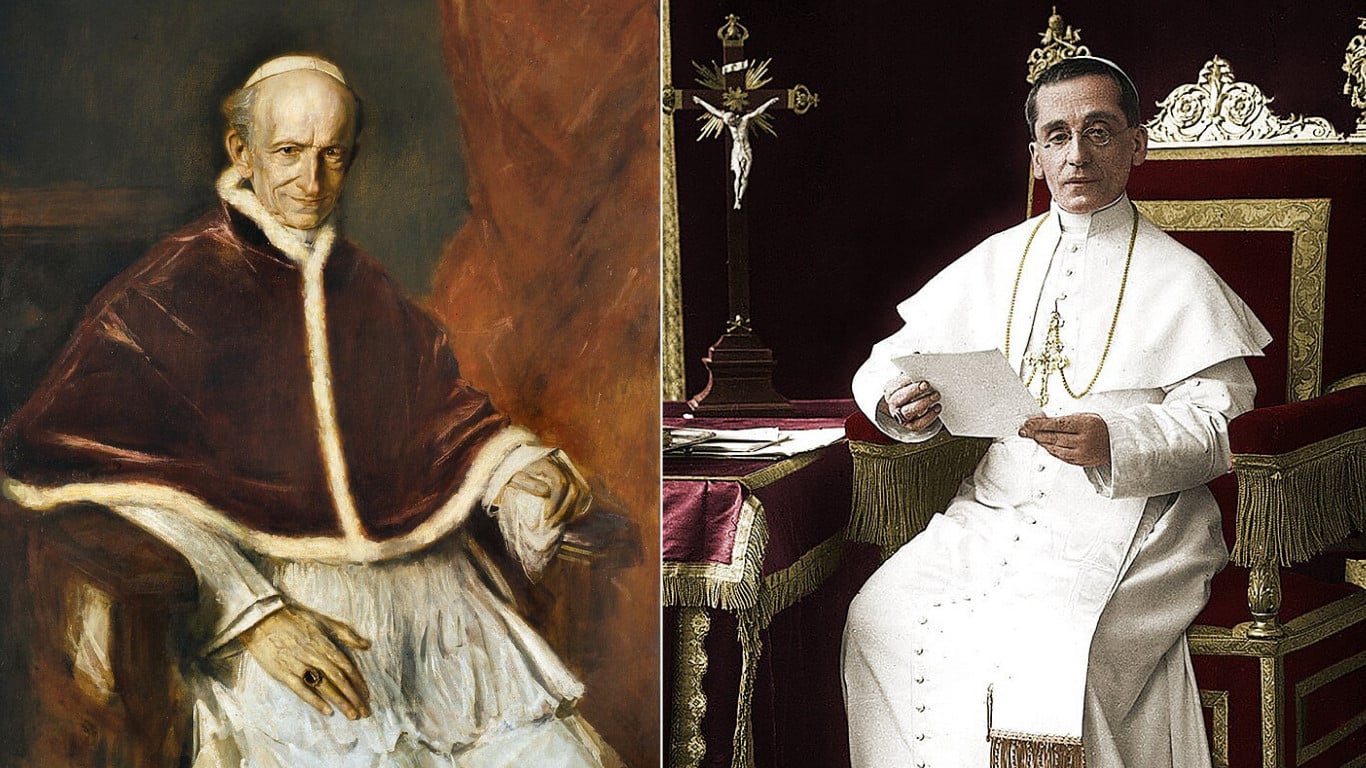
In their respective magisteria, Popes Leo XIII and Benedict XV taught that divine inspiration is incompatible with error of any kind in Scripture — importantly, not excluding scientific and historical error. Both popes condemned in no uncertain terms those who would distinguish the truth of each thing the sacred author stated from the inerrancy of the book’s salvific purpose.
In his 1921 Spiritus Paraclitus, Benedict XV summarized this as follows:
Moreover, our predecessor [Leo XIII], sweeping aside all such distinctions between what these critics are pleased to call primary and secondary elements, says in no ambiguous fashion that ‘those who fancy that when it is a question of the truth of certain expressions we have not got to consider so much what God said as why He said it,’ are very far indeed from the truth. He also teaches that Divine inspiration extends to every part of the Bible without the slightest exception, and that no error can occur in the inspired text: ‘It would be wholly impious to limit inspiration to certain portions only of Scripture or to concede that the sacred authors themselves could have erred.’ 1
When Vatican II’s schema on Revelation, De Fontibus, reiterated these teachings, it was attacked by a wave of revolutionary sentiment in the third session of the Council, primarily from bishops and Cardinals who denied the Bible’s absolute freedom — both by right and fact — from scientific and historical errors.
This uprising, spearheaded by Cardinals Franz König and Albert Gregory Meyer, was perhaps best summarized when Bishop Francis Simons of Indore, India declared before the assembly that mistakes of science and history “abound” in Scripture. “Therefore, in order to preserve the inerrancy of Sacred Scripture — as it must be concluded to be from divine inspiration — another approach to the problem must be taken.” 2
Father Barnabas Ahern, a peritus at the Council who had an influence on the text of Dei Verbum, calls this moment the “coup de grâce,” after which a decidedly new approach, different from that of Providentissimus Deus and Spiritus Paraclitus, was definitively incorporated into the text of the Constitution. He states: “[T]he precise point of faith in the general statement ‘The Bible is free of error’ was not always clearly seen. For this reason many thought that inerrancy precluded every kind of error. Vatican II, in its present statement, has now officially enunciated the exact meaning of inerrancy.” 3
Let us examine these changes made to the final document and see how this new meaning of inerrancy, which apparently does not preclude every kind of error, is expressed.
A different kind of inerrancy
The word “inerrancy,” used several times in De Fontibus, was removed, and appears nowhere in the text of Dei Verbum, which relates a certain concept of inerrancy, but with a radically different formulation.
The critical line from De Fontibus explains that since inspiration extended to all of Scripture, even the smallest elements, “everything stated by the hagiograph must be considered to have been stated by the Holy Spirit.” From this, it continues, follows the absolute absence of any error in Scripture, “religious or profane.” It thus reaffirms the impossibility of error on the part of the human author.
The revised passage in Dei Verbum, however, reads as follows:
Therefore, since everything asserted by the inspired authors or sacred writers must be held to be asserted by the Holy Spirit, it follows that the books of Scripture must be acknowledged as teaching solidly, faithfully and without error that truth which God wanted put into sacred writings for the sake of salvation [salutis causa].
Accordingly, in order to determine God’s salvific message, the exegete should ascertain the intended meaning of the human author: “[T]he interpreter of Sacred Scripture, in order to see clearly what God wanted to communicate to us, should carefully investigate what meaning the sacred writers really intended, and what God wanted to manifest by means of their words.”
Whereas De Fontibus held everything “stated” [enuntiantur] by the sacred authors to be inerrant, Dei Verbum teaches that what is “asserted” [asserunt] by the authors enjoys inerrancy.
This subtle change allows the exegete to distinguish between the religious message the author intended to assert, and the accompanying material which they merely assume in order to construct the narrative. The inerrancy of the text is then defined in relation to the phrase “salutis causa.” This purpose, Dei Verbum subsequently reminds us, would extend to all of Scripture [2 Tim. 3:16-17]. So, while all of Scripture may enjoy a kind or degree of inerrancy, the nature of this inerrancy in the individual parts can only be understood in light of the salvific purpose of the whole.
The Dispatch
Support Integrity’s growing number of contributors: Become a monthly donor!
Father (later “Cardinal”) Alois Grillmeier, a peritus at the Council and a co-author of Dei Verbum, explains the reason behind this change in his commentary on the document. Citing a work written during the Council by Father Pierre Grelot, he distinguishes between the “material” objects of Scripture, these being the so-called “secular truths,” and the “formal object” of Scripture, that being the work of salvation. The material elements, he says, though not salvific in themselves, exist only as a “framework” or “medium” to identify and deliver the salvific elements. “They are chosen and presented only in so far as they fulfill this purpose.” 4
According to a Methodist work of biblical criticism which Grillmeier revealingly quotes to explain his view, “Since they are but literary devices, strict historical accuracy in such particulars is not important, for they are there to provide a setting for this story, not to give historical information.”5
Therefore, while each part of each book is inspired, the inerrancy of each part exists only in relation to the saving purpose of the whole, not independently. Positive statements in Scripture touching on matters of history and the natural world no longer enjoy protection from error in themselves, but only insofar as the author materially employs them to deliver his overarching, salvific message.
Father Grillmeier concludes: “There are direct statements and accounts of salvation in which this formal object salutis causa is clearly verifiable. But there are also parts of Scripture which have only an auxiliary function in relation to these direct truths of salvation. Here, from the point of view of the secular sciences, somewhat less than the truth can be expressed.” 6
An intentional rupture indeed
This change in the concept of inerrancy is not the result of a vague or imprecise formulation, as some mistakenly think, but rather of careful intention. In support of this, Father Ahern observes:
For too long a time popular teaching has presented inerrancy in a merely negative way or, worse still, it has applied inerrancy to elements that have no connection with the purpose of inspiration … This distorted and naturalist view of inerrancy was bitterly criticized by the Council Fathers. Under their concerted action Vatican II has brought into the formal teaching of the Church a clear precision of what ‘biblical inerrancy’ really means. 7
Bishop Simons, who had called for this change, commented thusly after the Council: “The whole Bible is still considered inspired and without error, but it is authoritative and inerrant only in what it intends to assert for the sake of man’s salvation. This leaves the way open to admit errors even in the historical writings of the Bible, which is what many Fathers and theologians of Vatican II intended” (emphasis added). 8
Father (later “Cardinal”) Avery Dulles, who would become a darling of the conciliar conservatives, concurred with Simons: “Up to the present many Catholics have felt obliged to maintain that the biblical writers made no mistakes on any matter — even astronomy, biology, or secular history. The present Constitution [Dei Verbum], by pointing out that the scope of inerrancy is governed by the purposes of inspiration, makes it unnecessary to defend this exaggerated view” (emphasis added). 9
Thus, while maintaining a kind of inerrancy for the whole of Scripture — distinct from the theory traditionally called “limited inerrancy” — Dei Verbum smuggles in the possibility for historical and scientific errors by a textual sleight of hand. For the “common Catholic,” especially one unfamiliar with the relevant players and their deliberate attempt to subvert traditional teaching, this subtle change almost certainly would go unnoticed. However, this conciliar kind of “inerrancy” is in no way reconcilable with the inerrancy of Leo XIII, who equates any error on the part of the human author with error on the part of God himself.
By applying inerrancy not simply to what is stated but only to the ultimate salvific purpose of what is stated, Dei Verbum essentially embraces the claim condemned by Leo XIII, that “we have not got to consider so much what God said as why He said it.” It intentionally allows one to posit that inspiration may coexist with human error in particular passages of the Bible.
As Part II of this series showed, this was precisely the result desired by the most influential Council Fathers. It also embodies the formulation that Father Joseph Ratzinger, who would go on to contribute to the text of Dei Verbum, laid at the feet of the Fathers in 1962:
According to a practically irrefutable consensus of historians, there definitely are mistakes and errors in the Bible in profane matters of no relevance for what Scripture properly intends to affirm … Scripture is and remains inerrant and beyond doubt in everything that it properly intends to affirm, but this is not necessarily so in that which accompanies the affirmation and is not part of it. As a result … the inerrancy of Scripture has to be limited to its vere enuntiata [what is really affirmed].10
Part IV of this series will examine Paul VI’s October 17 1965 letter to the Theological Commission on this passage of Dei Verbum, the response of the Theological Commission, and how the effect of this intervention achieved a compromise without preserving an integrally Catholic view of inerrancy.
- Pope Benedict XV, Spiritus Paraclitus, (1920), no. 21. ↩︎
- Simons, in Leahy & Massimini, Third Session Council Speeches of Vatican II (Paulist Press, 1966), p. 88. ↩︎
- Ahern, in Miller, Vatican II: An Interfaith Appraisal (Notre Dame, 1966), p. 66. Fr. Ahern claims that the Catholic meaning of inerrancy was not clearly defined before the Council, but this is absurd. Benedict XV went into great detail in his explanations. Furthermore, when the Popes speak in an Encyclical with the intent to settle a matter, as Leo XIII and Benedict XV clearly did, they are authoritative, binding and no longer can be controverted by theologians. ↩︎
- Grillmeier, in Vorgrimler et al., Commentary on the Documents of Vatican II, Vol. III (Herder & Herder, 1969), p. 235. ↩︎
- Ibid. ↩︎
- Ibid., p. 236. ↩︎
- Ahern, in Miller, Op. Cit., p. 58 ↩︎
- Simons, in “Bishop’s New Book Denies Papal Infallibility Doctrine”, The St. Louis Review, Volume 28, Number 46, 15 November 1968. Simons acknowledged Vatican II’s rupture with Tradition, but did not think this was an issue, because he openly denied the dogma of papal infallibility. By all evidence, he was never punished for publicly professing this heresy. ↩︎
- Dulles, Revelation and the Quest for Unity (Corpus Books, 1968), p. 92. ↩︎
- Ratzinger (October 10, 1962), translated in Wicks, “Six Texts by Prof. Joseph Ratzinger as Peritus before and during Vatican Council II,” Gregorianum 89:2 (2008): 233–311, p. 280. ↩︎




_-_Pope_Leo_XIII_-_7744_-_Bavarian_State_Painting_Collections.jpg)
