
Editor’s Note: This essay is Part I of a new series critically reviewing Father Félix Morlion (1904-1987). Part II will discuss his involvement with ‘Pro Deo University;’ Part III will focus on his influence at Vatican II; and Part IV will uncover his role with the assassination plot against John Paul II.
Over the last sixty years, Catholic traditionalists have spilled oceans of ink dissecting the causes of the revolution that consumed the Church at the Second Vatican Council. The basic outline by which the modernist faction assumed control of the direction of the Church is now well known. Books like Romano Amerio’s Iota Unum and Michael Davies’ Pope John’s Council have done an excellent job describing how progressive clerics from Germany and the Low Countries hijacked the Second Vatican Council, what has been aptly called a coup d’état, and turned its proceedings into a victory parade for Modernist prelates in the hierarchy.
What is less appreciated among traditionalists is the extent to which the documents of the Second Vatican Council were also influenced by the U.S. Deep State. In fact, the American intelligence agencies —operating through proxies in the Vatican — executed a highly successful influence operation against the Catholic Church prior to the Council in the 1950s and 1960s. This operation resulted in the adoption of Nostra Aetate, which effectively abrogated the Church’s missionary outreach to unbelievers, and Dignitatis Humanae, which overturned centuries of Church teaching against religious liberty and false ecumenism. Both documents attempted to conform the Catholic Church to the ruling ideology of the United States, thereby turning the Church into an appendage of the American Deep State’s revolutionary aim of remaking the world in the image of the United States during the Cold War.
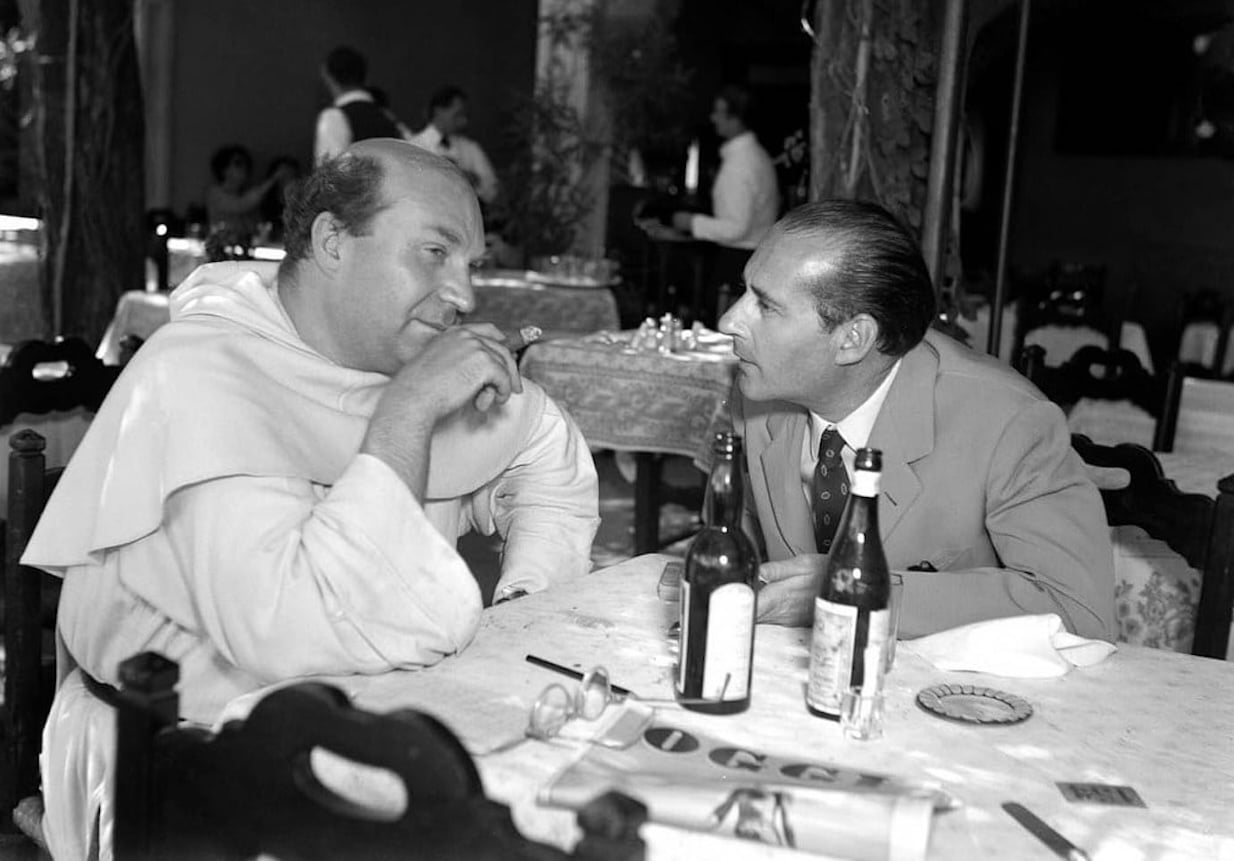
The main conduit by which the American intelligence agencies exerted influence over the Vatican during the critical years before the Council is the now-forgotten Belgian Dominican priest, Father Félix Morlion (1904–1987). Despite his importance, Morlion operated with near-complete invisibility — hence the title for this series. Nonetheless, the records that do exist of his activities attest to an astonishingly successful career of intrigue from the 1940s to the 1980s. 1
Morlion’s Biography
Born Andre Edward Maria Josef Morlion in Diksmuide, Belgium in 1904, Morlion was an atheist until converting to Roman Catholicism in 1925. After his conversion, he entered the Dominican order, where he studied philosophy and theology at the University of Louvain, then the premier Catholic university in Europe. In 1929, he was ordained a priest, remaining so for the rest of his life.
The Dispatch
At Louvain, Morlion developed his main research interest: the power of mass media and information control over the public. Morlion perceived that control of narratives circulating in media translated into raw political power — and to an increase in the power of the Church. As a young priest, Morlion became a prominent figure in the Catholic Action movement in Belgium, where he founded several organizations devoted to film criticism and Catholic social teaching.
In 1934, Morlion founded the Catholic Press Center in Brussels, a think tank devoted to combating totalitarianism in Europe by coordinating the efforts of Catholic journalists across the continent. 2 This event marked the beginning of Morlion’s career of laundering information into public consciousness on behalf of various intelligence agencies. The main function of Morlion’s organization was to manufacture narratives hostile to Communism and Nazism for dissemination in mass media throughout Europe. In this capacity, Morlion’s think tank was not an independent actor. Instead, it served as a clearing house by which ideas from conservative political elites in continental Europe could reach friendly journalists. Morlión’s reach was vast. By 1937, writers associated with his organization were servicing more than 1,500 newspapers in thirty different countries. 3
After the outbreak of the Second World War, the Gestapo issued a warrant for Morlion’s arrest. The intrepid Belgian made his way to Portugal, where he initially worked under the patronage of Gonçalves Cardinal Cerejeira, Patriarch of Lisbon. With Cardinal Cerejeira’s blessing, Morlion founded the Center of Information Pro Deo (CIP) to disseminate propaganda against Nazi Germany. 4 In 1941, Morlion made his way to America, where he placed the CIP at the disposal of the Office of Strategic Services (OSS) and its legendary director, Colonel William Donovan. The OSS needed an intelligence network in occupied Europe. Through the CIP, Morlion had access to sources and political elites across the continent. Donovan agreed to finance the CIP, which became the center of the OSS’s information gathering effort in Europe. 5
Join the Counter-Revolution: Become a supporter of Integrity today!
Thanks to their Church contacts, the CIP’s writers produced numerous reports on developments in occupied Europe. These reports proved especially useful to the United States in its strategic planning. In 1944, the Allies conveyed Morlion to Rome, where Father Morlion received papal approval for his efforts to reinvigorate Catholic propaganda through the CIP. After the war, with Pope Pius XII’s blessing, Morlion established the School of Mass Communication in Rome to train priests in his techniques of manufacturing narratives. 6 The School served as the foundation for Morlion’s efforts to conform the teachings of the Catholic Church with the liberal ruling ideology of the United States.
It is unclear if Pius XII was aware of Morlion’s role as an agent of influence for the United States. Perhaps Pius XII tolerated it out of a perceived union of interests between the Church and the United States against Communism and Nazism. 7 This calculation proved to be calamitous for the Church. Morlion set about remaking its teachings on ecumenism, religious liberty, universal suffrage democracy, and dialogue with false religions — that is, the Americanist heresy — to accord with the political and economic interests of the United States. Morlion did so by using his unparalleled access to elites in both the Vatican and in the United States, which enabled him to facilitate some of the most important personal relationships underlying the efforts of the liberal prelates at the Second Vatican Council.
- There are two books in Italian on Father Morlion’s life. Tomaso Subini’s La Doppia Vita di “Francesco Giullare di Dio”: Giulio Andreotti, Félix Morlion e Robert Rossellini (Monza: Libraccio Editore, 2023) describes his extensive connections to Italian political elites, including Giulio Andreotti, Prime Minister in seven governments from 1972-1973, 1976-1979, and 1989-1992, who briefly worked with Morlion in Rome in the early 1950s. Luigi Montuori’s Felix A. Morlion e il Servizion Segreto Vaticano Pro Deo (Chieti: Solfanelli, 2023) extensively describes Father Morlion’s work as an intelligence asset for the United States. English sources on Morlion’s life are fragmentary. The first published description of his later career in English that this author is aware of is a brief summary in the pro-Soviet Covert Action Information Bulletin, Number 25 (Winter 1986), 30, in the context of a diatribe against the Knights of Malta. Conspiracy theories notwithstanding, the summary is an excellent account of Morlion’s intelligence activities. A.N. Brady’s introduction to Father Morlion’s own The Apostolate of Public Opinion (Montreal: Fides, 1944) also provides an excellent background on Morlion’s career before and during the Second World War. ↩︎
- Valerie Aubourg, “A Philosophy of Democracy under God,”: C.D. Jackson, Henry Luce et le movement Pro Deo (1941-1964), Revue française d’études américaines,’ Number 107 (March 2006), 29. ↩︎
- A.M. Brady, Introduction’ to Father Felix Morlion, Apostolate of Public Opinion (1944), 16. ↩︎
- Ibid., 17-18. ↩︎
- Michael Graziano, ‘William Donovan, the Office of Strategic Services, and Catholic Intelligence Sources during World War II,’ U.S. Catholic Historian, Volume 33, Number 4 (2015), 92-96. ↩︎
- Roumiana Ougartchinska, La Verite sur l’Attentat Contre Jean-Paul II (The Truth about the Attack against John Paul II, Montreal: Presses de la Renaissance, 2007), 200. ↩︎
- Michael Graziano, ‘William Donovan, the Office of Strategic Services, and Catholic Intelligence Sources during World War II,’ U.S. Catholic Historian, Volume 33, Number 4 (2015), 96-97. ↩︎