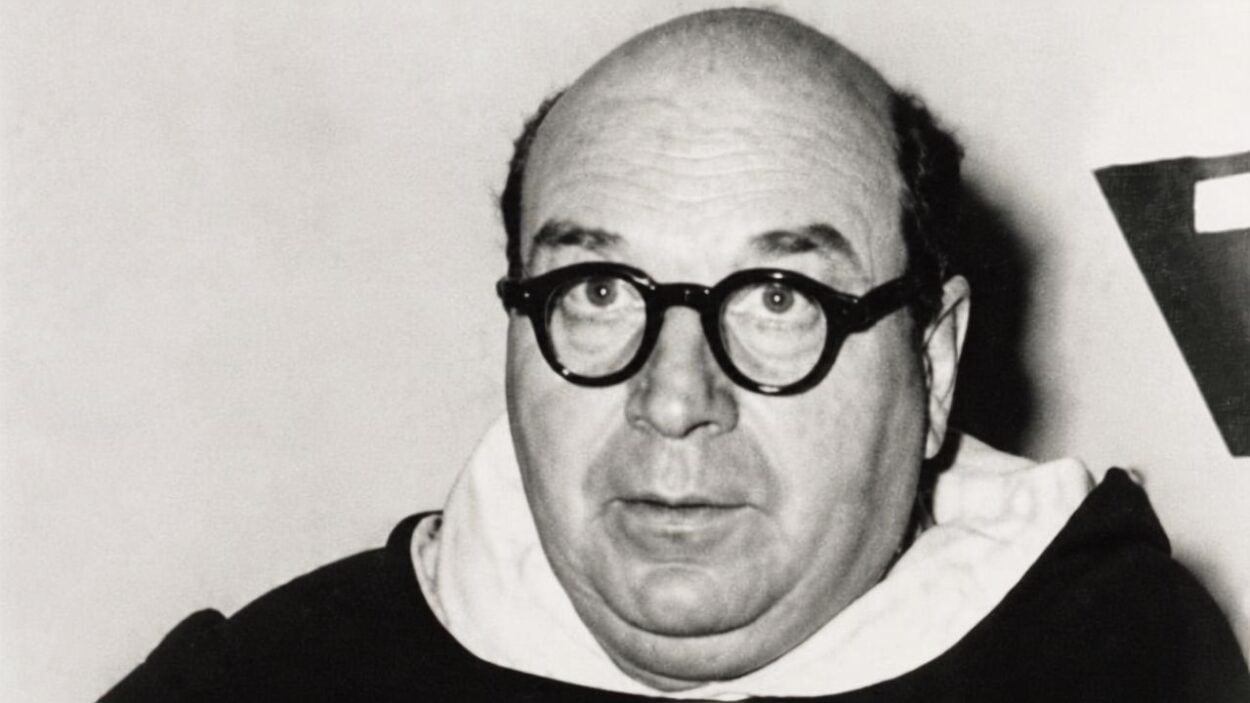
Editor’s Note: This essay is Part II of a new series critically reviewing the efforts of Father Félix Morlion (1904-1987). Part I discussed his involvement with the US Deep State; Part III will focus on his influence at Vatican II; and Part IV will speculate about his role with the assassination plot against John Paul II.
Grateful for the work of Father Morlion’s ‘Center of Information Pro Deo’ (CIP) during the Second World War, the newly-founded CIA kept a close relationship with him after 1945. By all evidence, he appears to have worked for the United States government until his death in 1987, as will be shown in these essays.
Father Morlion’s efforts on behalf of the United States government occurred mainly through the institutions which he founded within the structures of the Church. In 1945, he founded the Institute for the Study of Social Sciences Pro Deo, or Pro Deo University, a training facility for priests and lay Catholics established under the auspices of the Church which inculcated its students in the Americanist errors of free enterprise, religious liberty, and ecumenical dialogue. Pro Deo University was not a university according to the European model. Instead, it was established along the lines of an American business school, presumably to indoctrinate its students with the Liberalism of American academia and to facilitate relationships between its prominent attendees. 1
Accounts of the origin of Pro Deo University — who financed it, whether it had official approval to operate from Church authorities, and even what year it began operations — are murky. Its funding appears to have derived from the CIA’s black operations budget, or from large corporations like Standard Oil, which made a large donation to the school in the early 1950s. 2 In keeping with the priorities of its financial backers, the University also seems to have been designed to pass intelligence from the Vatican to the CIA. However, in the mid-1950s, the Americans found another purpose for the University — it would serve as a cutout to influence the Church to conform to the ruling ideology of the United States.
Father Morlion’s work as a propagandist for the OSS brought him into the orbit of Henry Luce, the newspaper titan and owner of the Time-Life empire, who placed his vast media empire at the disposal of the CIA to combat international communism during the Second World War.
In this capacity, Morlion liaised closely with Charles Douglas (C.D.) Jackson, managing director of operations at Time magazine who had been the Deputy Chief of Psychological Warfare for General Dwight Eisenhower’s army headquarters during the war. Jackson saw that Pro Deo University was gradually losing its usefulness as an intelligence source as Soviet control over Eastern Europe tightened. In order to combat this, Jackson proposed to Morlion and CIA Director Allen Dulles (uncle of the future-Cardinal Avery Dulles and brother of Secretary of State John Foster Dulles) that Pro Deo University help influence the Church to support the foreign policy of the United States by facilitating the exchange of information favorable to American objectives in the Church. 3 In a 1960 letter to one of Morlion’s assistants, Jackson articulated the true purpose of American support for Pro Deo University:
To us, there was something unique in Father Morlion’s vision of a university physically located in the Eternal City, functioning under the benevolent eye of the Vatican, under the direct supervision of the Dominican Order, yet with a multi-faith and multi-racial student body, with a multi-faith faculty, with a direct and continuing relationship to American ideas, text, and instructional techniques relating to those elements of American higher instruction which for a number of historical reasons, Europe seemed reluctant to furnish. 4
The Dispatch
Thus, the American motive for supporting Pro Deo University was to water down Roman Catholicism to make it compatible with the liberal American international project.
Fr. Morlion earns support
Morlion was a willing accomplice in this effort. Eventually, he changed the operating philosophy of Pro Deo University to accord with Jackson’s vision. At the same time, Morlion finally obtained Church patronage for his project. He had founded Pro Deo University with the unofficial approval of Archbishop Giovanni Battista Montini, the future Paul VI, who was then working as a kind of Undersecretary of State. Montini, with Pius XII’s backing, saw Morlion’s information warfare activities as useful to the Church. 5 Nonetheless, the sensitive nature of Morlion’s activities and his close connections to the United States rendered the survival of his project precarious.
Finally, in 1957 then-Father Michael Browne, Superior General of the Dominican Order, granted his approval for Morlion’s institute to operate under the auspices of his order. Later, Cardinal Browne became one of the notable allies of Archbishop Marcel Lefebvre’s Coetus Internationalis Patrum in its fight against the very heresies Pro Deo University promoted at the Second Vatican Council. That said, Browne seems to have been unaware of the role of this educational institute in creating the crisis in the Church at the Council. Another high-profile conservative ally was Giuseppe Cardinal Siri, Archbishop of Genoa, whose support for Pro Deo University worked at cross-purposes to his supposed traditionalism. 6
Join the Counter-Revolution: Become a supporter of Integrity today!
Thus, Morlion was now acting as agent of the United States with the support of two of the most prominent conservatives in Rome. Pro Deo University became arguably the most influential educational institute in the Church. By 1953, a glowing piece in Time magazine noted that the school had more than 90 faculty members and more than 1,000 students. 7 In that decade, the school also became international, with training centers established at universities of Lima, Peru; Rio de Janeiro, Brazil; Bogota, Colombia; and Santo Domingo, Dominican Republic, where Morlion set about building a vast patronage network amongst the political elites of these nations. 8
Morlion’s contacts with American elites also made him an excellent conduit for information between Washington and Rome. In 1962, during the Cuban Missile Crisis, Morlion was a key figure in defusing tensions between the United States and the Soviet Union by facilitating the transmission of President Kennedy’s peace offer to Premier Nikita Khruschev via Pope John XXIII. Later he helped peace activist Norman Cousins obtain an audience with Khruschev, ostensibly to discuss the release of the Ukrainian primate Josef Cardinal Slipyj from captivity, although the true purpose of the meeting was to gauge the Soviet leader’s willingness to agree to a nuclear test ban treaty. Cousins’ mission played a key role in building sufficient trust between the American and Soviet leadership classes to effect the adoption of the 1963 Partial Test Ban Treaty, the first arms control agreement between the United States and the Soviet Union. 9 A secondary effect of Cousins’ mission was the release of Cardinal Slipyj, which the Soviets agreed to as a goodwill gesture following Rome’s successful mediation with the United States over the Cuban Missile Crisis. 10
Inevitably, Morlion’s role as an agent of the most powerful and wealthy nation on earth eventually resulted in revolutionary changes in the Second Vatican Council. His role as a peritus will examined in part III of this series, and will describe the links between Pro Deo University, Morlion, and Nostra Aetate, the conciliar document that effectively abrogated the Roman Catholic Church’s missionary outreach to non-Christian religions, especially to the Jewish community.
- Valerie Aubourg, “A Philosophy of Democracy under God,”: C.D. Jackson, Henry Luce et le movement Pro Deo (1941-1964), Revue française d’études américaines,’ Number 107 (March 2006), pp. 32-35. ↩︎
- C.D. Jackson, ‘International University for Social Studies Pro Deo,’ memorandum to Allen Dulles (December 10th, 1956), declassified December 19th, 2013, ISCAP Appeal No. 2012-107, document number 1. ↩︎
- Ibid. ↩︎
- C.D. Jackson letter to Father Ferrero, quoted in lerie Aubourg, “A Philosophy of Democracy under God,”: C.D. Jackson, Henry Luce et le movement Pro Deo (1941-1964), Revue française d’études américaines,’ Number 107 (March 2006), p. 37. ↩︎
- Father Riccardo Lufrani (OP), ‘Pomeriggi Alla Minerva,’ Conferenza Morlion, p. 3. ↩︎
- C.D. Jackson memorandum to Allen Dulles (February 5th, 1957), ISCAP Appeal Number 2012-107, document number 2, declassified December 19th, 2013. ↩︎
- ‘Education: For Managers and Molders,’ Time (December 27th, 1953). ↩︎
- Valerie Aubourg, ‘“A Philosophy of Democracy under God,”: C.D. Jackson, Henry Luce et le movement Pro Deo (1941-1964), Revue française d’études américaines,’ Number 107 (March 2006), pp. 37-38. ↩︎
- Norman Cousins, The Improbable Triumvirate: John F. Kennedy, Pope John, and Nikita Khruschev: An Asterisk to the History of a Hopeful Year, 1962-1963 (New York: W.W. Norton, 1972), pp. 16-19. ↩︎
- Karim Schelkens, ‘Vatican Diplomacy after the Cuban Missile Crisis: New Light on the Release of Josyf Slipyj,’ The Catholic Historical Review, Volume 97, Number 4(October 2011), pp. 679-712. ↩︎