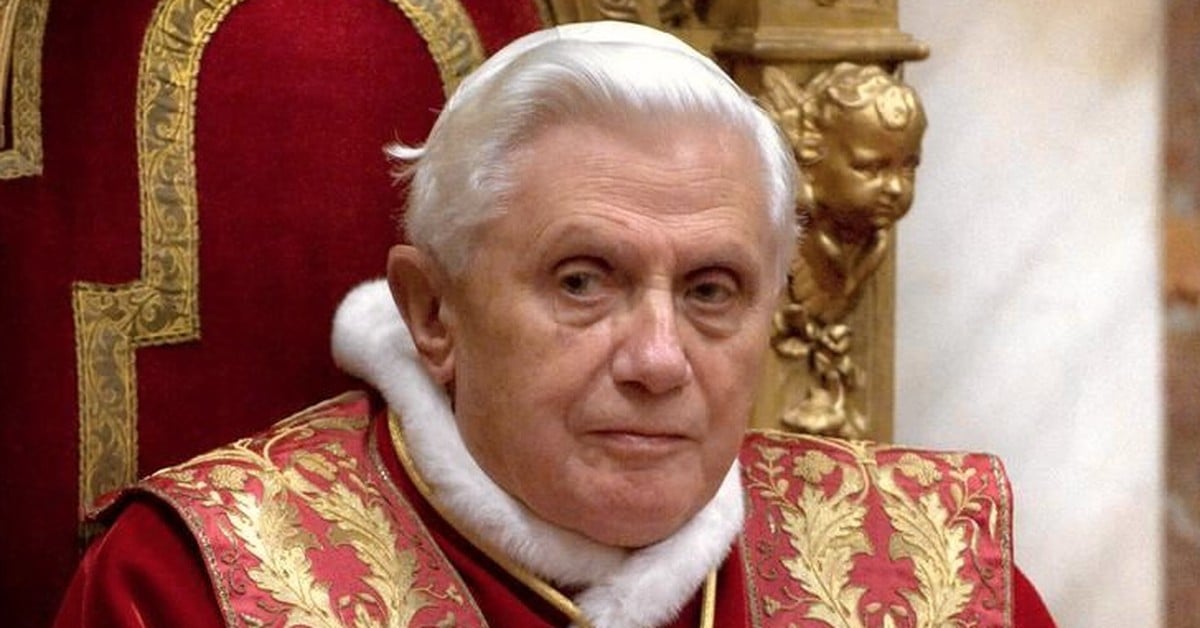
Editor’s Note: This essay is Part I of a new series examining Benedict XVI’s errant conception of original sin and its effects.
Recently, a letter written by the late Benedict XVI has gained attention online. The document, dated June 6, 2014, is a response to three questions included in a letter from Dr. Paolo Musso, professor emeritus of Philosophy of Nature at the Pontifical Urbanian University and the Pontifical University of the Holy Cross. It was originally published in the appendices of Musso’s 2021 book La Vita Extraterrestre. Science fiction author Patrick Abbott has posted a translation of the letter to X on September 29, 2026. Much to the excitement of Jimmy Akin, senior apologist at Catholic Answers, the letter appears by all accounts to be genuine.
Unfortunately, Musso does not share the text of the letter he sent to Benedict in his book, so we do not have any context for Benedict’s responses beyond what he writes. However, the letter alone is so full of heterodoxy that it deserves a proper examination. Musso shared it primarily for Benedict’s third response, regarding intelligent extraterrestrial life. Curiously, Benedict demurs on this question, while his first two responses on polygenism and original sin are far more noteworthy.
Benedict XVI’s reply
Benedict begins his response in the following manner:
The questions you put to me in your letter, which arrived on 8 May, are difficult and are now in a new phase of study and interpretation. Just as the problem of geocentrism could be clarified only in a new context of the vision of the world and in a new understanding of the literary genres of Scripture, so too the questions you have proposed are in a phase of maturation that at present does not yet allow complete answers. Only with this reservation can I offer some first annotations on the problems.
Firstly, whatever the persuasion one has on the question of geocentrism, it is a historical fact that the relaxations on the bans against heliocentric works were not a result of “a new understanding of the literary genres of Scripture.” The genre of the books of Joshua or Ecclesiastes were not reimagined in the late 18th and early 19th centuries — rather, it was permitted that specific verses could be understood according to human sense perception rather than absolute motion, in light of and motivated by a growing scientific consensus.
Whether or not that consensus is well-founded, which may be legitimately disputed, is outside the scope of this essay. Suffice it to say that the Church undertook no profound revision of defined doctrines, the kind of which Benedict goes on to suggest would be legitimate.
Secondly, can a doctrine such as original sin legitimately enter “a new phase of study and interpretation?” Can it be in “a phase of maturation that at present does not yet allow complete answers?” The first Vatican Council decreed: “If anyone says that it is possible that at some time, given the advancement of knowledge, a sense may be assigned to the dogmas propounded by the Church which is different from that which the Church has understood and understands: let him be anathema.”
Help support Integrity’s independent reporting: Become a monthly donor today!
The Fathers of Trent undoubtedly understood their definition of original sin to describe an individual, historical Adam, from whom all humanity descends and inherits his fault. Yet in this letter, Benedict writes as though advancements in scientific knowledge leave space open for new understanding of the doctrine of original sin.
Benedict continues:
Ad 1: The question of monogenism and polygenism (a single couple or a small group) was discussed extensively in the 1950s. After the Second Vatican Council, theological interest shifted to other areas; as far as I know, the discussion was not taken any further. At that time polygenism was not excluded absolutely. What remains fundamental, however, is that there exists only one human race and that all human beings are human in the same sense. A fundamental intention of the doctrine of the one Adam is precisely this: the defense of the unity of the human being and thus the defense of the equal dignity and of the metaphysical brotherhood of all human beings.
Contrary to Benedict’s assertion, polygenism, as far as it is addressed in Pope Pius XII’s Humani Generis, certainly is “excluded absolutely.” For confirmation, the approved translation of the encyclical from the time of Pope Pius XII by Fr. A. C. Cotter, a German Jesuit and neo-scholastic theologian, can be consulted. The relevant passage from his commentary reads:
But as regards another conjecture, namely so-called polygenism, the children of the Church by no means enjoy the same liberty. No Catholic can hold that after Adam there existed on this earth true men who did not take their origin through natural generation from him as from the first parent of all, or that Adam is merely a symbol for a number of first parents. For it is unintelligible how such an opinion can be squared with what the sources of revealed truth and the documents of the Magisterium of the Church teach on original sin, which proceeds from sin actually committed by an individual Adam, and which, passed on to all by way of generation, is in everyone as his own.
Against this interpretation, some have argued that Pius XII’s phrase “for it is unintelligible” [cum nequaquam appareat, alt. “it is in no way apparent”] was meant to imply only a presumptive judgement of inconsistency, leaving open the possibility of reconciling polygenism — as defined in the text — with the doctrine of original sin. For partisans of this view, it would of course be contingent on future theologians making clear how the opinion could be reconciled with that doctrine. However, this explanation relies on the error of trying to relitigate the conclusions of the Magisterium based on the arguments or reasoning given in the same documents to support them.
Melchior Cano, O.P., one of the great Dominican theologians of the Council of Trent, explains:
And indeed, in pontifical decrees, two things must especially be distinguished. One is, as it were, the intention and conclusion of the decree; the other, as it were, the reason and cause given by the Pontiff for what he established. 1
Cano continues that Councils and Popes do not always bring forward necessary reasons for a conclusion of faith, but sometimes merely plausible ones. However, the reasons they give need not themselves be certain, necessary, or even particularly convincing for the conclusion to retain its authority. 2
The Dispatch
In the case of Humani Generis, Pius XII gave one powerful reason (“for it is unintelligible”, etc.) for why he forbade the polygenist position (“No Catholic can hold”, etc.), but the force of this prohibition does not rest simply on the force of that argument. The conclusion stands by itself, motivated by his Papal authority.
Witness of theologians
The approved commentaries on the encyclical from the time of Pius XII concurred. 3 As Fr. Charles Boyer, S.J. put it: “It would certainly be stretching the thought of the Holy Father to see in the formula, ‘cum nequaquam appareat,’ a door left open for a different directive in the future. Polygenism, as defined in the encyclical, is definitely rejected.” 4
Fr. Cotter, previously cited, also wrote:
Some die-hards might wish to see a loophole in the words “for it is unintelligible” (cum nequaquam appareat) as if they left the door open for a different decision in the future. This would be an illusion. Polygenism is definitely banned; it should not even be put forward as a hypothesis. Monogenism is the Catholic doctrine, though the Encyclical does not settle the further question what precise theological note is to be assigned to it.
As for the theological note assigned to monogenism, Fr. José Sagües, S.J. notes that although this prohibition may not constitute an explicit definition of faith, it clearly constitutes a judgment on a matter of at least implicit faith, and it is accordingly incontrovertible, being sufficient to silence the polygenist position forever. 5
Fr. Augustin Bea, S.J., the Pope’s personal confessor who helped to draft the encyclical, agreed in a memo to the Holy Office, against those like Karl Rahner who wanted to see in the phrase an invitation to revisit the understanding of the decrees on original sin from Trent. “There is no doubt,” he wrote, “that the intent of the Holy Father was to assert that polygenism, as described in the encyclical, cannot be reconciled with Catholic doctrine on original sin.” 6
Answering Professor Kemp’s objection
Chafing against this survey of the theologians, certain modern authors still attempt to find leeway for an “orthodox” polygenism. Kenneth Kemp, professor Emeritus of Philosophy at the University of St. Thomas, is among them. In his work “Humani Generis & Evolution: A Report from the Archives,” Professor Kemp has suggested that Pius XII showed an intent to merely pass a provisional judgement when he ultimately declined to issue a note on the question of polygenism through the Holy Office. But as the same author later shows, Pius XII’s decision seems to have been one of compromise, as there was not an agreement among the Cardinals on the final text of the dubium (doubt). Some Cardinals feared the wording of the draft may in fact reenforce the doubts raised against the judgment of the encyclical. The Pope affirmed in an audience with the Cardinals that the encyclical was as clear as it needed to be in stating the irreformability of the doctrine of original sin as already formulated. 7
In fact, as Kemp himself also admits, the draft of the encyclical originally said that polygenism “cannot be safely taught,” implying only a potential harm in the position and not a definite error, or that it could be held simply as a hypothesis though not as certain, but the final document teaches that it cannot be held at all (Non enim… amplecti possunt). This reveals an intention to pass a definitive judgement. 8
Now, if there could hypothetically be a polygenistic theory which did not violate the criteria upheld by Pius XII, it is true that the encyclical does not speak about such a thing, as the commentaries acknowledge. But as Fr. Sagües notes, the possibility of such a theory already seems to be excluded. 9
Indeed, no commonly accepted model of evolution preserves the descent of all mankind from one original pair, with no humans afterwards drawing descent from another line. Furthermore, any polygenistic theory that does not contradict these two points inevitably falls into other errors.
For example, Kemp has proposed as a solution that the children of the originally ensouled pair (“theological humans”) would have reproduced with merely “biological humans” (animals) to produce ensouled offspring. This implies that in integrally “human” body could have existed at one point in an animal state, independent of the human soul.
Putting aside the obvious philosophical problem that this raises with regard to the definition of what man is, this also creates the biological absurdity of a population of irrational creatures existing with bodies that are hardly equipped to survive and multiply without the aid of reason.
In addition, this view is dangerously close to running afoul of the Council of Vienne, which condemned as a heretic anyone who would hold that the rational soul is not the form of the human body, of itself and essentially.
In spite of Kemp’s claimed Thomistic justification for his theory, even a brief assessment of St. Thomas’ writings on the matter shows that he rejected the possibility of a being that was human merely in regard to the body and not in regard to the soul. In St. Thomas’ Summa Theologica, we find rather:
Some have thought that man’s body was formed first in priority of time, and that afterwards the soul was infused into the formed body. But it is inconsistent with the perfection of the production of things, that God should have made either the body without the soul, or the soul without the body, since each is a part of human nature. This is especially unfitting as regards the body, for the body depends on the soul, and not the soul on the body (emphasis added). 10
Kemp’s desperate and, frankly, nauseating theory helps to illustrate what a profound stumbling block Pius XII’s condemnation of polygenism remains for theistic evolutionism in general.
Perhaps even more indefensible is Benedict’s anachronistic claim that the intention behind the doctrine of an individual Adam was to defend the “equal dignity” and “brotherhood” of mankind. Rather, as Pius XII himself suggests (along with Trent), aside from being taught explicitly in revelation, a real and individual Adam is primarily necessary for the comprehensibility of the doctrine of original sin. Relinquish it, and original sin must be redefined — as Benedict himself naturally does in the next paragraph of the letter.
Notice Benedict’s focus on the “fundamental intention” of the doctrine of a single historical Adam, rather than the substance of the doctrine itself. Here he displays his characteristic modernist thinking, wherein a more profound understanding of the meaning of a doctrine can be abstracted out of its historical trappings.
In the next article, we will examine Benedict’s response in the letter to the question of original sin, and summarize what this letter and the surrounding discourse reveal about the Conciliar Church more broadly.
- Cano, De Locis Theologicis, Book VI, Ch. VIII, Resp. 4. https://archive.org/details/de-locis-theologicis ↩︎
- Ibid. ↩︎
- Fr. Reginald Garrigou-Lagrange, O.P., himself a major force behind the document, wrote that Humani Generis condemns that theory of polygenism not merely as a dangerous tendency, but as a positive error “which is irreconcilable with the faith.” ↩︎
- Boyer, “Les lemons de l’encyclique ‘Humani generis.’ ”. Gregorianum, XXXI (1950), p. 533. ↩︎
- Sagües, “La enciclica ‘Humani generis’: Avances teologicos.” Estudios eclesidsticos, XXV (Apr.-June, 1951), pp. 176-177. ↩︎
- Bea, in ADDF 1950b, fol. 44-5. Quoted in Kemp, “Humani Generis & Evolution: A Report from the Archives”. Scientia et Fides (November 1, 2023), p. 24. ↩︎
- Kemp, Ibid., pp. 24-25. ↩︎
- Kemp, Ibid., p. 23. ↩︎
- Sagües, Op. Cit., pp. 177-178. ↩︎
- St. Thomas, Summa Theologica, Part 1, Question 91, Article 4. ↩︎