
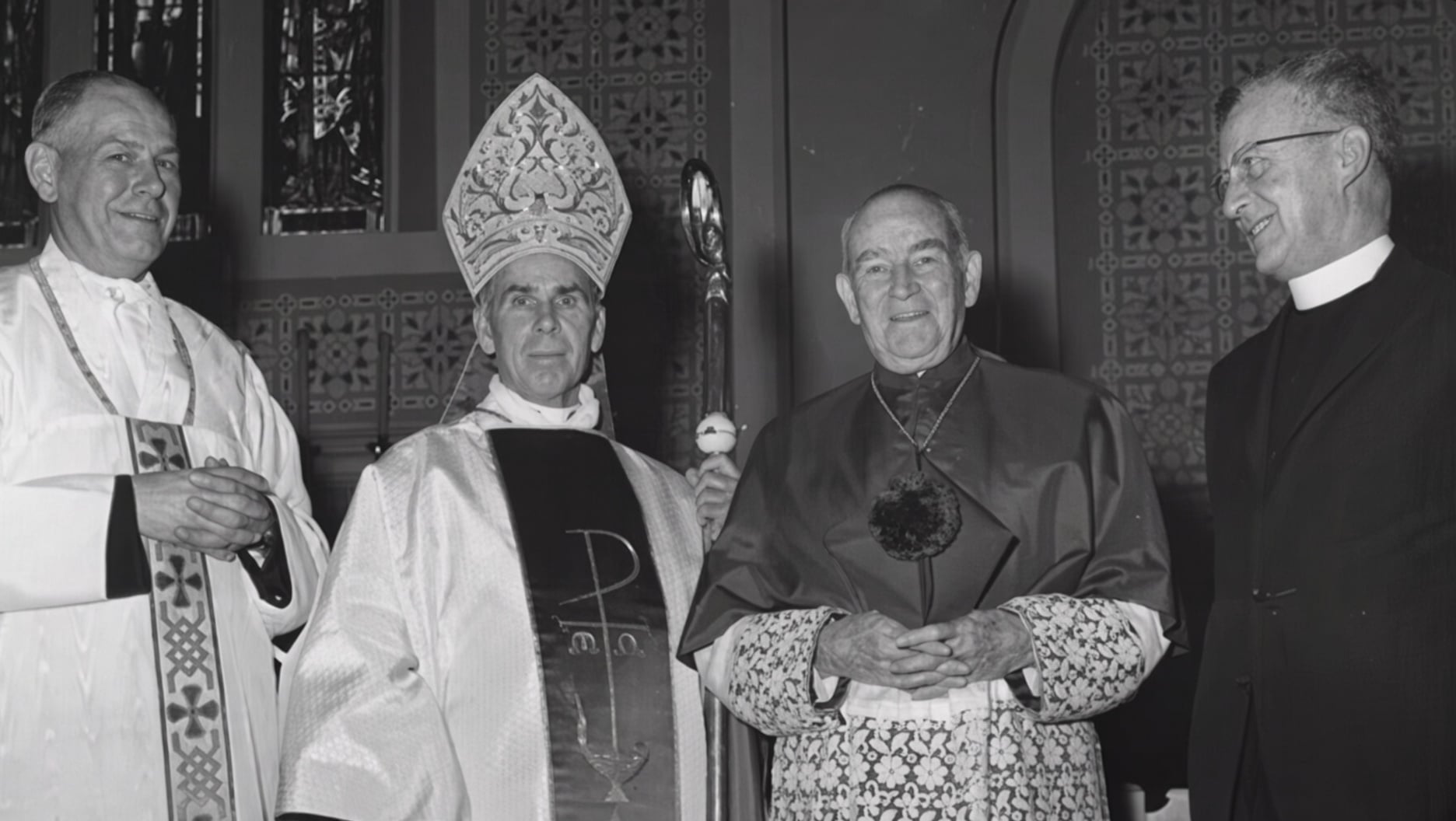
Pope Sixtus V established the Catholic Church’s office for scrutinizing candidates for beatification and canonization in 1587. 1 The official who was tasked with this duty came to be known as the Advocatus Diaboli, or “Devil’s Advocate,” though his official title is Promotor Fidei, “Promoter of the Faith.”
This position was all but eliminated in 1983 by John Paul II with his apostolic constitution Divinus Perfectionis Magister, which drastically reformed the canonization process. Prior to this, a canon lawyer would typically be tasked with arguing against the candidate.
Bishop Fulton Sheen, whose beatification in the Conciliar Church is almost certainly a precursor to his canonization 2 , will not have a Devil’s Advocate to oversee his case. This means that no one has been tasked to meticulously scrutinize his flaws — public and private, no matter how slight — in light of traditional Catholic teaching. Given that something is good when it is good in every respect, and bad when it is bad in any respect 3 , any candidate with a provable and substantiated defect, much less many, should not be honored by the Catholic Church as beatus, “blessed.” In the case of a canonization, the Holy Ghost would indeed prevent such a thing from ever occurring. 4
On Thursday, September 24, the notoriously heterodox Cardinal Luis Antonio Tagle will preside over a beatification ceremony for Sheen in St. Louis, Missouri. President Donald Trump has already offered his approval, noting in a social media post Sheen’s “heroic commitment to nourishing the soul of our country will inspire others to follow his example and lift our Nation upward and ever higher to God.” On Wednesday, September 23, Leo XIV himself drew inspiration from Sheen. “May the example and intercession of this holy bishop, known for his evangelizing work through the media, inspire many others likewise to find new ways of spreading the gospel message with joyful enthusiasm,” he said during an audience in the Vatican.
Over the past several days, scores of clergy and lay influencers have breathlessly championed the many good things Sheen did and said throughout his career. This is of no real significance in the face of the Devil’s Advocate, whose function is to focus not on the natural virtues of an individual per se but on accusations of substantial theological error or objective, public sin.
Undoubtedly, Sheen was a gifted rhetorician, highly intelligent, and opposed many of the modern evils of his day; but the problem is his lack of a consistent and integral witness to the Catholic faith and moral law, most especially during and after the revolution that occurred at the Second Vatican Council. An apt, albeit generous, historical comparison to Sheen would be Tertullian — an important Early Church figure in Catholic history, but one who nonetheless deviated from orthodoxy when it mattered most.
In recent months, Integrity Magazine has essentially stood alone in conducting a sober, objective appraisal of Sheen’s historical efforts. In decades past, Tradition in Action did this with original investigative work on his many deviations from orthodoxy. Already, Integrity has published essays reviewing his problematic reign as Bishop of Rochester in the late 1960s, his promotion of Vatican II ‘s reforms and erroneous teachings, his Americanist tendencies on Church-State relations, and his enthusiastic promotion of dissident Teilhard de Chardin. This essay continues that trajectory by challenging the pre-existing assumptions of those who admire Sheen.
Sheen’s immense popularity
In the winter of 1956, Bishop Sheen was ranked the third most admired man in the world among Americans, according to Gallup. Three years prior, he had won an Emmy award for “Most Outstanding Television Personality,” beating out figures no less prominent than Lucille Ball, Arthur Godfrey, and Jimmy Durante.
By 1961, on the eve of the Second Vatican Council, American Catholics were still mesmerized by Sheen. America Magazine conspicuously ranked him alongside Teilhard de Chardin and Thomas Merton as its most popular spring authors. Fast forward to today, and not much has changed.
Last week, on September 17, Sheen was praised on the floor of the United States Congress by Republican Representative Darin LaHood. Conservative influencer Jack Posobiec, meanwhile, has repeatedly promoted Sheen to his audience of over 3 million followers on X nearly every day. Bishop Barron, Taylor Marshall and even the world’s richest man, Elon Musk, have joined in the praise a well. The phrase “Full Sheen ahead!” is now commonplace.
All of this is unfolding in the context of Sheen’s upcoming beatification attempt. Increasingly, many Catholics are aware of, and are even publicly noting, his many problematic statements and actions. On Wednesday, September 23, Brother André Marie, M.I.C.M, issued two X posts expressing concern with Sheen’s theological views.
“He openly praised and embraced the errors of one of the greatest charlatans of our time, the notorious Pierre Teilhard de Chardin, S.J.” Marie wrote.
This same concern was also voiced by Hugh Owen, founder of the Kolbe Center for the Study of Creation. In a recent essay, he warned about Sheen’s embrace of Teilhard’s “evolutionary” anti-theology.
Aside from these concerns, users on social media have helped share the fact that in 1978 Sheen erroneously maintained that the Novus Ordo Missae was merely a translation of the Traditional Mass “from Latin to the vernacular,” entailing no “doctrinal changes.” Kirk Hansen of the Ascent of Mount Carmel YouTube channel has also drawn attention to the fact that Sheen introduced a highly controversial “sex education” program into the Rochester Diocese, and that it was vociferously opposed by faithful Catholics — a controversy Sheen himself later declined to address, telling the press only “no comment.”
For Catholics who are not yet convinced to reconsider their admiration for Bishop Sheen, below are four topics and corresponding questions one hopes they will grapple with.
1. Affinity for and consistent promotion of Teilhard de Chardin
Given the claim that Bishop Sheen was an obedient son of the Church, why did he fail to heed the 1962 Holy Office ruling which explicitly forbade the promotion of Teilhard de Chardin and his works?
In 1962, the Holy Office formally condemned the works of Teilhard de Chardin — a notorious evolutionist, quasi-pantheist French Jesuit known for his promiscuous embrace of modern science and its alleged findings. The Holy Office’s monitum warned bishops, religious superiors, seminary rectors, and others to protect the minds of the faithful, “particularly of the youth,” against the dangers posed by Teilhard’s writings and those of his followers, as they contain “serious errors” that “offend Catholic doctrine.”
As a bishop, Sheen would have been a recipient of this grave warning and thus it was his duty to abide by it. Unfortunately, he did the opposite, praising Teilhard throughout his career, even going so far in 1967 as to speculate that he “will appear like John of the Cross and St. Teresa of Avila, as the spiritual genius of the twentieth century.” That same year in his book Footprints in a Darkened Forest, Sheen devoted an entire chapter of effusive praise for Teilhard.
Perhaps Sheen’s most damning promotion of Teilhard came in his admiration for the latter’s infamous 1923 Desert Prayer, which Sheen confidently repeated to millions — including countless youths — watching his television show:
Since I, your priest, O Lord, have this day neither bread nor wine nor altar, I am going to spread my hands over the entire universe and and take its immensity as the matter of my sacrifice. Is not the infinite circle of things the ultimate host that will be transformed? Is not the seething crucible wherein mingled and boiled up all the operations of living and cosmic substances the chalice of pain that you desire us to sanctify? So let there be repeated again, today and tomorrow and forever — until the transformation shall have been exhaustibly affected in the divine words — this is my body.
Sheen’s invocation of Teilhard’s prayer occurred in an episode entitled “Stop World, I Want to Get On” 5 and was broadcast in color on The Fulton Sheen Program (1961–1968), meaning at the very earliest it was from 1965 6 — which places it after the 1962 Holy Office ruling. Confirming this was Sheen’s own reference to the 1961 broadway musical “Stop World, I Want to Get On,” the inspiration for the program’s title, and which he mentions “was here on broadway a few years ago.” 7
2. Novel attitude toward false religions
Did Bishop Sheen substantially adopt the attitude of the Roman Catechism produced after the Council of Trent on false religions and, if not, why not?
The Roman Catechism is the most authoritative universal catechism in the Catholic Church and is renowned for, as Pope Clement XIII affirmed, its freedom from “all error.” In its pages, the traditional attitude and position of the Church towards false religions is expressed. All “other societies arrogating to themselves the name of church, must necessarily, because guided by the spirit of the devil, be sunk in the most pernicious errors, both doctrinal and moral,” it teaches. 8
Bishop Sheen, however, took a markedly different attitude on this subject at times. In the 1950s, his Life is Worth Living show was in full swing, airing weekly on ABC and drawing millions of viewers. An archived YouTube episode from 1956 entitled “How to Compare World Religion” shows Sheen making many good points, including classic apologetics for Our Lord’s divinity by way of fulfilling prophecy and working miracles. Yet, towards the middle of the program, Sheen shared the following troubling remarks:
The Dispatch
What, then, is the proper attitude to take toward all world religions? Well, really, the proper attitude to take is that there is something good in all of them. Perfect truth is really like a circle … [joking about his handwriting] … Now, truth is like that circle — it has 360 degrees and that fullness would be found, for example, in the fullness of Christ’s Mystical Body. Now, we are to think of every religion under the sun as having something good, maybe some religion that started this afternoon in Los Angeles. That’s got some good in it — we only have ten degrees but it’s got some good. Buddhism, Confucianism, all the other world religions they have all got good in them. Then you get the others, maybe they’ll have something like 240 degrees of truth. Therefore, our attitude is not to be constantly to be pointing out the error, looking for the defects, seeking what is black — but rather laying hold of what is good (emphasis added).
After attempting to enlist Saint Paul (Acts 17, 22-23) in this apologetic approach, Sheen explained further:
And so, with world religions — everything is good. We can just as well start Christianity with Buddhism and Confucianism as we started with Plato and Aristotle. Therefore, it should not be the business of those who wish to give a divine religion, for example to Asia, to think they have to destroy everything. Start with what is good. Remember what is true in them [other religions] comes from God! What is erroneous comes from us!
At best, this presents a misleading picture of false religions, which are all the more, not less, dangerous owing to their mixing of truth with error. After all, who would be deceived by pure error?
Moreover, nowhere in his explanation did Bishop Sheen make the essential distinction between merely natural truths, which may be present in false religions, and supernatural truths; the latter belonging uniquely to the Catholic religion and which are stolen to the extent they exist, accidentally, in false world religions, i.e. Protestantism, Judaism, Shintoism, etc.
Rather, Sheen spoke only of unspecified “religious truths,” giving the impression of supernatural truth, while identifying them wrongly in false religions as such and treating them as a pathway of sorts to God. He also said the same of goodness, omitting the essential distinction between merely natural goods and supernatural goods.
Perhaps this is why in his 1980 autobiography, Treasure in Clay, Sheen esteemed the sacraments, asceticism, and prayer of false religions, stating:
The good Hindu, the good Buddhist, the good Confucianist, the good Moslem are all saved by Christ and not by Buddhism or Islam or Confucianism but through their sacraments, their prayers, their asceticism, their morality, their good life. (page 148)
What a far cry this is from Saint Paul’s proclamation that “without faith it is impossible to please God” (Hebrews 11:6).
3. Bishop Sheen and Bella Dodd
If Sheen’s anti-communist bona fides are unimpeachable, why did he forbid Bella Dodd from publicly exposing four communist cardinals?
Most Catholics know that Bishop Sheen was a forceful and outspoken critic of communism, which he called “the scavenger of decaying civilizations.” No less well-known is his successful efforts to convert Bella Dodd, a former committed communist.
A troubling question arises from Dodd’s later life, however. According to Dr. Alice von Hildebrand 9, wife of philosopher Dietrich von Hildebrand, Dodd told the couple that during her time in the Communist Party she had been in close contact with four cardinals in the Vatican, whom she described as “working for us.” 10 Von Hildebrand relayed that Dodd was not permitted to name them because Sheen, her spiritual director, forbade her from doing so. 11
If this testimony is true — and there is no good reason to doubt it — it is hard to envision a scenario in which Sheen could justify the silence. Our Lord warned against false shepherds and compared them in the Gospel of Matthew to “ravenous wolves.” Pope Leo XIII described communism a “deadly plague” that attacked private property, the family, and legitimate authority. 12 Pope Pius XI similarly declared communism “intrinsically wrong” and insisted that no one who wishes to save Christian civilization may collaborate with it in any undertaking whatsoever. 13 Communist Cardinals would therefore be wolves threatening potentially millions of souls. Why, then, would Sheen prevent Dodd from naming men who, by her account, served that ideology from within the hierarchy?
Even if Sheen acted out of prudence for fear of scandal and wanting it to be handled privately, the matter still deserves heightened scrutiny, especially in light of his perplexing promotion of the Saul Alinsky-affiliated Father David Finks in the Diocese of Rochester.
4. Publicly waffling on the intrinsic evil of contraception
If Bishop Sheen was truly in possession of heroic virtue, which is necessary in order for someone to be canonized a saint, why did he once tell contracepting married couples on national television to ‘continue making love’ and ‘trust in the mercy of God?‘
Bishop Sheen is well known for his repeated and public condemnations of contraception and artificial birth control. Against these evils Sheen dedicated entire programs and distinguished himself as one of the few prelates 14 who upheld Paul VI’s Humanae Vitae against artificial contraception — even though the conciliar document is not without its problems.
Stand with Integrity: Become a supporter today!
However, as his official biographer Thomas Reeves notes, there is at least one recorded instance in which Sheen softened his position. 15 On a 1969 episode of the The David Frost Show, Frost, after discussing priestly celibacy, pressed Sheen on birth control, raising the example of a married couple that did not want or dared not have more children. “What do you say to those people, cease making love?” he asked. To which Sheen answered, “I say to them, ‘I am still convinced that this is not right, but under the circumstances you must trust in the mercy of God. And you continue to make love’” (emphasis added). 16 17
Frost then asked if the advice would extend to the continuance of marital intercourse “with birth control.” Sheen replied:
Yes, with birth control. Believe me, this is a question of anguish — and we must admit that there are cases that tear your heart out, and concessions are made to these people. No one ever lays the finger on them and says that this is a sin. Here is only a moral guide. This is the ideal. This is the law. Not all of us keep the law … I sympathize with all these people with all of my heart. And so does the Church. And that was also the way the Holy Father concluded and he begged them over and over to trust in the mercy of God, and to abide in prayer (emphasis added). 18
While Sheen’s answer is not a simple endorsement of contraception, he breathlessly explains it away. One cannot help but recoil in shock at the answer he provides, especially given that a firm “no” would have sufficed.
What’s more, Sheen claims what is an objectively sinful practice is not one, implicitly sanctioning mortal sin on national television. This is in contrast to Pius XI’s 1930 encyclical Casti Connubi “On Christian Marriage,” wherein the possibility of matrimony being “exercised in such a way that the act is deliberately frustrated” is an offense “against the law of God and of nature.”19 Unlike Bishop Sheen, Pius XI clearly taught that those who engage in such behavior ought to be “branded with the guilt of a grave sin.” 20
To learn more about Fulton Sheen from a Devil’s Advocate perspective, consider reading the following Integrity Magazine essays:
- There are good reasons why Fulton Sheen should not be considered for beatification
- Fulton Sheen enthusiastically promoted Vatican II’s Modernist reforms
- Kolbe Center founder warns about Fulton Sheen’s embrace of Teilhard de Chardin’s ‘evolutionary’ theology
- EWTN shares video of Fulton Sheen promoting dissident Teilhard de Chardin
- EWTN deletes scandalous Fulton Sheen video after backlash on social media
- Sorry, Fulton Sheen: The laity will not ‘save’ the Church
- Fulton Sheen the Americanist? A critical examination of his remarks on Church-State relations
- Unlike the former, the latter is an infallible act of the Pope definitively and finally declaring such a man to not only be 1) enjoying heaven, but to have lived a life worthy of 2) veneration and 3) imitation. In this way, true Saints and their example are an implicit rule of morals established by the Church. ↩︎
- One searches in vain throughout Catholic history to find a single example of a recipient of formal beatification who was later determined to be unfit for canonization. ↩︎
- The Latin maxim reads: bonum ex integra causa, malum ex quocumque defectu. ↩︎
- Fr. JV De Groot, O.P., The Infallibility of Canonizations, 1909. — “God, who fits means to their end, will provide, for the sake of safeguarding the truth in the Church, that the Church’s judgment concerning the saints not be corrupted by any error or falsehood of witnesses. For the Church is guided in judgments of this kind ‘chiefly through the instinct of the Holy Spirit;’ and ‘divine providence preserves the Church, lest she be deceived in such matters through the fallible testimony of men.’ St. Thomas, loc. cit.” ↩︎
- Thanks is to be extended to Mr. Kelvin Sandigo for tracking down the original on YouTube. ↩︎
- The research database EBSCO reports that only the last two seasons of The Fulton Sheen Program were in color, meaning the 67’ and 68’ seasons, whereas the first 5 seasons of the same show were in black and white along with the entirety of Life is Worth Living which ended in 1957. As of publication, the episode remains listed on the Fulton Sheen Company Inc catalog. ↩︎
- The musical Stop the World – I Want to Get Off opened in London’s West End on 20 July 1961 (after a tryout in Manchester) and on Broadway on 3 October 1962. ↩︎
- Catechism of the Council of Trent, Part I, Art. IX, Q. XV. ↩︎
- Alice and her husband Dietrich befriended Dodd around 1965–66, after meeting at one of her lectures. ↩︎
- Symonds, Kevin. “Rethinking Bella Dodd and Infiltration of the Catholic Priesthood.” Homiletic & Pastoral Review, 24 Dec. 2021. ↩︎
- Symonds, Ibid. ↩︎
- Pope Leo XIII, Quod Apostolici Muneris, (1878). ↩︎
- Pope Pius XI, Divini Redemptoris, (1937), no. 58. ↩︎
- Reeves, Thomas, “The Life and Times of Fulton Sheen: America’s Bishop”, (2001), pp. 323-32. ↩︎
- Ibid., p. 338 ↩︎
- Ibid., p. 338. ↩︎
- This exchange was also recorded contemporaneously by the Catholic Courier Journal in the issue on September 19, 1969. “Arbp. Sheen Discusses Church Change” was the headline for the article. ↩︎
- Reeves, Ibid. ↩︎
- Pope Pius XI, Casti Connubi, (1930), no. 56. ↩︎
- Ibid. ↩︎