Editor’s note: This article contains references to vulgar language.
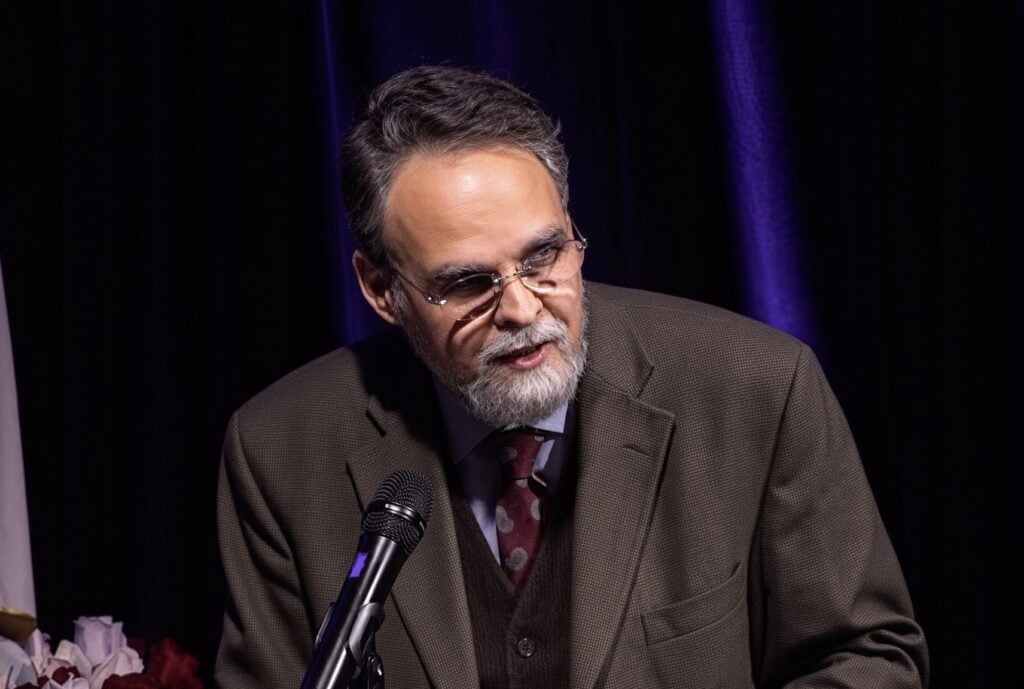
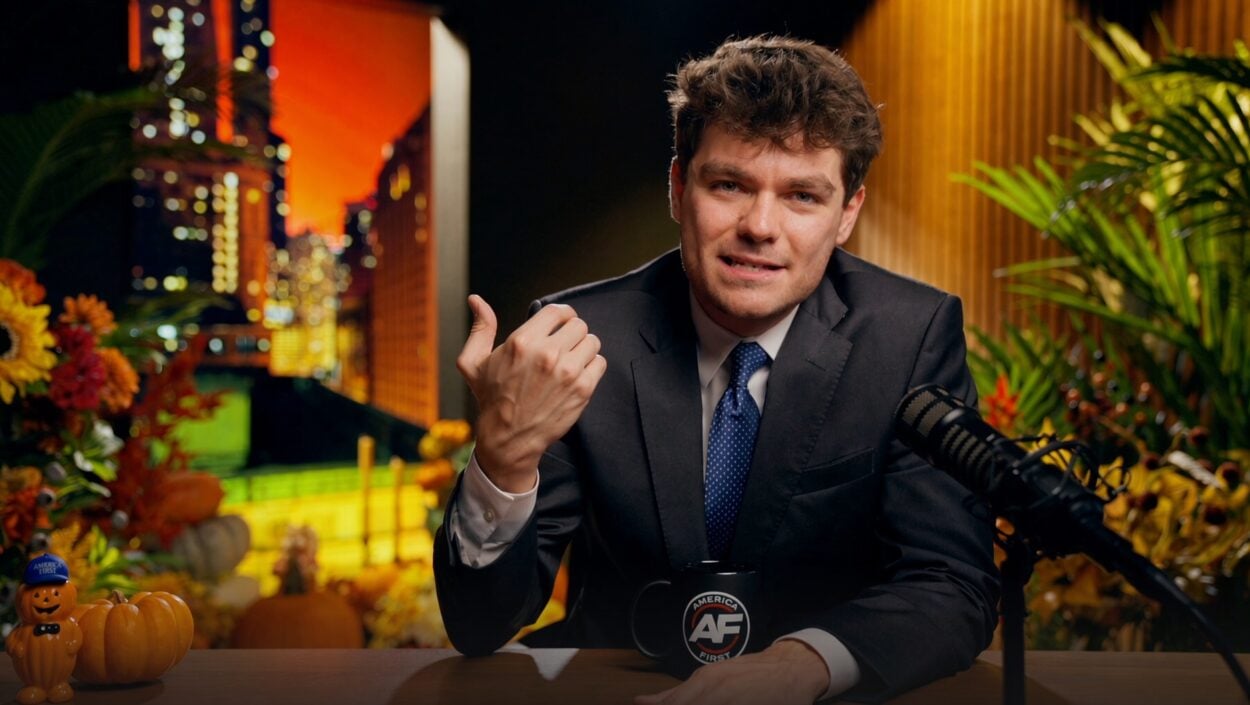
Twenty-eight-year-old political commentator Nicholas J. Fuentes may be highly controversial but he should not simply be dismissed with cheap epithets.
True, Catholics are justified in condemning Fuentes’ foul, often obscene language and other indiscretions on his livestreams as they cause scandal and tarnish his Catholic witness. Yet he remains enormously popular with his Gen Z followers — the Groypers — precisely because he offers something truly exceptional: razor-sharp insight into United States and international politics, with zero regard for the tired, sacred cows of the post-World War II consensus that reinforces the prevailing Judeo-Masonic paradigm.
For young Catholic men in America, Fuentes is one of the few voices willing to resolutely proclaim unpopular truths about feminism, race, liberalism, and, most especially, Jewish power. It is therefore strange that he does not extend this courageous approach to his Catholic faith, as demonstrated by statements he made on a recent show.
In footage shared on social media last month, Fuentes is seen responding to a viewer’s question about the Second Vatican Council. He has addressed the subject before. Unfortunately, his comments reveal an insoluble contradiction between his political and religious worldviews.
Fuentes dismissed the idea that a lay Catholic should sit in judgment over an ecumenical council: “It’s not my favorite thing of all time, but that’s the Church … we must do what the Pope says.” He further explained, “I don’t have an opinion. I do what the Pope [says] … who died and made you the Pope?”
Firstly, what Fuentes may not know is that the original schemas drafted prior to the Council were replaced with modernist tainted ones that were at odds with prior Church teaching on an array of subjects thanks to a coup effort waged by liberal and dissident clergy, some of whom were not only philosemitic but were actively doing the bidding of Jewish lobby groups and the U.S. Deep State.
Given that the Council and its subsequent reforms have — in fact — evidently and regularly deviated from Catholic doctrine as it has always been taught and received, it is not sufficient for a Catholic such as Fuentes today to simply superficially “obey” whatever the post-conciliar authorities are teaching. The rotten “fruits” of closed parishes, fewer vocations, laity who do not abide by the Church’s moral teachings, and abusive clergy are also just a few of the many signs that the Council itself should be scrutinized closely by those who are intellectually able to do so, given that prior to it these were not normative.
In the video clip, Fuentes says that he has no personal “opinion” on the Council because it is his responsibility to be docile rather than to offer private theological insights. This is all well and good and even emblematic of the proper Catholic attitude and position with respect to papal authority — abstracting from the present crisis in the Church, of course.
However, in April of this year, not only did Fuentes share his personal views on the Council but he drew attention to the false ecumenism embodied in Nostra Aetate. After offering an intelligent critique of the text and its implementation, he described it as “a flawed document.”
This is the central problem for Feuntes. He clearly is aware that Vatican II’s landmark document on Rabbinical and Talmudic Judaism is “flawed” and he is likely aware that he offers criticisms that sharply diverges from the remarks made by modern post-conciliar Churchmen on the subject. Being caught in such a dilemma is not simply resolved by saying “we must do what the Pope says” as the conciliar popes themselves are the ones enforcing the “flaws” in Nostra Aetate to the detriment of what Fuentes is seeking to accomplish politically.
The Dispatch
Having said that, Vatican II is more than flawed. It erroneously declared that Scripture does not teach that the Jews can be portrayed as corporately rejected (Mt. 21:33–46) or that they are laboring under a curse (Mt. 25:27). It also explicitly condemned “hatred, persecutions, displays of anti-Semitism” directed against Jews, while failing to define that term. It further encouraged “mutual understanding and respect” between Christians and Jews. Nostra Aetate — in the vein of the “perennialism” criticized by Fuentes — also blasphemously maintains that the Church has “a high regard” for the “doctrines” of false religions, not only those doctrines which, fortuitously, may be true, but even those which “differ” from her own teaching.
One hopes Fuentes will recognize that not having an opinion on such matters is not an option.
Even more to the point, Leo XIV, the man Fuentes pledges his fealty to, has enthusiastically and repeatedly championed Nostra Aetate. In 2025, while commemorating the 60th anniversary of that document, Leo described its treatment of Judaism as its “heart and generative core,” while stressing its rejection of antisemitism and maintaining that “the Church does not tolerate anti-Semitism and fights against it.”
Notably, Fuentes has on more than one occasion publicly defended the traditionalist Catholic position that the Jews have a unique responsibility in the passion of Our Lord. This position, however, places him directly at odds with post-conciliar teachings and the implementation of the reforms. His political rhetoric concerning Jews, in other words — especially support for social restrictions on Jews in public life — has consistently been the exact opposite of what Vatican II demands. If Fuentes’s “I do what the Popes say” comment was made literally, then his long-standing position is nearly diametrically opposed to Paul VI and his conciliar successors.
Immigration, the death penalty, and Leo XIV
The variance between Fuentes and those who he claims as his Catholic authorities extends beyond Judaism, however. Refreshingly, Fuentes’ politics emphasizes nationalism, racial preservation, and severe immigration restrictions, while Leo, by contrast, has repeatedly spoken of protecting migrants and refugees, called for more mass immigration, and endlessly championed the false humanism universally imposed by the allied victors of World War II.
Leo’s most recent 2026 message on migration, for instance, called for “protection, welcome and genuine opportunities for integration.” On July 4, while visiting Spain, he gave a symbolic imprimatur for the borderless world long-envisioned by Jewish powers. This hardly resembles the political instincts normally associated with Fuentes’s hardcore, America First nationalism.
Enjoying this article? Become a monthly supporter of Integrity today!
It is also difficult to see to what extent Fuentes is willing to obey Leo’s un-Catholic insistence that the death penalty is “inadmissible” and condemned, or his public support for its worldwide abolition in the name of. Fuentes has previously called for the death penalty for Karmelo Anthony. “The courts need to make an example,” he said.
What’s more, Leo’s globalist-tainted speeches emphasize liberal solidarity, exaggerated human dignity, and international cooperation while warning against reducing politics to categories such as “us or them.” This is a far cry from Fuentes’s worldview, though he and others would likely characterize Leo’s comments as non-dogmatic.
Thus, we see that Fuentes, the political dissident who fights for American nationalism and often traditional values, has hardly anything in common with the conciliar popes and their dogma-less humanitarian religion. Whether he knows it or not, Fuentes has much more in common with traditional Catholicism and the popes prior to Vatican II.
Read more: Vatican II and the Protestant Reformation were united by the same revolutionary spirit
The good news for Nick is that he need not become politically liberal to remain Catholic. Instead, he might be pleasantly surprised to discover that, if he seriously investigated what traditional Catholicism has always taught, including its application to the present crisis, he would find himself far more at home there — and with far fewer contradictions. Not only that, but he would then be able to truly call himself an obedient Catholic.