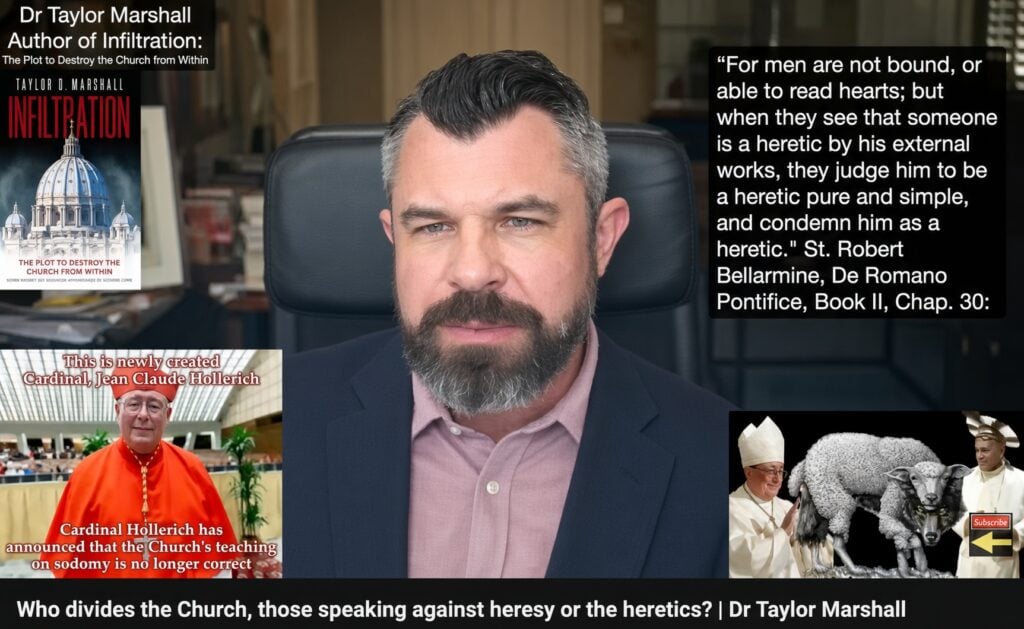
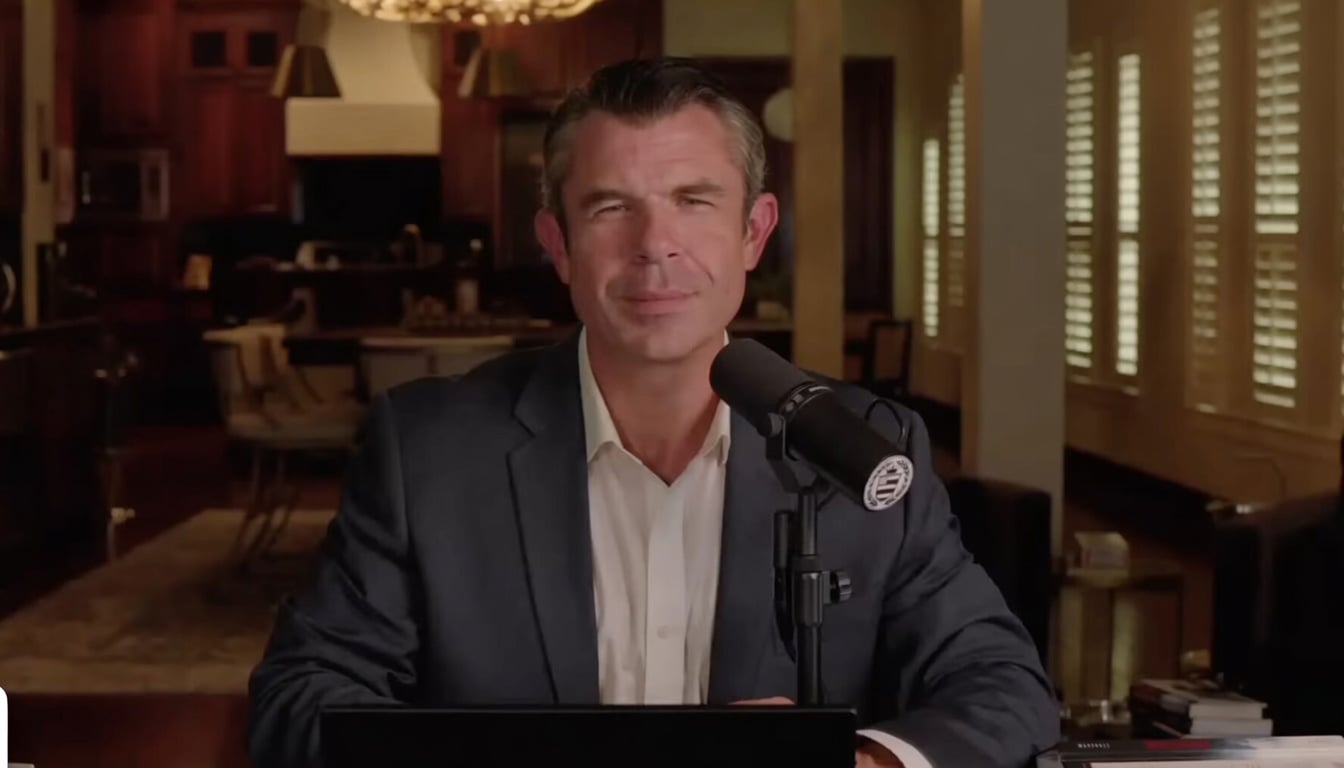
Readers will recall the infamous volte-face of Dr. Taylor Marshall in 2025 following the election of Leo XIV.
Having previously identified then-Cardinal Robert Prevost as the “worst case scenario,” Marshall now praises what he once decried, routinely promoting Leo and his many public appearances on social media.
What Dr. Marshall said about Cardinal Prevost in his now-deleted video, just three days before he took the name Leo XIV, is worth recalling before analyzing his evolving stance on the papacy and its prerogatives.
“He’s liberal. He emphasizes migrants, being pastoral, which usually is code word for denigrating dogma, denigrating morals,” Marshall rightly said. “He has supported the Amoris Laetitia movement for allowing divorced and civilly-remarried people to receive Communion and has shown support for Fiducia Supplicans … that’s the blessing of same-sex couples.” On nearly every one of these charges, Marshall has been proven correct.
The worst case scenario
In 2026 alone, Leo has distorted Church history and teaching on slavery to appease modern sensibilities, described the infernal Amoris Laetitia document as a “luminous message of hope regarding conjugal love and family life,” and has indirectly lent his imprimatur to the invasion of Spain when during a visit to the Canary Islands last month he told migrants, “I want to bow before your dignity.”
In 2025, while being interviewed with Crux, Leo entertained the possibility of “changing what the church says about any given question,” in particular about so-called LGBT issues. He said this while noting that there must be a “change [in] attitudes before” anything else.
These remarks implicitly amount to what Dr. Marshall described in his video as “denigrating dogma” and “denigrating morals”, given that the prohibition against unnatural vice is not subject to change.1
While Catholics no longer regularly hear the hard, often unpopular truths once given on his podcast, Dr. Marshall’s first accusation against then-Cardinal Prevost was not only his most accurate, but also his most succinct: “he’s liberal.”
Rightly denouncing conciliar errors
It is necessary to review some of the important public comments Dr. Marshall has made in recent years. Doing so will help us better understand the ecclesiological principles he maintained, whether he understood their implications or not at the time. This will also contextualize his approach toward Leo, differing greatly from his coverage of Francis.
In 2019, Marshall rightly and forcefully rejected the grave errors in Francis’ Abu Dhabi Declaration and Amoris Laetitia, observing that “this [Abu Dhabi] statement bothers me … I think it’s more heretical — more grievous — than anything in Amoris Laetitia except for the part, no, even the part where it says eternal condemnation is not according to the logic of the Gospel.”
In 2021, Dr. Marshall correctly identified both Dignitatis Humanae and Gaudium et Spes as being at rupture with Catholic Tradition. That same year, he jokingly claimed to “submit with full religious submission and assent to all the canons and anathemas of the Second Vatican Council — all of them!”, perhaps not realizing that the extraordinary magisterium, if exercised, demands the assent of faith, not merely obsequium religiosum.2
Most tellingly in 2021, Marshall went so far as to assert the existence of a “false church” established in the 1960s and 70s, whose genesis any reasonable third-party would attribute to the Second Vatican Council. In his book Infiltration, he was not afraid of using the term “novus ordo Church.” 3
More recently, in 2024, Marshall added his name to a letter co-signed by a group of over ninety priests and scholars asking Francis to withdraw Fiducia Supplicans, a declaration he explicitly approved and which blasphemously permits — under certain circumstances — the blessing of homosexual couples, as such.
Even though Fiducia Supplicans engaged what appeared to be the ordinary Magisterium, the signatories maintained that “the error comes from the Roman See and is destined to scandalize all the faithful.”
Recent changes in argumentation
Despite having admirably rejected the errors coming from Rome for nearly a decade — often tracing them to their root cause, Vatican II — Dr. Marshall now appears to be familiarizing himself more fully with Catholic principles of ecclesiology. While subtle, this would explain his recent commentary, or lack thereof, when it comes to publicly rejecting the same conciliar errors emanating from Leo XIV.
The Dispatch
This change was likely accelerated by the looming, now completed, SSPX consecrations and attempted excommunications last month.
For evidence, on June 1, Marshall sincerely asked his X followers if they knew what degree of assent is owed to specific doctrines in Nostra Aetate, the Vatican II declaration on non-Christian religions. “I’d like to see [this] clarified this year,” he stated.
Later that month, he spoke favorably about John Salza and Robert Siscoe — both of whom were previously committed “Recognize and Resist” partisans 4 but who have since abandoned the stance owing to its insoluble ecclesiological problems.
On July 31, Marshall responded to Salza and Siscoe’s “Trad Answers” X account by giving them book recommendations. He suggested they read Father Bernard Lucien, an intelligent and ardent opponent of the Recognize and Resist position, who has vigorously attempted yet failed to reconcile Dignitatis Humanae with Catholic tradition.
Earlier, in 2025, perhaps due to realizing that universal disciplinary laws are secondary objects of infallibility — which is to say a given liturgical law for the Catholic Church is guaranteed to never be bad, nor harmful nor burdensome — Dr. Marshall revised his position on attendance at the “New Mass” of Paul VI.
During an appearance on Fr. Chris Alar’s podcast, Marshall said that he will attend the Novus Ordo Missae on occasion when traveling.
What this new trajectory suggests is that Marshall will no longer be publishing video titles such as “Is Pope Francis creating a ‘Different’ Church?”, even though Leo XIV is committed to the same conciliar ideology and program.
False presentation of John XXII
Despite Dr. Marshall’s seeming decoupling from the classic Recognize and Resist position, some of his tendencies have not gone away — at least not yet.
As recently as July 26, Marshall trotted out the tired case of Pope John XXII in an attempt to draw a tenuous analogy to the present crisis in the Church and reinforce the idea you have to stay with Leo XIV, whom he considers Pope.
But Marshall relayed the case erroneously, erring on both the fact and principle of the matter, claiming that Pope John XXII “publicly admitted that he had personally preached heresy.”
Dr. Marshall erred on a matter of fact because John XXII’s opinion was just that: an opinion, not heresy. Only with and after the definition of his successor, Pope Benedict XII, did the denial become heretical, which until that time was lawfully able to be controverted.
Join the Counter-Revolution: Donate to Integrity today!
The error on a matter of principle, at least implied in the context of Marshall’s response, was that John XXII engaged the Magisterium to diffuse this error. This is not true. Rather, he publicly offered his opinion in sermons, without exercising the Papacy with its prerogatives. Without this essential distinction, the audience is liable to believe Pope John XXII errored in the sense Protestants, Gallicans, and Modernists have long since maintained — which is not true.
Incidentally, John XXII permitted others to hold the more common opinion on the matter and, before his death, retracted his minority view altogether.
A vacancy is the only reasonable conclusion
All this being said, as Marshall continues to familiarize himself with Catholic principles of ecclesiology, fully abandoning his Recognize and Resist theology, the formal vacancy in the Apostolic See since 1965 will continue staring him in the face, with all of its implications.
Unfortunately, he seems absolutely opposed to admitting this reasonable conclusion — one can only speculate as to the motivations, good or ill — and so he is likely to begin denying the evident facts of the Crisis, sanitizing the doctrinal revolution of Vatican II and becoming its biggest cheerleader.
- Pope St. Pius X, Lamentabili Sane, (1907), props. 54, 58 & 64. ↩︎
- Fr. Joachim Salaverri, S.J., The Force of Encyclicals in Light of “Humani Generis”, (1952) — “Examining the doctrine of theologians concerning the virtue by which this act of assent pertains, we have found with surprising unanimity that it is the virtue of obedience. The same answer has been given to us formally or equivalently by the monuments of the Magisterium of the Church itself. According to this we can take it as common doctrine in the Church, that the internal assent to the teachings of the ecclesiastical Magisterium is an act of intellectual obedience, in which out of reverence for God we submit ourselves to the doctrinal authority of the Church, and for this reason the theologians are also accustomed to call it religious assent, because as Saint Thomas teaches: ‘ad religionem pertinet exhibere reverentiam Deo, in quantum est principium creationis et gubernationis rerum”. ↩︎
- Dr. Taylor Marshall, Infiltration, Sophia Institute Press, 2019, p.164 ↩︎
- Fr. Domenico Palmieri, S.J, Treatise on the Roman Pontiff, (1891) — “Therefore those men miserably deceive themselves who think that they can adhere to the Roman See and the Roman Church while resisting the Pontiff.” ↩︎