
Editor’s note: This is Part II in a series of essays on Dei Verbum and the Second Vatican Council. Click here for Part I.
The Traditional teaching on inerrancy and inspiration
The magisterial teaching on Scriptural inspiration and inerrancy is primarily found in two encyclicals: Providentissimus Deus by Pope Leo XIII in 1893 and Spiritus Paraclitus by Pope Benedict XV in 1920, the latter of which clarifies and expounds upon the former.
Both encyclicals explicitly condemn any distinction between the degrees of inspiration and inerrancy in the “religious” or “primary” content of scripture versus the “profane” or “secondary” content.
They establish — according to the teachings of St. Augustine, St. Thomas Aquinas, and St. Jerome — that all Scripture is equally inspired, containing no error of any kind, physical or historical, however inconsequential certain details may appear. They also strictly define that God did not permit any error whatsoever on the part of the human authors of the Bible, as any error attributed to them would be attributed to God.
Historical and scientific inerrancy
Concerning truths of the natural world, Leo XIII quoted St. Thomas, who says that the sacred writers “went by what sensibly appeared,” that is, they did not write in a technical sense, but in a manner accommodated to common human experience and perception.
Of course, St. Thomas did not mean that those things in Scripture which touch upon facts of the natural world are given in a false or deceptive manner, nor that Scripture, lacking scientific authority, never intends to speak on such things. “We have to give belief to those things written in the books of the prophets,” St. Thomas writes elsewhere, “even though they treat of conclusions of scientific knowledge.”
The Angelic Doctor goes on to explain, according to St. Augustine, that the Holy Ghost only related in Scripture what was useful for salvation, which means that the answers to certain obscure secrets of the physical universe cannot be derived from Scripture.
At the same time, St. Thomas maintains that there are also many truths of the natural world that can be useful for salvation, as they lead to piety and magnify God’s wisdom and power. “Hence,” he writes, “we find that mention of these is made in Holy Scripture.”
Quoting from the same work by St. Augustine, Leo XIII further establishes that while it was not the intention of the Holy Ghost to elucidate the “essential nature” of the physical universe, Scripture — being absolute truth — nevertheless enjoys authority over the human sciences. Any scientific theory, therefore, which contradicts Scripture must be rejected.
“Whatever they [i.e., the natural philosophers] assert in their treatises which is contrary to these Scriptures of ours, that is to Catholic faith, we must either prove it as well as we can to be entirely false, or at all events we must, without the smallest hesitation, believe it to be so,” he affirmed.
While the Popes allowed that the sacred writers spoke “according to appearances” on physical things, they forbade the opinion that Scripture similarly narrates history merely according to how things appeared to have happened at the time.
Benedict XV, for instance, condemned in Spiritus Paraclitus those “who hold that the historical portions of Scripture do not rest on the absolute truth of the facts but merely upon what they are pleased to term their relative truth, namely, what people then commonly thought, [etc.].”
“For whereas physics is concerned with ‘sensible appearances’ and must consequently square with phenomena,” he writes, “history on the contrary, must square with the facts, since history is the written account of events as they actually occurred.”
‘De Fontibus’ upheld the Traditional teaching
Vatican II’s original schema on Scripture and Tradition, De Fontibus, clearly maintained all these points, rejecting any distinction between the inspiration of the religious message intended by the author and the “merely profane” details of nature and history which they included in the text:
“Similarly, since God himself by the inspiring Spirit is the Author of all Holy Scripture and, as it were, the writer of everything produced in it by the hagiograph’s hand, it follows that all and each of the parts of the sacred books, even the slightest parts, are inspired. Therefore, everything stated by the hagiograph must be considered to have been stated by the Holy Spirit,” it reads.
The Dispatch
Enjoying this article? Donate today to support Integrity’s writers.
“Because divine Inspiration extends to everything, the absolute immunity of all Holy Scripture from error follows directly and necessarily. For we are taught by the ancient and constant faith of the Church that it is utterly forbidden to grant that the sacred author himself has erred, since divine Inspiration of itself as necessarily excludes and repels any error in any matter, religious or profane, as it is necessary to say that God, the supreme Truth, is never the author of any error whatever,” it also states.
The Modernists go to war
This passage of De Fontibus came under attack in the autumn of 1964 during the third session of the Council.
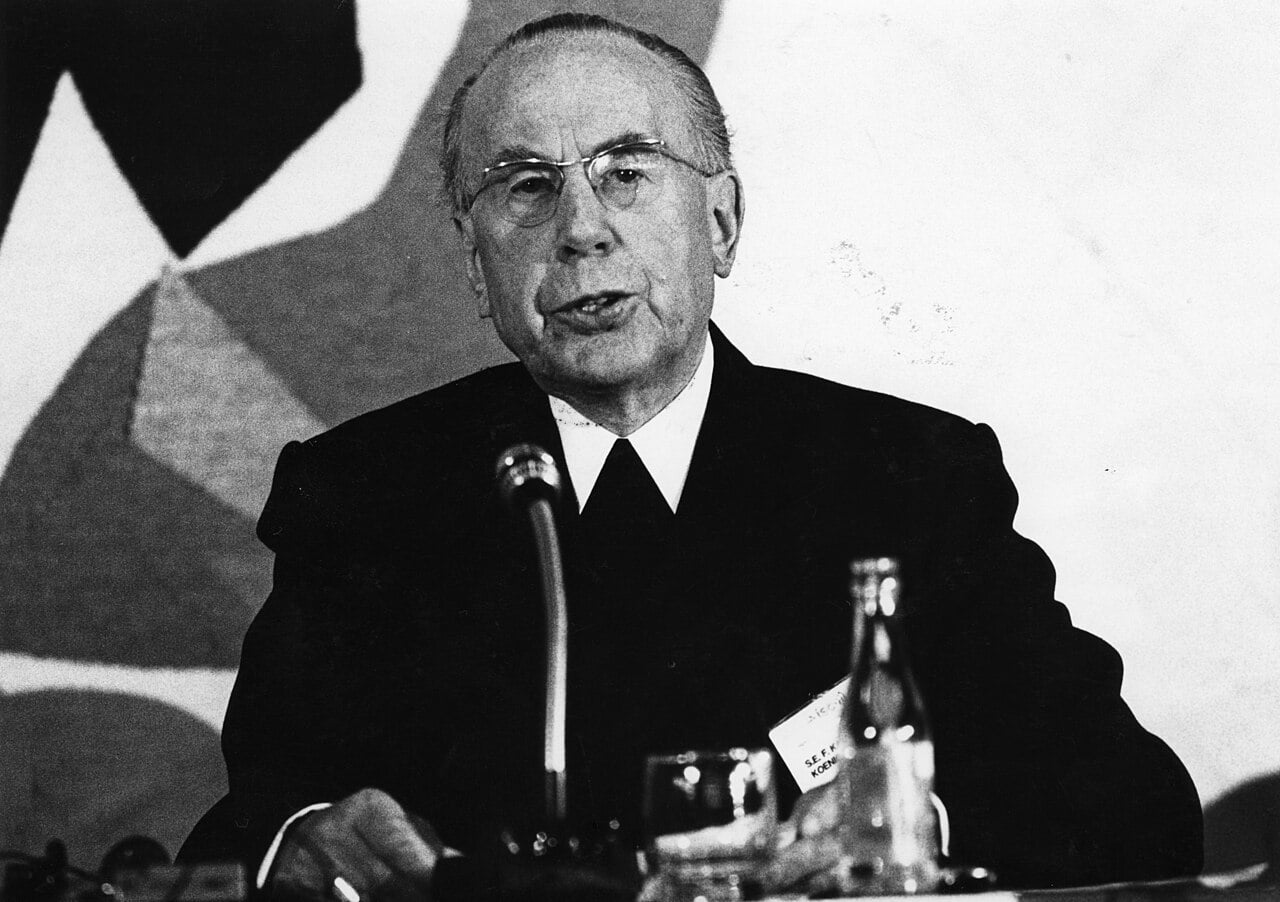
The turning point occurred when Cardinal Franz König delivered a speech during the plenary assembly’s review of Form F of the draft, where he declared that “information of history and natural science in the Holy Bible sometimes falls short of the truth.” 1
König, who was the Archbishop of Vienna, argued that the question of inerrancy had to be reevaluated — and fearlessly so — since divine inspiration would not be lessened by the limited historical and scientific knowledge of the sacred writers.
According to Fr. Alois Grillmeier, a peritus at the council who had a prominent role in writing Dei Verbum, Cardinal König’s speech “was not opposed or rejected either in the assembly or in the Theological Commission.” 2
Read more: ‘The end of the Catholic religion’: Msgr. Joseph Fenton on Vatican II
While two or three conservative bishops maintained that no change was needed to the formulations of Leo XIII and Benedict XV, nobody directly rebutted König’s claims. The vast majority of the assembly concurred with König, and Paul VI allowed this blasphemous and heretical pronouncement to resound unchallenged.
Citing König, Cardinal Albert Gregory Meyer announced that a concept of inerrancy needed to be developed that went “beyond the teaching of the encyclicals Providentissimus Deus and Spiritus Paraclitus.” 3
Archbishop Joseph-Floribert Cornelis also approvingly cited König and reiterated that Scripture contains errors. He argued that a distinction should be made between the content merely “materially” present in Scripture and that religious message which the sacred author intended to teach, only the latter of which would constitute the inerrant substance of Scripture. 4
Archbishop João José da Mota e Albuquerque similarly argued that a distinction should be made between the sacred writers’ accuracy in recording past events and their inerrancy of religious intention: “The criterion of the truth of Sacred Scripture is not that exact correspondence with past events which experts in profane historical science try to obtain; but it is the intention of the inspired author, which always relates in some way to the revelation of salvation.” 5
Accordingly, only the author’s intended religious message would be protected, and not necessarily the particular details they drew upon to construct their narrative.
Archbishop Aníbal Muñoz Duque argued that the term “error” should be defined in a way that would accord with the modern world’s concept of truth, in order to avoid the “grave scandal” of calling Scripture “inerrant” unequivocally. 6
Bishop Alberto Devoto of Goya said that the document should be rewritten to communicate that the value of the Bible’s truth varies according to the quality of affirmation which the sacred writer intended to give any particular passage. 7
These statements and others along the same lines became the basis by which the document’s section on inspiration and inerrancy was re-written.
Part III of this series will examine the critical changes made to the final document’s statements on inspiration and inerrancy, and how they deviate by design from the teachings of the Doctors and Popes given above.
- Grillmeier, in Vorgrimler et al., Commentary on the Documents of Vatican II, Vol. III (Herder & Herder, 1969), pp. 204-205. ↩︎
- Grillmeier, in Vorgrimler, Ibid., p. 233. Fr. Grillmeier was later made a “Cardinal” by John Paul II. ↩︎
- Grillmeier, in Vorgrimler, Ibid., p. 207. ↩︎
- Ibid. ↩︎
- Ibid. ↩︎
- Ibid., pp. 207-208. ↩︎
- Ibid., p. 208. ↩︎