
In previous articles in this series (see here, here, and here) we looked at evidence for the relatively recent historical reality of Noah’s Flood. We also considered the physical processes that accompanied this cataclysmic chastisement.
In order to make this series complete, it is important to consider the spiritual dimension of the Flood — which is its most important dimension as it marked a last-ditch wake-up call from God to souls that would otherwise have been eternally lost.
In the third chapter of his First Epistle, St. Peter wrote the following (v. 18-20) about the souls that perished in the flood:
“Because Christ also died once for our sins, the just for the unjust: that he might offer us to God, being put to death indeed in the flesh, but enlivened in the spirit, In which also coming he preached to those spirits that were in prison: Which had been some time incredulous, when they waited for the patience of God in the days of Noe, when the ark was a building: wherein a few, that is, eight souls, were saved by water.”
The italicized phrase in the original Douay–Rheims Bible is telling: “spirits that were in prison.”
The great Catholic exegete Bishop Richard Challoner (1691–1781) explains the meaning of this passage as follows: “These spirits in prison, to whom Christ went to preach, after his death, were not in heaven; nor yet in the hell of the damned: because heaven is no prison: and Christ did not go to preach to the damned.”
Thus, the deluge was not a wasted effort on God’s part, as the numerous victims of the Flood were not automatically damned and were instead offered a chance at repentance. While their sins certainly warranted perdition, as St. Peter notes, Our Lord:
- Pulled the rug out from under their world;
- Made their souls wait in a limbo-like state for about sixteen centuries until His bodily coming upon the Earth;
- In His mercy, preached to them after His self-sacrifice on the Cross so that they could freely and definitively choose Him or reject Him.
We do not know how many souls chose Him, but they were given the opportunity — an opportunity that life in their depraved antediluvian world would not have made possible.
That said, it is salutary, and not just a little frightening, to consider what these persons went through before they perished. Thus, a thought experiment is in order.
The terrible lead-up to the Great Flood
Below we will first consider what the situation was like in the pre-Flood world. In the next essay, we will analyze what those who were alive likely experienced as the water continued to rise.
Scripture says that pre-Flood people had a natural lifespan of around nine centuries. Given how closely descended they were from physically perfect Adam and Eve, such a lifespan is indeed plausible. Such a long life would have enabled a man to accomplish a great deal in a single lifetime, including having many children. The growth in population over time would have been astounding in the pre-Flood world. Imagine living long enough to enjoy the company of half a dozen generations of descendants.
Second, because man has a God-given curiosity and desire to improve upon the things he encounters, his personal accumulation of knowledge, as well as inventiveness, would have been astounding by our short-life standards. This would have been compounded by multi-generational and multi-family synergy as well.
The application of this accumulated knowledge to the world, what we broadly call technology, would likely have been highly advanced. We must be careful, however, not to let our modern ideas of technology — wires, microchips, motors, engines, etc. — color our thinking about past inventions. The very few pre-Flood human artifacts that have been found in coal and other Diluvian deposits, however, do give tantalizing indications of at least good metallurgy practices (Genesis 4:22). Other fragments that have been found suggest uses that are at least technologically analogous to ours.
The Dispatch
As far as natural surroundings go, pre-Flood man would have dwelt and multiplied in an environment featuring luxuriant and abundant vegetation. The vast accumulation of plant fossils, in coal and other deposits, points to that. The vegetation would have extended from the North Pole to the South Pole.
Fossil forests, some with non-petrified wood, are found in these now very harsh regions. It is plausible that deciduous trees were created specifically for the polar and adjacent seasonally diminished sunlight latitudes. The abundance of tropical plant fossils globally indicates a universally warm climate.
Man himself would have been surrounded by a great abundance of animals, both in kind and numbers. The vast quantity of creatures in the fossil record, both land-based and marine, many varieties now extinct, indicates this.
Additionally, Scripture indicates that there likely were almost no weather phenomena: only a daily morning mist and then a breeze during the latter part of the day are mentioned. Salubrious is a helpful word to describe the pre-Flood world, which was analogous to a giant greenhouse. And keep in mind that this was already post-Fall, yet it was a world that seems positively paradisiacal when compared to our present-day standards.
Support Integrity’s growing number of contributors: Become a monthly donor!
However, man was struck by Original Sin, as we continue to be today, and he did not appreciate what he had. Like us today, he sinned, even grievously.
In Genesis 6, Noah speaks of widespread evil and of thoughts universally focused on sin:
“And God seeing that the wickedness of men was great on the earth, and that all the thought of their heart was bent upon evil at all times, And the earth was corrupted before God, and was filled with iniquity. And when God had seen that the earth was corrupted (for all flesh had corrupted its way upon the earth).”
For a specific example, the non-canonical Book of Jasher speaks of husbands giving their wives contraceptive potions so that the women retained attractive (to their husbands) figures. (See chapter 2:20-22).
With mankind’s depravity at this level — except for Methusaleh, Noah’s Father, Lamech, and Noah himself with most of his family — God said “Basta!” or “Enough!” and embarked on an attention-grabbing enterprise.
In His mercy, He waited until righteous Lamech (not to be confused with the Lamech descended from Cain) and then Methuselah died to carry out His plan. As Christ said in the Gospel, pre-Flood persons were marrying and giving in marriage (e.g., Matthew 24: 37-38):
“And as in the days of Noe, so shall also the coming of the Son of man be. For as in the days before the flood, they were eating and drinking, marrying and giving in marriage, even till that day in which Noe entered into the ark, And they knew not till the flood came, and took them all away; so also shall the coming of the Son of man be.”
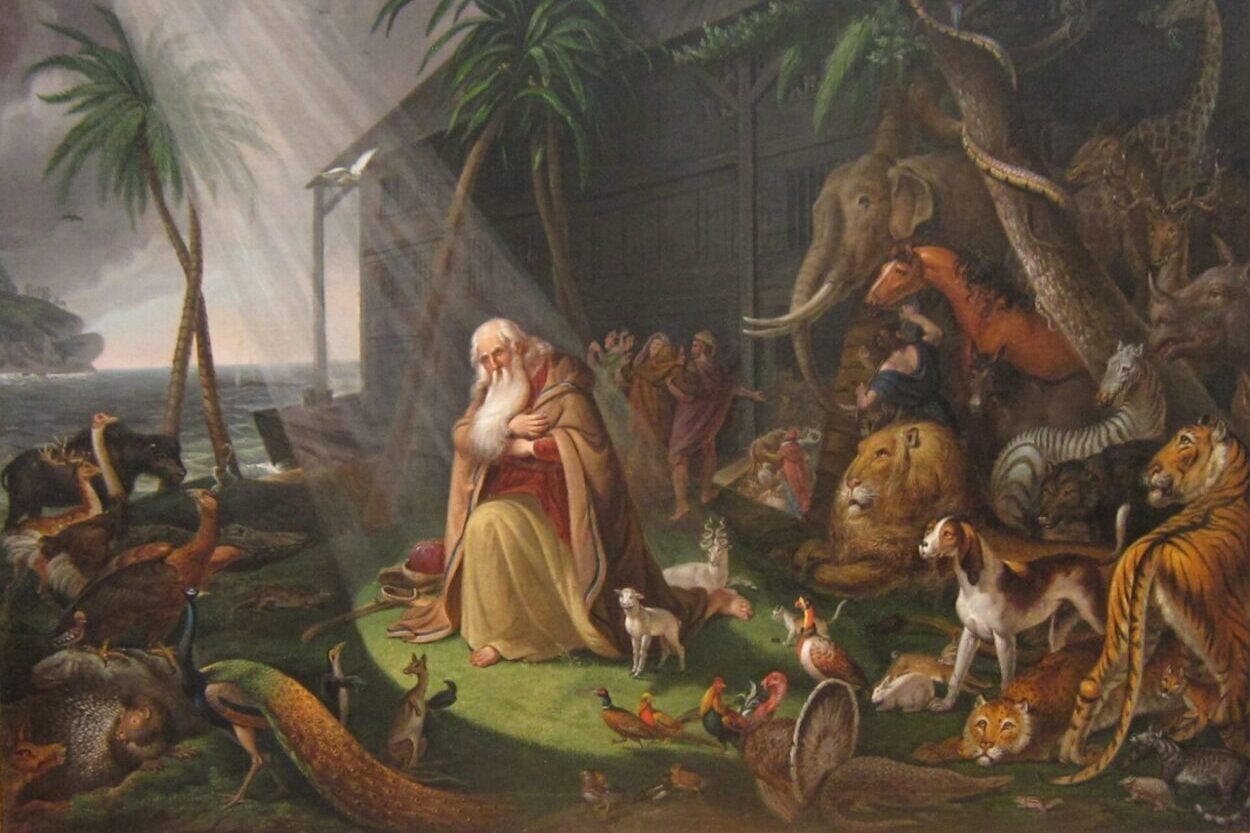
Humanity was thus living a daily depraved life, quite unconcerned that Noah was building an Ark for about a century.
The likelihood of advanced technology at the time would have meant that his Ark-building efforts were universally known, and universally disregarded. One can plausibly assume that he was mocked, ridiculed, or simply written off as a lunatic by the populace at large.
With that said, we will consider in the next essay what these very surprised persons who did not board the Ark would have suffered during the Flood. The geologic evidence of what actually occurred is horrifying.