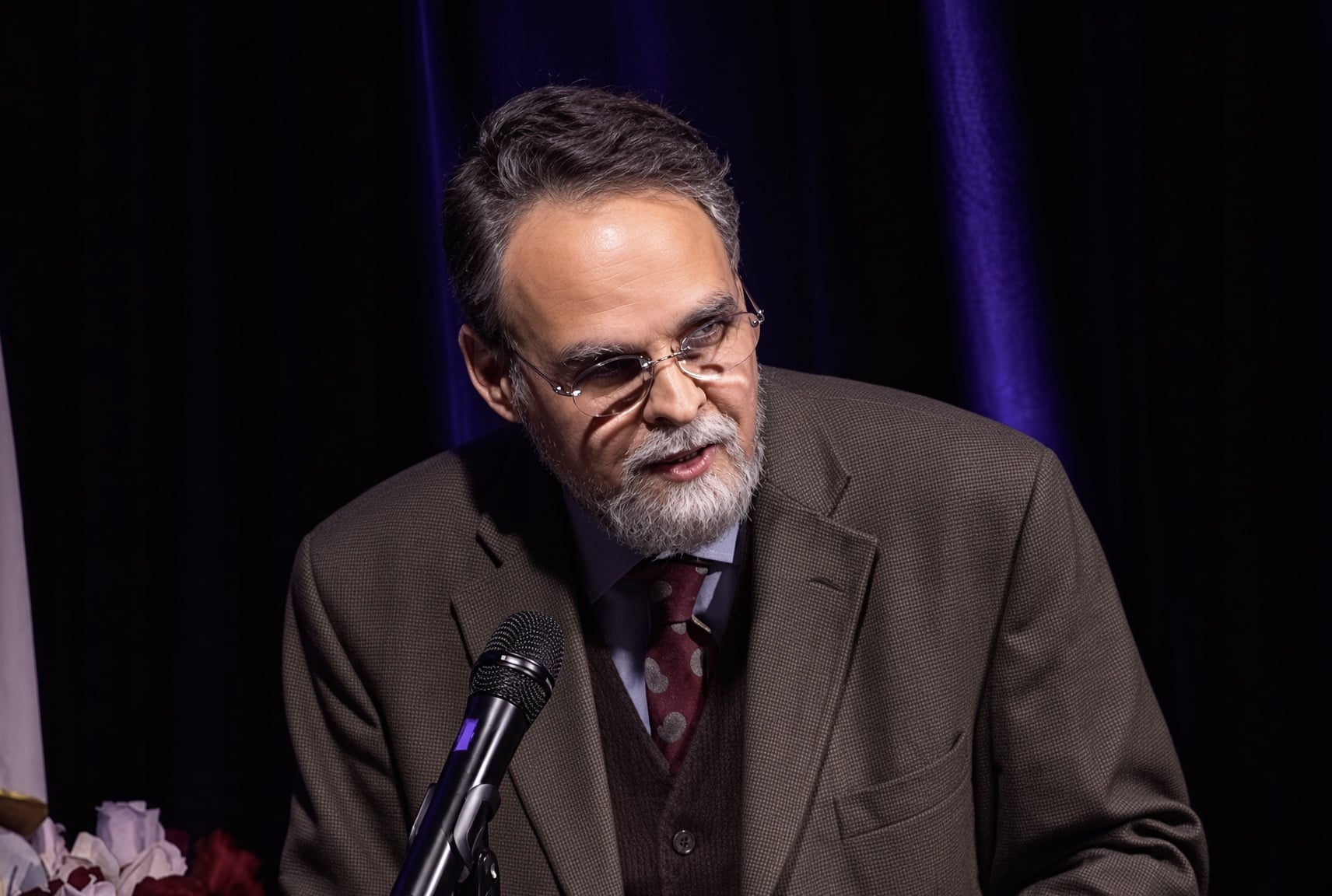
Dr. Peter Kwasniewski, Trad Inc.’s de facto theologian-in-chief who more or less gets to decide when the movement should and should not resist Leo, was one of the first speakers to take the stage this past Friday at Michael Matt’s 2026 Catholic Identity Conference. While Dr. Kwasniewski got the usual diagnosis of the crisis right, his speech was greatly obscured by “unite the clans” hypocrisy.
First, let’s give credit where credit is due. The learned former professor said that in the 1960s and 1970s the Church’s leadership fell prey to an ideology exalting modernity that resulted in the suppression of the historic Roman Rite, corrupted catechesis, and a waging of a “war against the Catholicism of our fathers and forefathers.” He also acknowledged the terrible problem that is created when a hierarchy becomes a “propagator and enforcer” of those errors. “A revolution was imposed on us from above,” he correctly remarked.
Later, Kwasniewski said “we can and must fight against the usurpers,” though he failed to identify who those “usurpers” are and explain the theological implications of using that term. Is Leo XIV, for instance, a usurper in his view?
Dr. Kwasniewski further stated that “most of the practicing Catholics of our time” are “terribly confused and mixed up” instead of being mere “apostates and infidels.” While one may agree in a general sense with this assessment insofar as it pertains to the laity, can the same really be applied to those in the Catholic Inc. influencer class and the conciliar hierarchy who — as Kwasniewski notes — not only defend but enforce the “errors” of the “revolution”?
Between speeches, emceé Michael Matt urged traditionalists to be charitable toward one another. His remarks were astonishing given his vehement attacks on Integrity co-founder Stephen Kokx and other Traditionalists on Substack last year when, while failing to name them specifically, he called them “morons” who were simply seeking “clicks” on YouTube. In any case, Dr. Kwasniewski echoed Matt’s sentiments in his speech. “Traditionalists have been badly treated for a long time and this will probably continue for some time to come,” he said. “But we can show the world that our reaction is to pray more, to forgive, to show unfeigned charity.”
Enjoying this article? Become a monthly support of Integrity today!
Kwasniewski proceeded to claim that he is “advocating big-tent traditionalism,” adding that he “strongly advocate(s) as much mutual understanding and tolerance among traditional Catholics as is compatible with the required beliefs and obligations of the Catholic faith, even understanding and tolerance when it comes to what those required beliefs and obligations may be in the areas that are especially controversial at this time” (emphasis added).
So here is Dr. Kwasniewski calling for Traditionalists to have “tolerance” for others on “especially controversial” topics that pertain to what Catholics are actually “required” to believe in this time. This is something all Traditionalists should agree with. However, without a hint of irony, he undermines his and Matt’s battle cry by going on a platitude-laden broadside that endorses the very intolerance he decried only moments earlier.
“We are the little countries that need one another. The Ecclesia Dei communities, the SSPX, the diocesan clergy who love tradition, the independent — but not sedevacantist chapels — the quiet allies and sympathizers we have in almost every ecclesiastical environment” (emphasis added) he decreed. “They are meant to offer support and cover for each other, not get in each other’s way, much less turn against each other like cancerous cells turning against the body.”
First off, Dr. Kwasniewski never defines who or exactly what he means by “sedevacantists.” Does he mean the “interregnumists” who hold the seat of St. Peter has been empty since Benedict’s resignation/death? Is he referring to the “sedeprivationists” who adhere to the Cassiciacum Thesis and maintain a formal vacancy in the Apostolic See in contrast with a total vacancy? Is he referring to the “strict” or “1958 sedevacantist” view and to groups like the CMRI? Does the good doctor even know anyone personally in these “clans”? Has he tried reaching out to them on a personal level to discuss their concerns?
Kwasniewksi was not finished invoking inexact terminology and needless polemics. Again, without defining the term, he attacked “sedevacantism” as being a “monstrous” error and a species of “hyper-papalism.”
“Instead of belonging to a real body spread throughout the world, scarred with sins and racked with pain, yet bearing the marks of the Lord Jesus until the end of time, they [the sedevacantists] conjure up a Gnostic church of uncontaminated doctrine,” he remarked.
There is much to address here. First, Dr. Kwasniewski has seemingly never grappled with, in a truly extensive intellectual fashion, the question of the Chair of St. Peter being vacant. In April 2025, he said on X that he simply would not “engage sedevacantists” after Mario Derksen of Novus Ordo Watch published an essay on his support for the pre-55 Roman Rite.
“Their understanding of papal authority is dominated by the approximately 150-year period since Vatican I (they rarely cite documents prior to “Pastor Aeternus”), i.e., the period of peak ultramontanism, which has tended to morph into a hyperpapalism contrary to both faith and reason,” he said.
If Dr. Kwasniewski’s CIC speech is his attempt to finally respond to Derksen and others, it was done in extremely poor fashion as it failed to address many serious questions that deserve serious treatment.
Second, it is true that the Church has always been “scarred with sins and racked with pain,” at least in the broad sense. Our Lord knew that members of the Mystical Body of Christ would fall into sin throughout the centuries after his death. This is why he gave priests the power to retain sins through the sacrament of confession. What’s more, when members of the hierarchy make imprudent decisions, they can undoubtedly make the path to heaven more difficult or “painful” for ordinary parish priests, women religious, laity, and others.
But this is not how Kwasniewksi was using those terms. With his choice of terminology, he was, in effect, insinuating that the Church was never given the promise of indefectibility — not only by way of right but also in fact. In other words, he made the classic mistake of pointing to the private sins and imprudent faults of its members to argue that the Church is somehow capable of officially and authoritatively teaching error on faith and morals. “They conjure up a Gnostic church of uncontaminated doctrine,” he remarked. This is simply un-Catholic. “It is unthinkable that an institution established by God for the salvation of souls could lead men into error and turn them away from God,” the Baltimore Catechism affirms. Gregory XVI in Mirari Vos also taught in 1832 that “it is obviously absurd and injurious to propose a certain ‘restoration and regeneration’ for her as though necessary for her safety and growth, as if she could be considered subject to defect or obscuration or other misfortune.” But here is Dr. Kwasniewski mocking those who put forth a “Gnostic church of uncontaminated doctrine.”
Kwasniewki’s criticism of “gnostic” sedevacantists is due, at least it seems, to his particular understanding of the passion of the Church. The aforementioned Mario Derkson has explained this phenomenon in a previous essay on his website. It seems that Dr. Kwasniewski generally views the “passion” as follows, as explained by Derksen:
The Vicar of Christ persecutes the faithful; the Pope is no longer the proximate rule of Faith; the Church has abandoned her mission and no longer actively seeks to make converts; the Church introduces sacrilegious liturgical/sacramental rites, harmful laws, and false teachings, the Church has defected from the Faith and is no longer a reliable guide to salvation.
Subscribe toThe Dispatch
In reality, the passion of the Church, as Derksen explains it, is more akin to the following situation:
The chief shepherd is struck, the sheep are scattered; the Mystical Body is persecuted by its enemies; Jesus Christ is persecuted in His Vicar; the faithful are thrown into great confusion; many abandon the Faith because they are scandalized by what has happened; Catholics are mocked and taunted for holding on to the true Faith.
Dr. Kwasniewksi attacked “sedevacantists” in other ways during his speech. Perhaps forgetting the fact that the Conciliar Church does not bear the mark of unity in any way — either in faith, doctrine, or governance — he mocked those Catholics who seek refuge in “a few fragile outposts, ever splintering in pursuit of an infallibility and sacramental validity that, according to them, has disappeared from nearly every church in the world.”
But doesn’t a similar situation exist in most dioceses across the world, where those “usurpers” Kwasniewski speaks of are “enforcing” the errors of Vatican II and where Trads like him have to hide out in the one or two indult or FSSP chapels that are merely permitted to exist? Moreover, “sacramental validity” is of the utmost importance. To flippantly dismiss, for instance, the changes to the 1968 consecration rite and other revisions to the sacraments made after the Council as something that is not of paramount importance is extremely dangerous and rather anti-intellectual.
Elsewhere in his speech, Dr. Kwasniewski speaks about the papacy. “We will not find sanity or solutions in papalotry, in making the pope the be all and end all, the measure of everything we are, everything we believe, and receive,” he said.
Compare that with what actual popes taught on how Catholics ought to revere the papal office. “One simple way to keep men professing Catholic truth is to maintain their communion with and obedience to the Roman Pontiff,” Pius IX said in Nostis et Nobiscum. “This chair [of Peter] is the center of Catholic truth and unity, that is, the head, mother, and teacher of all the Churches to which all honor and obedience must be offered. Every church must agree with it,” Pius IX affirmed in Inter Multiplices. “And what is this unity unless one person is placed in charge of the whole Church who protects it and joins all its members in the one profession of faith and unites them in the one bond of love and communion?” Pope Gregory XVI wrote in Commissum Divinitus. What does Dr. Kwasniewski make of these official teachings?
Kwasniewski then accused “sedes” of being out of touch with reality:
What I find to be the most serious problem with the sedes is that they are disconnected from the much messier reality on the ground. For it is essential to their position to paint everything in black and white terms, to say the faith is absolutely gone from most Catholic churches … there has already been a global apostasy that the popes are unbelievers, etc. This is all far too simplistic.
Actually, many — if not most — “sedes” are former Novus Ordo Catholics who have also spent time in Ecclessia Dei groups and the FSSP. They are thoroughly aware of the “messier reality” on the ground in the dioceses, which is why they fled to Traditional chapels that are out of the reach of Modernist and so-called conservative bishops. Beyond that, Dr. Kwasniewski’s claim that the “sede” position cannot be correct because it is “far too simplistic” is absurd. A “simple” solution does not, of itself, attest to the veracity or falseness of a position.
Contuing on, Dr. Kwasnieski takes a personal swipe at those whom he has deemed unworthy of being included in the “unite the clans” movement.
“I am living in a conservative diocese where you actually find serious Catholics who know their faith, going to Novus Ordo parishes. Big families and vocations are still happening there,” he said. “The Lord has not abandoned His Church. And even the pope who says and does so many unfortunate things also says and does true and good things.”
No one can deny that there are “serious” persons who attend diocesan and Indult Masses. They often pray the rosary, have large families, observe Ember Days, and so on. The main issue is the doctrines they are being taught from the pulpit. Indeed, Dr. Kwasniewski’s bigger error here is when he says Leo is simply doing “many unfortunate things.” In actuality, Leo is, as Dr. Kwasniewski himself alluded to earlier in his speech, waging “war” on the faith of our fathers daily. Leo is not, in other words, making one-off statements or elevating the occasional somewhat liberal cleric to a high office. Rather, he is seeking counsel from open dissidents like Cardinal Fernandez, issuing documents and statements that habitually undermine traditional Catholic doctrine, and, worse, is invoking the Masonic motto of the French Revolution. Does this not at least compel Dr. Kwasniewski and others to entertain the possibility that an extended vacancy of the Chair of St. Peter is happening right now and that this explains the absolute chaos taking place across the entire Church and world?
Before welcoming Dr. Kwasnieski to the stage, Michael Matt spoke about the importance of the Latin liturgy:
Tangibly, the thing that unites us in the real world, in real time, is the Mass of our fathers. The traditional Latin Mass … which was established by Jesus Christ himself on Holy Thursday. That’s what unites us all. I can’t wait to hear what Dr. Kwasniewski is going to say with respect to this ‘unite the clans’ being around the touchstone of the faith, the traditional Latin Mass.
But this is to forget several key aspects of the Catholic faith. First, the Latin Mass was normative in the West and not the East for centuries. It alone is not what “unites” Catholics across the world. Second, Catholics can only truly “unite” under the pope — who is the visible principle of unity in the Church — and in the same faith, worship, and governance. The Latin Mass, or the “worship” component of this, is simply one third of the unity experienced by Catholics. By claiming that the Traditional Latin Mass will re-anchor the Church doctrinally, Matt effectively reduces Catholicism to the use of the correct missal. As such, it seems that Catholic Identity Conference wants to reduce a very serious issue — the fact that the indefectible Church founded by Christ cannot herself be the very instrument persecuting Catholicism — to a campaign for preserving the Traditional Latin Mass as an exotic enclave within a post-conciliar establishment hostile to it. The novelty of this approach seemed to be summarized in Dr. Kwasniewski’s remark that, “we do have definite principles to be sure. But I would maintain that they are not entirely adequate to new problems that have arisen.” This is a fancy way of saying we needn’t abide by past teachings on the papacy and its prerogatives and can just make up a new understanding of the office ourselves.
Elsewhere, Dr. Kwasniewski dramatically told his audience that “We are not in a situation where our enemies are willing to parley amicably with us and arrive at a compromise. They are seeking our marginalization, ostracization, extinction, and annihilation.” No doubt. But can an institution that seeks to do this to actual Catholics really be identified as the Mystical Body of Christ, the Bride of the Savior of Mankind? This, of course, was just one of the many elephants knocking over tables and drinks in the CIC conference room.
It is highly ironic that Dr. Kwasniewski and Michael Matt are quick to criticize Leo XIV for wanting to exclude Traditionalists yet when it comes to who is allowed to be part of the “unite the clans” project, they do the same to those who hold different positions than they on whether the Chair of St. Peter is currently vacant. Do they, one must ask, truly mean what they are actually saying about having charity and tolerance about “controversial” subjects? This is the main difference between the Trad Inc. brand of Catholicism that seeks approval from the conciliar authorities and the Counter-Revolutionary Roman Catholic movement which wants to have a true “big tent” where voices who have been gatekept from the CIC can finally have a seat at the table.