Forty years after one of the most scandalous religious events of the post-conciliar era, Vatican officials are preparing to run it back.
From October 25 to 27, the Community of Sant’Egidio will host an international gathering titled Unarmed and Disarming Peace. Like the original event in 1986, hundreds of religious, cultural, and political figures from dozens of countries will descend on the famous hill town in central Italy’s Umbria region.
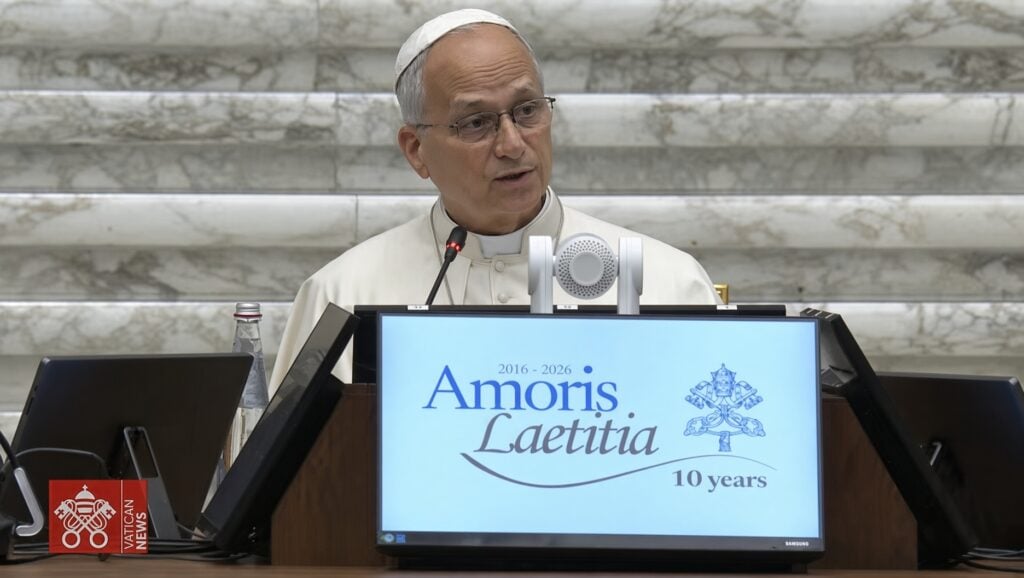
To underscore the Synodal Church’s continued commitment to the Modernist revolution, Leo XIV will be appear at the gathering on the event’s final day, which is the exact 40th anniversary of the so-called World Day of Prayer for Peace that John Paul II attended.
Instead of showing prudence by avoiding further scandal, Leo is not only sending a highly symbolic taunt to the traditional Catholic faithful, but obstinately doubling down on the post-conciliar Church’s spiritual harlotry.
On the event’s final day, Leo will join Ecumenical Patriarch Bartholomew and representatives of other schismatic and heretical Christian sects for prayer in the Basilica of St. Francis. While that is happening, Jews, Muslims, Hindus, Buddhists, and representatives of other erroneous religions will pray at separate locations, violating the First Commandment. But the fact that there will not be non-Christian prayers offered in Leo’s presence — as was the case when John Paul II participated in 1986 — does not diminish the false ecumenical character of the meeting.
Indeed, at the conclusion of the event, Leo and some 80 religious leaders will assemble for a common appeal for peace. More than 380 representatives from more than 50 countries are expected to participate. As of the publication of this article, no priest or bishop from the Society of St. Pius X (or like-minded Traditionalist group of clergy) has been asked to attend. One is reminded of the warning found in Jeremiah 6:14-15:
“And they healed the breach of the daughter of my people disgracefully, saying: Peace, peace: and there was no peace. They were confounded, because they committed abomination: yea, rather they were not confounded with confusion, and they knew not how to blush: wherefore they shall fall among them that fall: in the time of their visitation they shall fall down” (emphasis added).
The first Assisi gathering
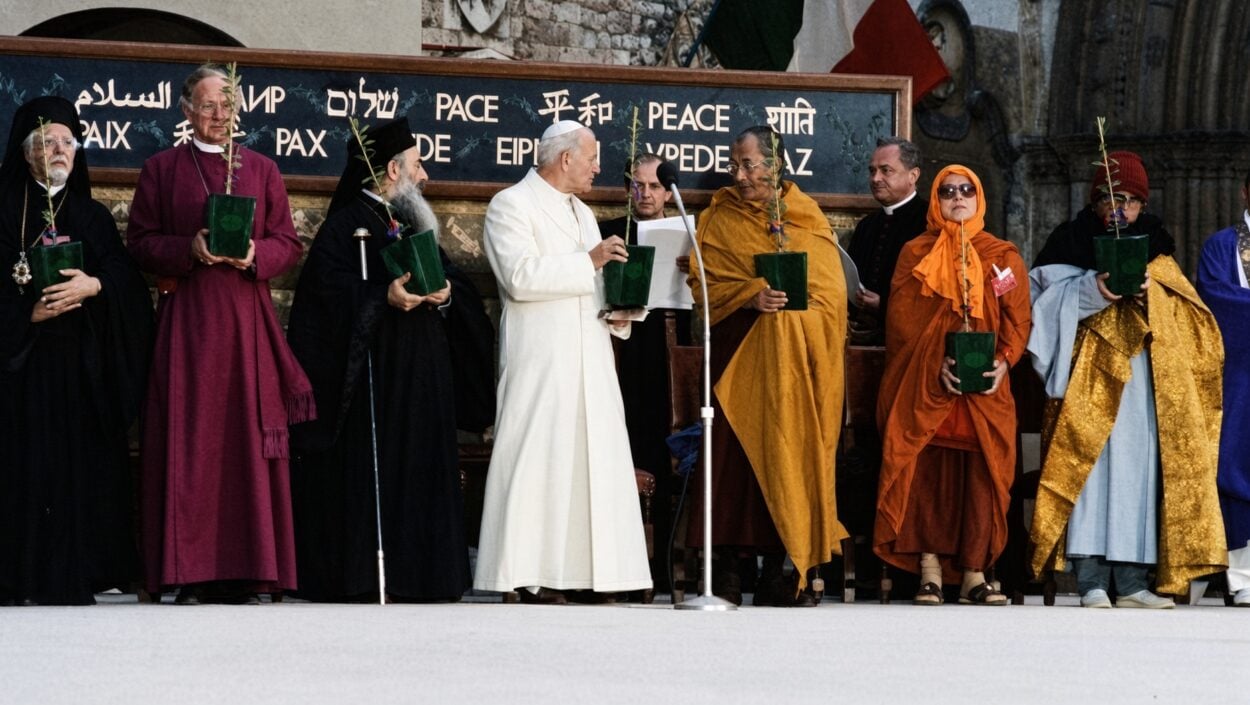
On October 27, 1986, John Paul summoned representatives of the world’s religions to Assisi to pray for peace.
In a half-baked attempt to minimize the scandalous nature of the event, organizers distinguished between “praying together” and “being together to pray.” The religions initially prayed separately, according to their own rites, but afterwards assembled in the Lower Square of the Basilica of St. Francis, where each sect was permitted to present its own prayer, one after another, while John Paul II and the other participants stood by in tacit approval.
Support Integrity’s independent reporting: Become a donor today!
The denial that the gathering constituted a common interreligious prayer or implied that all religions were equivalent did little to mitigate how the spectacle was perceived by orthodox Catholics. An event in which the supposed Roman Pontiff assembled with representatives of non-Christian cults while Buddhist, Hindu, Muslim, Jewish and other prayers were offered for a common intention would have been impossible before the Second Vatican Council.
Assisi was, at least until then, the most dramatic visible “fruit” of the Council’s new approach to ecumenism and non-Christian religions — an approach which was and is nothing less than religious indifferentism and veiled universalism. Unitatis Redintegratio elevated ecumenical engagement above the Church’s mandate to save souls, while Nostra Aetate introduced a new and erroneous language of dialogue and esteem towards non-Christian religions.
The Dispatch
Assisi was, at the end of the day, the spectacular, but woeful, articulation of the principles embodied in these documents. John Paul II himself referred to Assisi shortly beforehand as an “ecumenical and interreligious initiative.”
The Spirit of Assisi refuses to die
The scandal of 1986 was by no means an isolated aberration. Four further major interreligious gatherings followed at the location, each perpetuating the ecumenical experiment inaugurated by John Paul II.
In January 1993, John Paul again summoned Protestant, Jewish, and Muslim representatives to Assisi, ostensibly to pray for peace in the war-torn Balkans. In January 2002, following the September 11 terrorist attacks, he convened another gathering of religious leaders, once again placing the Church alongside the world’s false religions in a public appeal for peace.
Benedict XVI continued the tradition in October 2011, marking the twenty-fifth anniversary of the original event, even extending invitations to agnostics and non-believers. Francis followed in September 2016, commemorating the thirtieth anniversary with yet another scandalous gathering. Bergoglio famously said at that gathering that “proselytism is a grave sin” and the “strongest venom against the path of ecumenism.”
Thus, what began as an unprecedented scandal became an institutionalised feature of the post-conciliar Church. Far from repudiating the original event, successive Vatican leaders embraced and perpetuated its legacy. And now Leo XIV prepares to add his name to the list.
Assisi and Archbishop Lefebvre
One of the strongest and most vital reactions to the cursed 1986 meeting came from Archbishop Marcel Lefebvre, founder of the SSPX.
While his conflict with Rome over the new Mass, religious liberty, collegiality, and ecumenism long predated Assisi, the meeting became a catalyst in the now almost mythical showdown that culminated in the 1988 consecrations of Frs. Bernard Fellay, Bernard Tissier de Mallerais, Richard Williamson and Alfonso de Galarreta.
Lefebvre and Brazilian Bishop Antônio de Castro Mayer issued an extraordinary declaration on December 2, 1986, condemning the gathering. They described Assisi as the “high point” of Rome’s rupture with the previous Magisterium of the Church.
Then, on June, 29, 1987, eight months after Assisi, Lefebvre publicly announced his intention to provide episcopal successors to ensure the continuation of his work. The SSPX itself identified the Assisi gathering and Rome’s continued defence of Vatican II’s teaching on religious liberty, as being at the origin of the decision.
The consecrations, excommunications and subsequent Ecclesia Dei apostolic letter had a paradoxical effect, however. By calling for respect for Catholics “attached” to the Latin liturgical tradition, demanding a “wide and generous” application of permission to use the 1962 Missal, Rome inadvertently gave greater visibility and institutional space to the Traditional movement.
One can only hope and pray that now, forty years later, Assisi 2026 will once again provide the impetus to awaken more slumbering Catholics and rally them into action. After all, Sant’Egidio makes no secret of the continuity and explicitly presents this year’s meeting as a continuation of the “Spirit of Assisi,” which the community has cultivated for four decades.
Hopefully, it will backfire even more spectacularly this time and make Catholics realize that the post-conciliar Church is not the one founded by Jesus Christ.