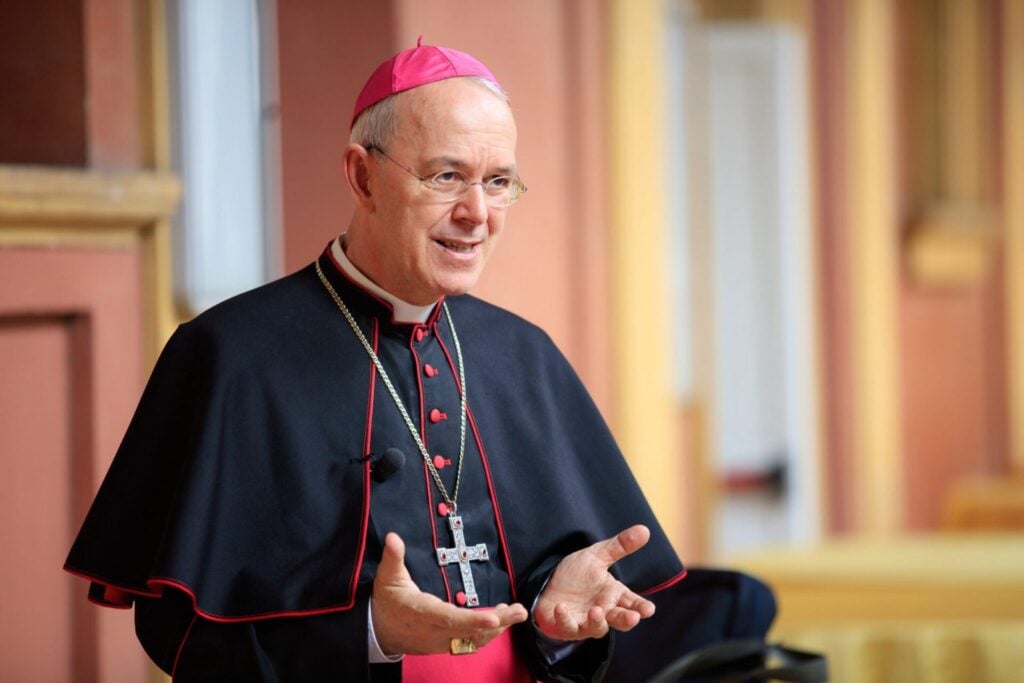
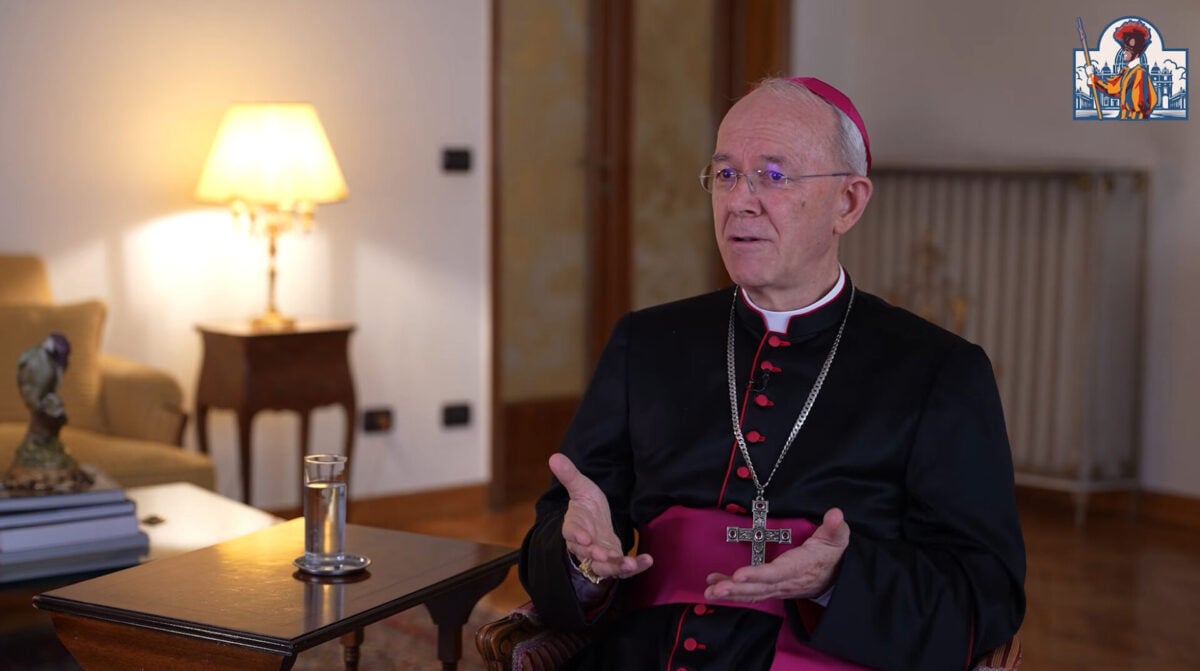
On October 29, 2026, Bishop Athanasius Schneider — auxiliary bishop of Astana, Kazakshstan, and favorite of conservatives and would-be traditionalists — gave a wide-ranging interview to Ad Vaticanum’s Niwa Limbu.
In the course of this interview, Limbu asked the bishop to explain why “sedevacantism” is wrong.
“Sedevacantism” is the conclusion that the Holy See has been vacant (or at least only “materially” occupied) since the Second Vatican Council. 1
It is, as we all know, a popular topic for conservatives and would-be traditionalists to attack. Such attacks allow such persons to signal that they are not going “too far” in their comments or analysis of the present crisis in the Church.
There is an extent to which this tactic recalls Our Lord’s Parable of the Pharisee and the Publican:
O God, I give thee thanks that I am not as is this sedevacantist.
We are all used to this by now. But even if such a tactic were justified, the Eighth Commandment prohibits the bearing of false witness. This means, among other things, that we must be fair and accurate in how we represent others — including our opponents, and even “sedevacantists.”
Unfortunately, Bishop Schneider’s answer was indeed full of caricatures, misconceptions and exaggerations — to the point of objectively containing falsehoods.
Right of reply
On November 2, 2026, I informed Ad Vaticanum that Bishop Schneider’s comments were inaccurate and unjust, and requested a “right of reply.”
The editor agreed to consider such a submission, provided that what I wrote was not an “apologetic piece for sedevacantism.”
Striving to respect that condition as much as possible (by focusing on setting the record straight, rather than making a positive case for “sedevacantism”), I submitted my response on November 5, 2026.
Despite a few attempts at further contact, I did not receive any further response from the editor of Ad Vaticanum. The article which follows is that submission.
Even ‘sedevacantists’…
“Sedevacantism” is, of course, a popular topic for conservatives and would-be traditionalists to attack. Such attacks allow such persons to signal that they are not going “too far” in their comments or analysis of the present crisis in the Church. There is an extent to which this tactic recalls Our Lord’s Parable of the Pharisee and the Publican:
“O God, I give thee thanks that I am not as is this sedevacantist.”
Nonetheless, the Eighth Commandment prohibits the bearing of false witness: this means, among other things, that we must be fair and accurate in how we represent others — including our opponents, and even “sedevacantists.” It also includes a duty to rectify mistakes which harm the reputations of others (and even offer restitution).
Even secular outlets recognize this. It is, for example, standard journalistic practice that those who are the subject of significant criticism should be offered such a right of reply. 2 Such criticism certainly includes imputations of doctrinal error, for there can be few things more harmful to a man’s reputation than this.
Although Ad Vaticanum did not itself impute doctrinal error to “sedevacantists,” it is regrettable that it has chosen to allow Bishop Schneider to do so without also discharging this duty of both justice and charity.
I am grateful to Integrity Magazine for agreeing to publish this article. Certain lines, included on the presumption that it would be published, have been struck out.
Introduction
In a recent interview given to Ad Vaticanum, Bishop Athanasius Schneider was asked the following question by Niwa Limbu:
Your Excellency, this might sound like a basic question. But why is sedevacantism wrong? And more broadly, when does disobeying any legitimate ecclesiastical figure go too far? And when is it not only permissible but necessary to refuse obedience?” (emphasis added).
Unfortunately, Bishop Schneider’s answer revealed a serious lack of understanding about the position commonly known as “sedevacantism.”
As someone who holds to this particular conclusion — that Paul VI and his successors have not enjoyed papal authority — I am grateful to Ad Vaticanum [Integrity Magazine] for giving me the opportunity to clarify the points in question. After all, there is little use in attempting to refute straw-men or caricatures of one’s opponent’s positions. And as Nicodemus said to the Chief Priests and Pharisees:
“Doth our law judge any man, unless it first hear him and know what he doth?” (John 7:51)
‘The deepest theological error of sedevacantism’
Bishop Schneider begins by mischaracterizing the views of “sedevacantists,” and labelling this our “deepest theological error”:
Well, sedevacantism is in itself something completely wrong, because the deepest theological error of sedevacantism is that they absolutize the papal authority — in the sense that the pope is always infallible, almost twenty-four hours [a day], and every word of the Holy See must be infallible.”
On the contrary, “sedevacantists” by no means hold that “the pope is always infallible” or that “every word of the Holy See must be infallible.” That this is the case is very easy to verify. In one of my own articles, published first at Integrity Magazine and then at The WM Review, I clearly set out circumstances in which the exercise of a Pope’s magisterium is infallibly assisted, and when it is not — and the varying levels of assent these modes require of us.
The same has been expressed by various “sedevacantist” writers over the years. For example, Mgr Guérard des Lauriers, who first expressed the so-called “Thesis of Cassiciacum,” stated the following:
[I]t is not always clear whether a given decision is doctrinal or merely disciplinary in nature. Let us mention in passing the condemnation of Action Française by Pius XI, and its revocation by Pius XII – acts whose apparent contradiction can only be explained by the fact that they belong to the domain of the non-infallible ordinary magisterial power, both practical and theoretical … The ‘duty to disobey’ may indeed be a painful reality — but only in those cases where it is solely the non-infallible Magisterium that is involved” (emphasis added). 3
Abbé Damien Dutertre of the Roman Catholic Institute, writing on behalf of Most Holy Trinity Seminary, wrote the following:
In order to better understand the extent of the Church’s indefectibility in teaching the faith, we shall briefly consider in the following questions the infallibility of ecumenical councils, the infallibility of the Roman Pontiff, the infallibility of the universal ordinary magisterium, and the value of the non-infallible magisterium (emphasis added). 4
Throughout the chapter cited, he recognizes that the Pope does not always engage the assistance of infallibility in his teaching.
The popular “sedevacantist” website Novus Ordo Watch also has an article specifically titled “Do Catholics have to Assent to Non-Infallible Church Teaching?”
It also seems strange to claim that “sedevacantists” believe that Popes are always infallible, given that many of them hold that Popes may fall into heresy — which would be impossible if Bishop Schneider’s claim were correct.
As should be clear, Bishop Schneider is mistaken in claiming that “sedevacantists” believe that “the pope is always infallible” and that “every word of the Holy See must be infallible;” the injustice of such a claim is only aggravated by calling it our “deepest theological error.”
The infallibility of Ecumenical Councils
Bishop Schneider continues:
And therefore the approval by the pope of some ambiguous statements of Vatican II, and later, is, for the sedevacantist, a proof that this cannot be a pope, and therefore the Holy See is vacant.
The Dispatch
Here he is more accurate, but at the expense of Catholic doctrine. It is a standard thesis of Catholic doctrine that ecumenical councils — which are such only because of their approval by the Pope — are capable of teaching infallibly. This applies not just to the canons and anathemas of a Council, but also in those parts of the chapters which clearly define a doctrine of faith and morals.
Now, while Bishop Schneider characterizes the issue as one of “ambiguous statements,” 5 this is not an accurate representation of traditionalist (and “sedevacantist”) arguments regarding Vatican II. Rather than referring to mere ambiguity, these authors base their conclusion on what they claim are actual errors in the conciliar documents, proposed in ways that would otherwise indicate infallibility; what they claim are harmful aspects of the liturgical reform, and the broader claim, expressed by Archbishop Lefebvre himself, that the reforms amount to a “new religion.” 6
One may disagree with these claims, but suggesting that our conclusions are based on mere “ambiguity” does not accurately represent what is being argued. Instead, it presents the arguments as being based on foolish grounds which “sedevacantists” themselves would reject.
He continues:
But it is a wrong theological starting point, because infallibility is very rare, and [requires] a very close, very limited, narrow interpretation — not a broad interpretation of infallibility. This is Catholic doctrine; this is Catholic tradition. This is the basic error.
As Bishop Schneider does not explain what he means by this “limited, narrow interpretation,” it is not possible, at this time, to respond further than with what I have already stated.
An extended vacancy ‘is also an error’
Bishop Schneider states:
The second: to assume that the Church has had no visible head for already sixty or seventy years is also an error. It is close to the Protestants, who say that the Church has no visible head but Christ only, the invisible head. And so it is coming close to the Protestant understanding of only the invisible head of the Church only.
As this is not the place to defend the thesis of an extended vacancy, I will limit my comments to pointing out that a range of respected pre-conciliar theologians recognized an extended vacancy of the Holy See as possible — including Cardinal Billot, Dom Prosper Guéranger, Fr. Anton Straub, Fr. Domenico Palmieri, Fr. Emil Dorsch, Fr. Sylvester Berry and Fr. Raphael Cercia. Such theologians variously acknowledge that the See may be vacant or doubtfully occupied for years, or even for a “considerable” or “long” time. Full references are available in my article cited below. Bishop Schneider and others may wish to argue that the present duration exceeds what these theologians envisaged; but that is a separate argument from the one he actually makes — which is to associate the very idea of an extended vacancy with Protestantism.
“Sedevacantists” also by no means say that the Church has no visible head but Christ, as if there has been some change to the Church’s indefectible constitution. On the contrary, our position is that the Holy See, or the office of the papacy, continues, but is currently vacant (or rather, only “materially” occupied by one who is not truly the Pope) — to the great detriment of the life of the Church. The very essence of our position is that the office remains, and that the vacancy is temporary – a qualification to which Bishop Schneider himself appeals in his next comment.
This is discussed in greater length here:
‘They do not study honestly church history’
He then states:
And then there is a lack of church history. They do not study honestly church history. There were cases of popes who were condemned because of errors — not heresies, but errors or ambiguities in doctrine — like Honorius, Liberius, John XXII, and so on. And this happens: rarely, but this happens.
First, accusing “sedevacantists” of being dishonest in their study is a regrettable tactic — not least because the accusation is not proved.
Next, let us note that the examples which Bishop Schneider raises are not relevant to the question at hand. For example:
- Honorius, in a private letter which was discovered years after his death, facilitated the spread of heresy by failing to take action against certain heretical terms, and ordering silence on both the heretical and orthodox terms.
- Liberius is accused — with the truth being debated to this day — of signing an ambiguous profession of faith.
- John XXII preached sermons, explicitly as his own private opinion and welcoming correction, which affirmed an error which had not yet been condemned by the magisterium. 7
But what have such examples to do with the arguments actually advanced, which concern matters not only different in magnitude, but also in kind? Bishop Schneider’s historical examples have nothing to do with such arguments.
Further, as “sedevacantists” argue that the current situation is unprecedented, it is unjust to accuse them of being ignorant or lacking honesty in their approach to Church history without providing historical examples that are actually relevant.
‘Unworthy popes’
Bishop Schneider then states:
And then also to believe that the Church is guided by Christ, even through unworthy popes, as has happened in church history, and in some ambiguous situations — which in our time is only a temporal situation. And Christ will, again, resolve it.
Let us first note again Bishop Schneider’s reference to “ambiguous situations” — an assessment of the current crisis which we reject.
More importantly, Bishop Schneider here implies that “sedevacantists” have reached their conclusions because they believe Paul VI and his successors to have been “unworthy popes.” But this is false; our position is based on holding them not to have been Popes at all. Bishop Schneider does not address this point, and so these comments are also essentially “begging the question,” or assuming what needs to be proved.
As for his comments about this crisis being a “temporal [temporary?] situation” which “Christ will resolve,” “sedevacantists” are in agreement: but for this reason, it seems strange for Bishop Schneider to assert it as if we were not.
True Obedience vs. False Obedience
Bishop Schneider spends the rest of the section presenting his understanding of the matter of obedience. To do so necessarily implies that “sedevacantists” have misunderstood the rather basic distinctions which he presents; but this is false.
In a recent article at LifeSiteNews, engaging with Archbishop Carlo Maria Viganò’s comments on the same subject, I provided a series of texts taken from “sedevacantists” recognizing that it can, under certain circumstances, be legitimate to resist (and therefore certainly disobey) certain commands of a Pope. These included examples from Msgr. Guérard des Lauriers, Abbé Bernard Lucien, Bp. Donald Sanborn, Abbé Damien Dutertre, Novus Ordo Watch, John Lane, and myself. They are found under the heading Sedevacantism and papolatry are mirror-image errors?, available here:
However, we are obliged to say that Bishop Schneider’s example of St. Paul “resisting” St Peter, as detailed in the Epistle to the Galatians, is once again irrelevant. This scriptural example related to behavior, on the part of St. Peter, which St. Paul believed constituted a scandal to the faith. But this has nothing to do with the accusations leveled by “sedevacantists” against Paul VI and his successors, as mentioned above. St Robert Bellarmine stated:
[W]hen St. Peter compelled the Gentiles to Judaize, this was not an error of preaching but of conduct, as Tertullian suggests in his work de Praescriptionibus adversus haereticos. St. Peter did not ratify by some decree that they must Judaize, rather, he formally taught the contrary in Acts XV. 8
It is precisely because the “sedevacantist” arguments concern such matters — and not merely the personal conduct — that the example of Sts. Peter and Paul at Antioch is not relevant.
In fact, “sedevacantists” can agree with aspects of the principle which Bishop Schneider derives from this incident, and its interpretation by Sts. Augustine and Thomas Aquinas: namely, that even subjects may speak out in public in defense of the faith when it is threatened. However, it does not follow from this that the particular dangers to the faith which these authorities had in view included those of our day — which, we argue, they would have considered impossible.
In short, Bishop Schneider’s presentation of the matter of obedience in this section is unjust, because it incorrectly implies a misunderstanding on the part of “sedevacantists” — whereas we agree on these principles. We simply hold that the principles of true and false obedience are the wrong ones to apply to the question at hand. To draw an analogy, his argument is like accusing a plumber of not understanding heating systems because he does not use a radiator to unblock a lavatory.
I have explained this point at greater length here:
Conclusion
Bishop Schneider concludes his treatment of this matter by stating his willingness to suffer personally, if this is what obedience demanded of him:
[U]sually we have to obey, of course, those commands which are promoting the faith, or in simply disciplinary matters — even when they are unjust, we must accept this. When the pope will depose me, I will accept it without any problems, because it’s not my… I am not important in the Church at all. But when the faith is undermined, when the sacredness of the liturgy, then I must speak — with love and reverence, and love for the pope. And if he will punish me for this, I will accept it and be happy to be punished also, for the sake of love for the Church.
While we “sedevacantists” disagree with his assessment of Leo XIV’s legitimacy as “pope,” we can admire his commitment to putting the Church and the integrity of the faith above all other considerations.
However, we can only regret that his comments on our position are so consistently inaccurate, and rooted in a misunderstanding of our arguments. In this article, we have seen that what Bishop Schneider calls the “deepest theological error of sedevacantism” is not, in fact, a proposition to which “sedevacantists” adhere at all. We have seen that Bishop Schneider does not recognise the theological precedent for positing an extended vacancy of the Holy See, and instead misrepresents our position by associating this idea with Protestantism. We have seen that his accusation of negligence and dishonesty with regards to church history is similarly unfair, as are his references to the principles of true and false obedience.
We must be scrupulously fair in how we represent others — even our opponents, and even those who themselves treat us with a lack of justice or charity. It is my hope that Bishop Schneider recognize that this duty should also govern his treatment of “sedevacantists,” and I thank the team at Ad Vaticanum [Integrity Magazine] for giving me the opportunity to make this representation.
- Author’s Note: For reasons discussed elsewhere, the terms “sedevacantism” and “sedevacantist” are not universally accepted by those who hold the See to be vacant. ↩︎
- Cf., for example, the BBC’s Editorial Guidelines on the matter here: https://www.bbc.com/editorialguidelines/guidance/right-of-reply ↩︎
- CdC Vol. I. ↩︎
- Abbé Damien Dutertre RCI, “Chapter I : The Indefectibility of the Church”, TheThesis.US, n. 13. ↩︎
- Ed. Integrity Magazine: It is hard to make sense of Bishop Schneider reducing the problem of Vatican II to more or less one of “ambiguities” in light of his official, written work. For example, in his popular 2023 “Credo: Compendium of the Catholic Faith” catechism, rather than taking issue with mere ambiguities, Bishop Schneider cites portions of the Council, identifying their errors and proceeding to correct them. Notably, he identifies doctrinal error in the conciliar conception of religious freedom (p. 104) and ecumenism (p. 84). The viewer can only speculate as to why this analysis is left out when dealing with “sedevacantist” interlocutors. ↩︎
- Archbishop Lefebvre said: “Two religions confront each other; we are in a dramatic situation and it is impossible to avoid a choice […]” Archbishop Marcel Lefebvre, Open Letter to Confused Catholics, p 84 of this edition. And in 1976, he also said: “We are not of this new religion! We do not accept this new religion! We are of the religion of all time; we are of the Catholic religion. We are not of this ‘universal religion’ as they call it today — this is not the Catholic religion any more. We are not of this liberal, modernist religion which has its own worship, its own priests, its own faith, its own catechisms, its own ‘ecumenical Bible.’ We cannot accept these things. They are contrary to our faith.” Archbishop Marcel Lefebvre, Sermon 29 June 1976, available here. ↩︎
- Consider Fr. Jean-Michel Gleize SSPX’s account of the issue here: https://sspx.org/en/news/question-papal-heresy-part-1-8650 ↩︎
- St. Robert Bellarmine, On the Roman Pontiff, Vol. 2, Book IV, Ch. 8, pp. 175–6. Trans. by Ryan Grant, Mediatrix Press, 2016. ↩︎