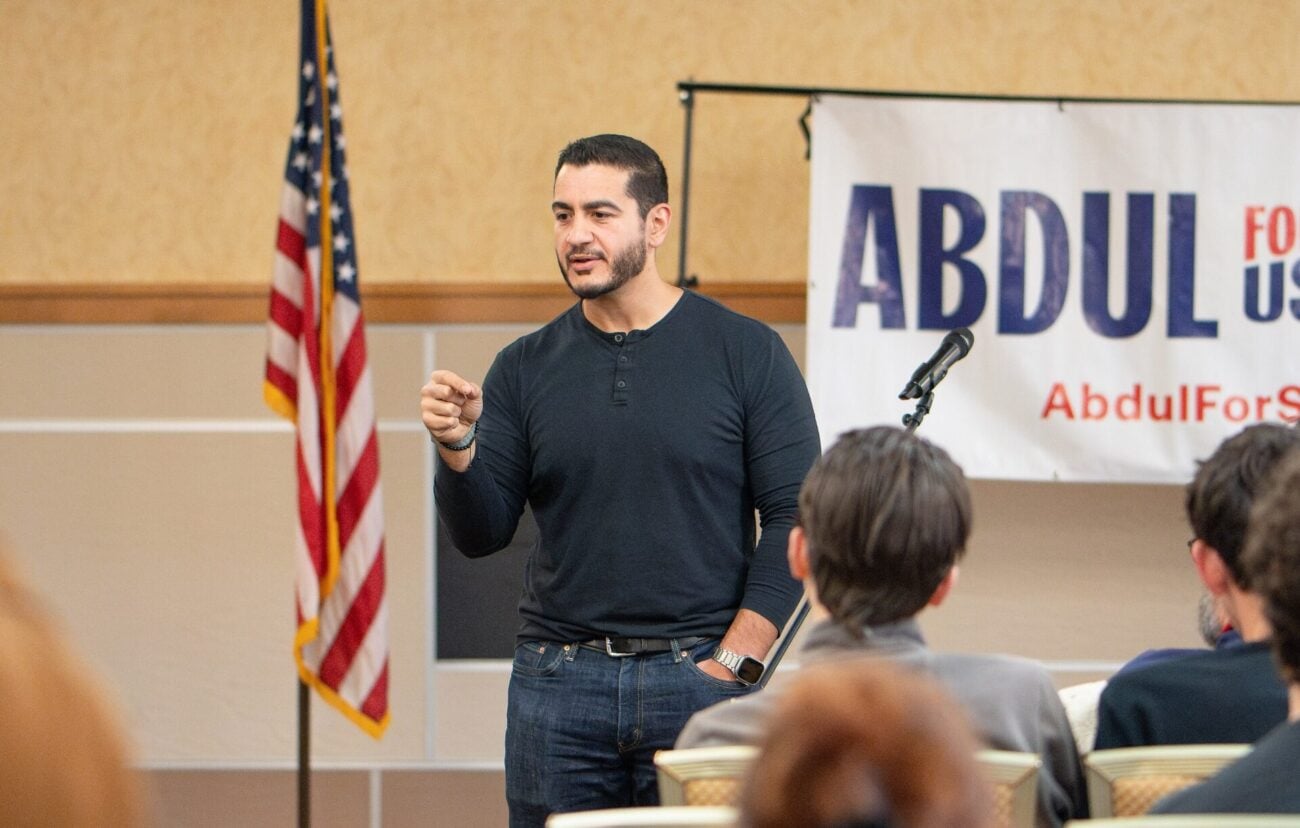
From campaigning alongside Hasan Piker to his alleged ties to the Muslim Brotherhood, Michigan’s recently elected Democratic Senator, Abdul El-Sayed, is no stranger to controversy.
In the run-up to the midterm elections, El-Sayed, the first Muslim to have been elected to the United States Senate in the history of American politics, made some controversial remarks during an August 24 interview with Jesse Watters on Fox News.
During the exchange, he not only defended the right of Muslims to practice their religion without government interference but also went so far as to compare Sharia law to Catholic canon law.
“Nobody is trying to push sharia law on anyone else,” he said. “Just like I hope nobody is trying to push canon law on anybody else, because we live in America, where you should have the freedom of your religion.”
Apart from the fact that, according to Catholic teaching on the Social Kingship of Christ, El-Sayed has no business exercising authority over the civil sphere, his comparison appears to have been a calculated, albeit transparent, attempt to downplay the entirely justifiable fears of American Christians concerning the rapidly growing influence of Islam in the United States and throughout Europe.
El-Sayed was not only wrong in his comparison to canon law, but most likely deliberately misleading viewers given the clear and fundamental differences between the two systems in their scope, authority, application, and enforcement.
Catholic canon law exists to govern the internal affairs of the Catholic Church, regulating matters such as the clergy, sacraments, marriage, ecclesiastical administration, and discipline. Unlike state-enforced Sharia law, the Church’s canon law’s penalties are ecclesiastical and not civil, with its most severe sanctions are limited to excommunication, removal from ecclesiastical office, and restrictions on ministry. Canon law, in other words, is not a national criminal code, nor does it authorize civil governments to punish citizens for rejecting Catholic teaching.
On the other hand, Sharia law, despite what the progressive political establishment wants Americans to believe, constitutes a far broader framework of religious, moral, and legal principles derived from the Quran and the teachings of Mohammed. Its scope extends beyond mere worship and into the spheres of marriage, divorce, inheritance, financial transactions, social conduct, and criminal justice.
Whereas Catholic canon law operates within the Church’s ecclesiastical jurisdiction, Sharia law is often incorporated into the national legislation of several Muslim-majority countries, where state authorities may exercise coercive powers in enforcing religiously derived laws. Not only is Sharia law incompatible with Western Civilization and its values, and also the most elementary Christian teachings, it also contains deeply troubling provisions.
The Dispatch
Political aspects of Sharia law
Classical Islamic jurisprudence prescribes the death penalty for apostasy from Islam. Those who seek to convert to Christianity may face prosecution, imprisonment, and even execution. This stands in stark contrast to Catholic canon law, which makes no such provision for those who apostatize.
Another grave concern involves Islamic blasphemy laws, especially as it is enforced in countries such as Pakistan, where Christians who are accused or convicted of blasphemy face imprisonment, death sentences, and, in some cases, brutal mob violence.
Click here to support Integrity’s independent Catholic journalism!
Ironically enough, secular and political liberals in the West enthusiastically embrace the global spread of Islam under the banner of migration and multiculturalism. However, to their own ultimate detriment, they ignore its religious intolerance and the threat it poses to their licentious lifestyles.
Traditionally, non-Muslim populations brought under Islamic rule face three options: conversion, submission to its system of taxation and subordinate legal status, or continued armed resistance. Open borders advocates in the West who still do not recognize Muslim migration as the Trojan horse it is being as to eradicate Christian culture and establish a global caliphate are simply naïve. The refugee of yesterday is simply tomorrow’s agitator and religious criminal who demands to impose his way of life on the host country he supposedly has “fled” to.
Christians as second-class citizens?
Where Sharia law is enforced by the state, the freedom to evangelize is also often restricted or outright extinguished. The distribution of Christian literature, public preaching, and attempts to convert Muslims can even be criminalized, with converts and evangelists potentially facing imprisonment or death.
A whole catalogue of other restrictive and deeply troubling provisions also exists in Sharia law that make it incompatible with Christianity and Western values. For instance, it contain rules governing marriages, inheritance rights, religious considerations in child custody disputes, and criminal punishments that may result in flogging, amputation, or execution.
El-Sayad seems to be promoting himself as the acceptable face of this oppressive religious legal code. His comparison should therefore be rejected as sugar-coated propaganda and an attempt to soften up Americans. At the moment, not only is the United States but also Europe facing annihilation from two fronts: on the one hand, Jewish interests that have covertly advanced to the point where almost all governments and societies have been put under their influence is not outright full sovereignty, and on the other hand, Islamic actors serving as a militant force threatening to eradicate Christian and Western culture.