

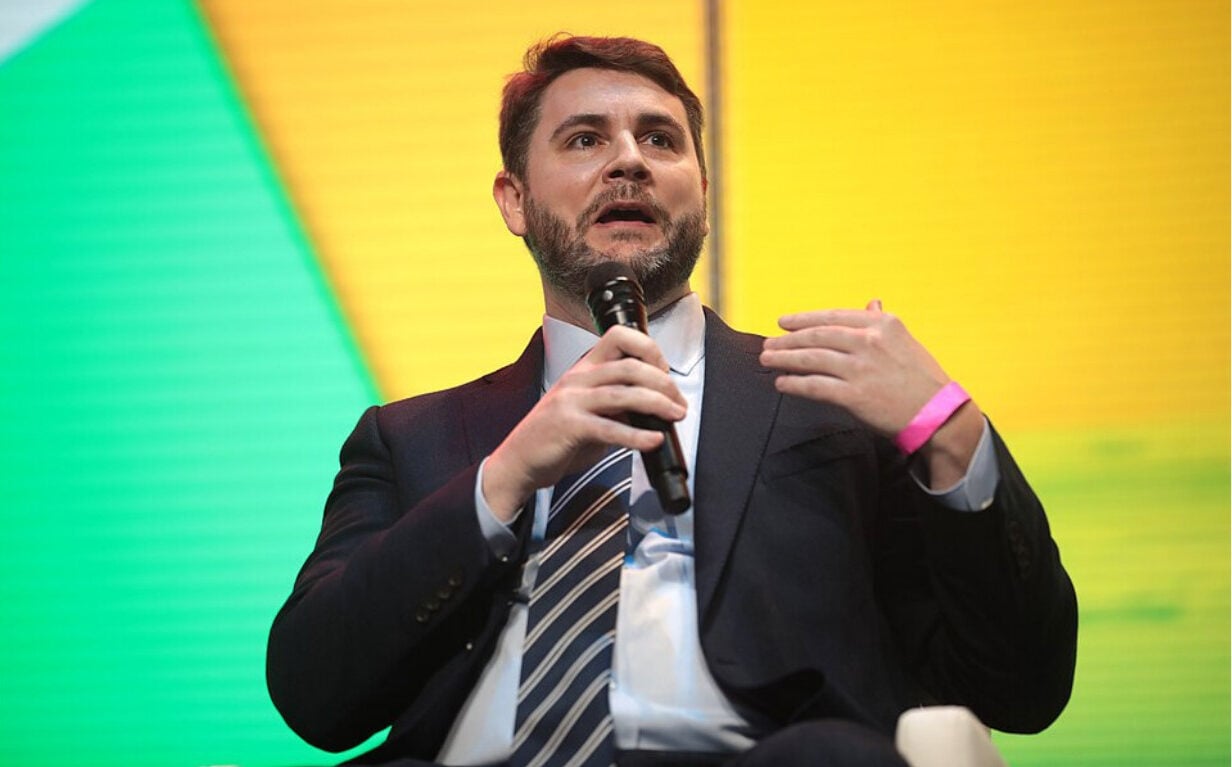
On Sunday, influencer James Lindsay wrote an essay on X responding to a Fox News report on the growing interest in Catholicism on college campuses across the United States. While some may be tempted to dismiss his commentary as the ramblings of a paranoid and unserious internet personality, it would be a mistake to do so for several reasons.
In his post, Lindsay ably presented the tenets of Americanism, broadly understood as American exceptionalism in the religious, moral and philosophical domains.
“Edmund Burke was instrumental in laying out these ideas very clearly in the late 18th century and became known as the father of modern philosophical conservatism as a result” Lindsay explains.
It is necessary to recall that “conservatism” in the United States is but a moderate form of Liberalism; a worldview dominated by the thought of the aforementioned Edmund Burke but also of John Locke, Montesquieu, James Madison and, more recently, Russell Kirk, among others.
Lindsay then offers critical insights into the increasingly perilous position the revolutionary American paradigm finds itself in today, along with the sclerotic ruling class that upholds it.
While Lindsay’s grasp of political philosophy is to be praised, not everything in his essay is intelligent or accurate. For example, at one point he treats the papacy with characteristic glibness, blasphemously arguing that it is the “throne Jesus Himself allegedly gave” to St. Peter (emphasis added). Elsewhere, he approvingly cites a 1961 book on brainwashing by Robert Jay Lifton, using pejorative language to mock the Church’s sacrament of confession and those who believe in an objective moral standard, presumably one revealed by God:
Who is James Lindsay?
Lindsay is an American mathematician, author, and political commentator best known for his criticism of Critical Theory and the modern “woke” movement. Unsurprisingly, as a committed Liberal, his greatest enemy is illiberalism, whether that is on the political left or, as is increasingly the case today, the political right.
In fact, the term “woke right” is his brainchild, and he regularly appears on programs such as PragerU, ReasonTV and The Jeremy Boreing Show to explain its meaning.
Lindsay has a complicated political and religious history. In 2020, he made it clear that up until that year he was a “vote blue no matter who” Democrat. Prior to that, he was an avowed atheist, writing books “debunking” the existence of God, while playing a small part in the broader “New Atheist” movement. In 2024, before pivoting to agnosticism, he said on X that he was thinking about “pretending to be Christian so I can tell Christians how bad they are at being Christian.”
More recently, Lindsey has enmeshed himself in Jewish power networks and has been repeating pro-Israeli propaganda about its relentless war in Gaza.
It should come as no surprise, then, that Lindsay’s biggest political and religious enemy are traditional Catholics, members of the one true Israel.
Liberalism and the Kingship of Christ
Lindsay notes in his essay that “Young people in our country and throughout the West are badly deracinated, churning in cultural and social uncertainty, and they’re attracted to Catholic (and Orthodox) conversion to find solidity.”
The Dispatch
Lindsay continues by lamenting that “secular classical liberal and Protestant circumstances are [increasingly] portrayed as incapable of satisfying those perceived needs.” He then notes, correctly, that Catholicism will “lure young Americans away from classical liberalism, Americanism, and Protestantism.”
Lindsay’s outlook is, by all appearances, close to that of James Madison, the celebrated “Father of the Constitution.” In Federalist no. 14, Madison praised the American Revolution as something with “no parallel in the annals of human society.” He credited it with producing “fabrics of governments which have no model on the face of the globe.”
Madison saw, as Lindsay does, America’s political experiment as being unprecedented. It was a break, or, what Liberals like to call “progress,” from everything that came before it.
Whereas for traditional Catholics, the so-called Novus Ordo Seclorum ushered in by the revolutions of the late 1700s was a tragic departure from the sound principles which underpinned Christendom.
Defend the Kingship of Christ: Become a monthly donor at Integrity today!
Lindsay has been active on social media in recent days attempting to defend his Liberal ideology.
“All tyranny is basically the same,” he mockingly said in response traditional Catholic Bug Hall, who had noted the insufficiency of the Constitution as a governing document and had said a future Catholic U.S. would ban the oxymoronic term “Judeo-Christian.”
But lest one think Lindsay is alone in treating traditional Catholicism as threat to his cherished Americanism, the former United States Assistant Secretary of State for International Organization Affairs, Kim R. Holmes, shares his views.
In July, Holmes correctly identified American conservatism with Liberalism, noting that to reject the latter is to call into question — more or less — the entire American so-called experiment.
“The [post-liberal right] is a conscious rejection of the principles of the American founding, of the essential American idea,” Holmes said in a X post.
Holmes was responding to fellow Liberal Marc Thiessen, a Republican commentator, who relentlessly attacks Catholic integralism and the aforementioned, and broader, “Post-Liberal” movement.
Liberalism under assault
Many things can be said about James Lindsay, but one thing he cannot be accused of is failing to detect threats to Liberalism. As a partisan, he is vigilant in exposing said threats, whether that be the union of Church and State, the primacy of the common good over individual goods, or incursions on religious liberty.
Ever watchful, he will continue saving his most vitriolic responses — evidencing of a growing illiberal streak — for his growing number of targets.
.jpg)