
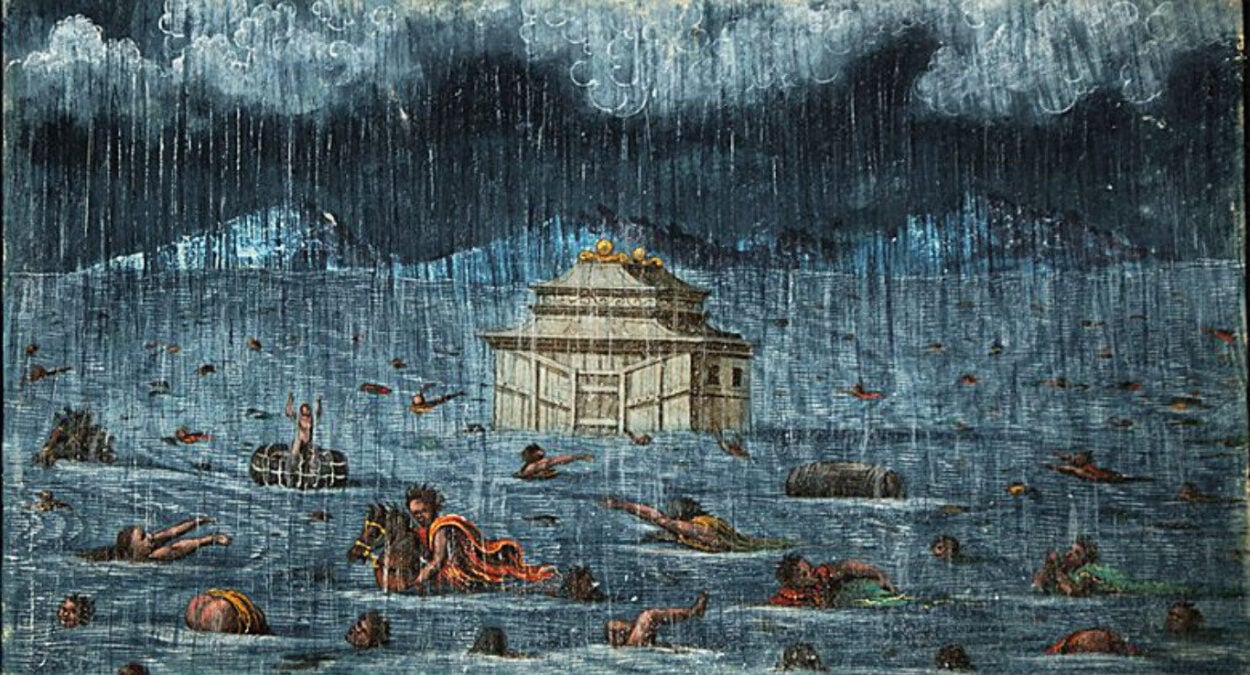
Having written in a previous essay (click here) about what the pre-Flood world was like, we will now examine the grim reality of what the Hydroplate Theory and the author’s own field observations indicate how men at the time of Noah were acting and what occurred during the Flood itself.
In Genesis Chapter 6, Moses describes the situation as follows:
And God seeing that the wickedness of men was great on the earth, and that all the thought of their heart was bent upon evil at all times, it repented him that he had made man on the earth. And being touched inwardly with sorrow of heart, He said: ‘I will destroy man, whom I have created, from the face of the earth, from man even to beasts, from the creeping thing even to the fowls of the air, for it repenteth me that I have made them.’ But Noe found grace before the Lord (emphasis added).
In other words, God was deeply offended by sinful man to the point of wiping out mankind altogether and even the lesser creatures of the land-dwelling sort.
Now, what were man’s offenses? Great wickedness, i.e. not the run-of-the-mill venial sins all of us commit. “All the thought of men’s hearts was continually bent upon evil,” Genesis says. Put another way, evil had been internalized and lived out by everyone except Noah. Genesis 6 continues:
And the earth was corrupted before God, and was filled with iniquity. And when God had seen that the earth was corrupted (for all flesh had corrupted its way upon the earth,) He said to Noe: ‘The end of all flesh is come before me, the earth is filled with iniquity through them, and I will destroy them with the earth’ (emphasis added).
God means business, serious business. Given that the specific sins of man in the pre-Flood world were not enumerated in the Bible, it stands to reason that their variety was very great in addition to their gravity. Man was essentially “living” a “life” of mortal sin, individually and societally, in other words.
Notably, because Noah loved God, God confided His plans to him. Given that the Old Testament is typological, this latter point is worth seeking commentaries on by the Church Fathers and Doctors.
The Douay-Rheims commentary on Genesis 6 states the following on the meaning of the phrase “it repented him”:
God, who is unchangeable, is not capable of repentance, grief, or any other passion. But these expressions are used to declare the enormity of the sins of men, which was so provoking as to determine their Creator to destroy these his creatures, whom before he had so much favored.
The important point here is provocation: men were doing their wrongs with an in-your-face attitude towards God. Such evil required a commensurate shake-up, not because God delights in revenge, but because He knew that continuing to allow that sort of conduct to continue would permanently harden the hearts of these poor souls, rendering a happy eternity for them impossible. A severe mercy was necessary, a mercy flowing from infinite love that cannot bear to see His beloved lost forever.
Ensure more articles on Biblical history are published at Integrity: Become a monthly donor today!
Those who disregarded Noah’s approximate 100 years of building the Ark (and who probably ridiculed his likely equally long and increasingly frantic exhortations to repentance) were about to see their near-paradisical world obliterated in a very dramatic, really cataclysmic, way.
The Deluge was a supernatural event but it employed natural processes. According to the Hydroplate Theory (HPT) paradigm, a sudden crack developed in the sixty-mile-thick granitic crust of the Earth, quickly encircling the globe like a baseball seam. The cause of the crack is unknown; though it could have been angelic action. Regardless, the extremely pressurized and incandescently hot subterranean water blasted upward hypersonically, pulverizing the fissure’s five-dozen-mile-high side.
The Dispatch
The upward rushing water — the “fountains of the great deep” according to Genesis — were initially far hotter in their subterranean chamber but after expanding when it entered the atmosphere cooled down to a tepid degree.
Some of this water, given its speed, went off beyond the Earth, moving at or above escape velocity, carrying debris with it. Much of the water simply arced high upward and came down as blinding, torrential rain, bringing some dirt and debris with it as well. The Hebrew word geshem is used when speaking of this heavy, driving rain.
As the Earth’s granitic crust shook as the water burst upward, other water pulsed sideways over the land, akin to a debris-filled tsunami. Based on the varying thicknesses of sediment layer collections, these tsunamis varied in size and frequency, but all of them carried sediment, whether the pulverized granite from the sides of the ever-expanding global fissure or the various mineral sludges (limestone, iron hydroxide, gypsum, etc.) from the water’s chamber below, or a combination thereof. Layers of sediment thus accumulated on the land.
Any vegetable, animal, human, or human work such as buildings that were at or near the fissure as it opened would have been pulverized immediately by the initial blast of water, or soon thereafter as they fell into the depths atop the crumbling fissure-side rocks. The tsunamis would have also violently stripped far-off lands of vegetation, human works, animals, and people. What’s more, the blinding 24/7 rain, falling as it did from a higher altitude than from a simple storm, started affecting the furthest reaches of the globe by eroding the soil and vegetation and whatever else was upon the land.
Few men would have stood directly over the cracks. The opening fissures were initially a thin line across a vast earth. Those who were there would have had almost no time to understand what had occurred — unless God first sent a warning quake, which is not hard to imagine. The whole catastrophe was ordered for the salvation of souls, and a last tremor before the deep broke would have been mercy as much as judgment.
Men who were further away from the cracks would have had some reaction time before a tsunami of sediment slurry, not water, overran their area and wiped everything out, analogous to what happened in Nepal on August 26. Of course, by “wiping out” is meant a violent stripping of the land and, because the tsunami was a very dense fluid with rock fragments, an intense grinding of what it picked up and then left as a layer of sediment. Because God was permitting all this to save souls, it is plausible that He permitted a few initial small walls of water to strike first so that people had time to repent.
As the torrential rain was coming down, the earth would have been shaking. Given that rain was not a phenomenon mankind experienced before, many would have been shocked at the sight of it, and no doubt many would have remembered Noah’s warnings.
The rainfall lasted forty days without stop. That is almost six weeks. The runoff from the flood, with whatever it was carrying, filled the lowest-lying areas, and the water level gradually rose. As the Earth’s fissures widened — the fountains of the great deep were pulverizing its collapsing sides continuously — the water level rose globally, causing more of the land to be covered by tsunami-deposited sediments overtopped by water, leaving fewer and fewer areas of non-submerged land.
What happened to the people and animals not on the Ark?
The least mobile creatures were submerged and buried first amid this process. The somewhat more mobile ones were overtaken later on. The remains of these, which have many signs of sudden death and rapid burial, ended up in the sediment layers, sometimes as graveyards of vast numbers of specimens. Even though one cannot drown a fish, many were entombed in the sediments, but obviously not all because many are around to this day.
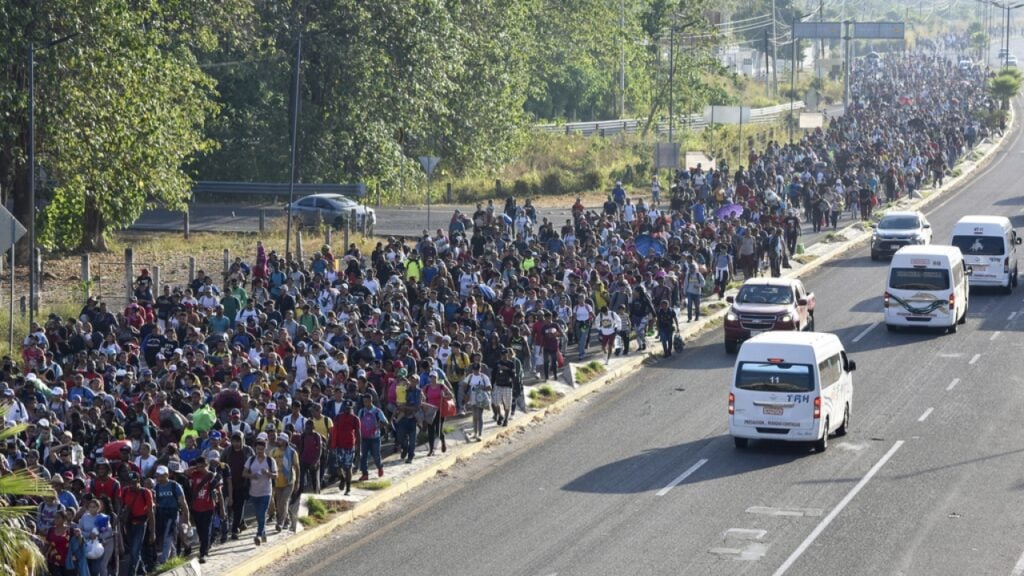
The most fleet-footed/fleet-winged creatures — man among them — fled to higher ground as the water rose. Men saw the water wash away their many works and buildings as walls of slurry-water overran and ground up the landscape. Men fled in blinding all-day and all-night rain. Those that were exhausted in flight drowned, as did those with whom a larger tsunami caught up.
Men who reached the last high ground still above the water found frightened surviving animals gathered there with them. They could only wait until the waters rose and drowned them. This would have been weeks into the Great Flood.
Now, how did they survive so long in that rain without shelter? Walt Brown in his Hydroplate Theory had emphasized that much of the world’s vegetation was uprooted by the violence of the Flood and floated as giant vegetable mats on the surface of the waters before eventually being buried and turned into coal. The last surviving men would have likely spent weeks living on a floating vegetable mat, making rainproof shelter out of the branches of the toppled trees so that they could sleep at night, and eating whatever plant edibles were foraged on board.
Eventually, the mat would rise and fall with each passing tsunami. As the wood became waterlogged, however, it would gradually sink, and the people had to get off. Their remaining time on Earth consisted of trudging through shallow water on thin layers of lime mud that were deposited again and again by small tsunamis. The water protected their prints from rain, and the mud solidified quickly after each deposition, as shown by clams trapped in their burrows.
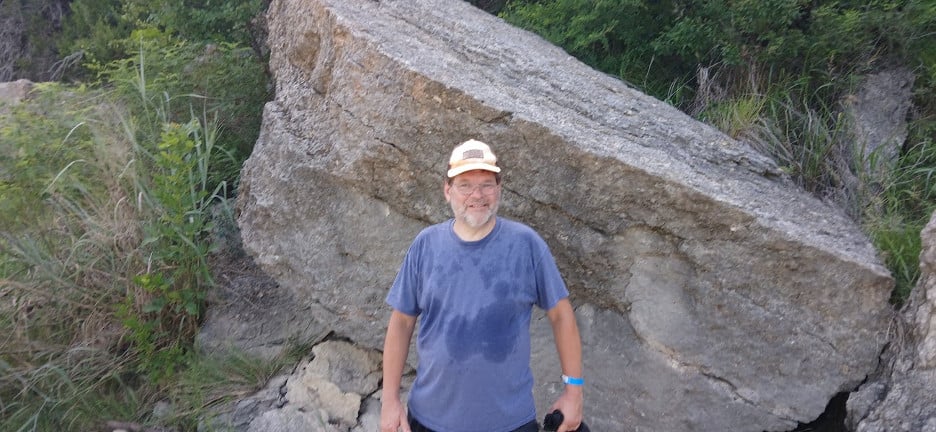
In the opinion of the author, a thick layer, or double layer, of rock a few thin strata above the human prints’ strata, represents the larger tsunami(s) that swept them away to their deaths, potentially entombing them in that layer.
As has been seen, the Flood was an absolute nightmare, but a potentially salutary one for those many who refused to turn back to God when Noah was building the Ark. Let us pray that we ourselves do not need to have that sort of wake-up call.